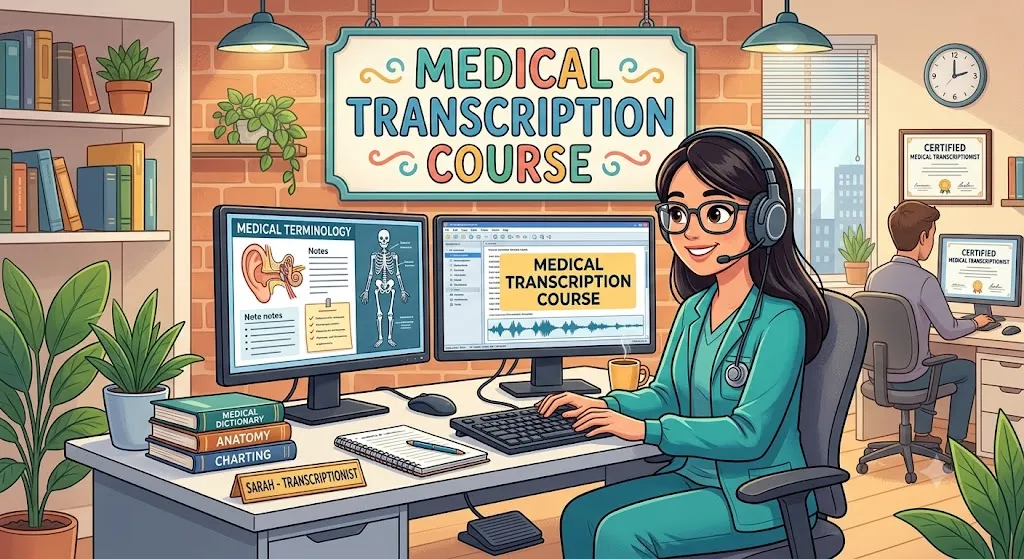

Accurate medical records are essential in the healthcare industry to facilitate quality patient care. Doctors record voice notes on how patients are diagnosed, treated, have any surgeries done and the follow-up care every day. Those recordings need to be transformed into coherent, precise reports. This is where medical transcriptionists enter the picture.
The Professional Medical Transcription Course– Train students to familiar with the language of medicine, pay attention to detail while listening to physicians dictations to create accurate medical records. This is a great career for those who want to get into the health care industry without directly caring for patients.
Quick Answer
Professional Medical Transcription Course — A course that provides training on how to transcribe physicians audio recordings to medical documents. The curriculum includes medical terminology, anatomy, English grammar, and transcription and editing techniques such as proofreading for numerous types of reports including those found in hospitals, healthcare BPOs, and many kinds of documentation firms all making the most out of available transcription tools.
What Is a Medical Transcription Course?
A best medical transcription course is designed to teach students the skills required to prepare accurate medical reports from recorded dictations.
Medical transcription professionals listen to audio recordings created by healthcare providers and convert them into written documents while maintaining accuracy, confidentiality, and proper formatting.
These reports become an important part of a patient's permanent medical record.
Why Is Medical Transcription Important?
Healthcare organizations depend on accurate documentation for patient care, insurance claims, legal compliance, and future treatments.
Medical transcription helps:
- Maintain complete patient records
- Improve communication between healthcare professionals
- Support insurance claim processing
- Reduce documentation errors
- Improve healthcare efficiency
Without proper documentation, hospitals may face delays in treatment and billing processes.
What Will You Learn in a Medical Transcription Course?
A Certified Medical Transcription Course covers both theoretical concepts and practical training.
Students usually learn:
Medical Terminology
Medical terminology is the foundation of transcription.
Students understand:
- Disease names
- Medical abbreviations
- Diagnostic procedures
- Surgical terminology
- Prescription-related terms
Knowing medical language helps transcriptionists prepare reports accurately.
Human Anatomy and Physiology
Students also study:
- Cardiovascular system
- Respiratory system
- Digestive system
- Nervous system
- Musculoskeletal system
Understanding body systems allows learners to recognize medical terms correctly while transcribing physician recordings.
English Grammar and Communication
Medical reports must be written using proper English.
The Advanced Medical Transcription Course helps students improve:
- Grammar
- Sentence structure
- Vocabulary
- Punctuation
- Professional writing
These skills improve document quality and readability.
Listening Skills
Doctors may speak at different speeds and with different accents.
Students practice listening to real medical recordings to improve:
- Concentration
- Pronunciation recognition
- Medical vocabulary
- Typing accuracy
- Listening speed
Regular practice builds confidence in handling real-world dictations.
Editing and Proofreading
Medical transcription is not only about typing.
Students learn how to:
- Correct spelling errors
- Verify medical terminology
- Improve grammar
- Maintain report formatting
- Ensure document accuracy
Editing ensures that reports are professional and error-free.
Learn Healthcare Documentation Standards
Medical documentation follows specific formats.
The Industry-Oriented Medical Transcription Course teaches students how to prepare:
- Patient history reports
- Consultation notes
- Discharge summaries
- Operative reports
- Emergency department reports
- Radiology reports
Students also learn documentation guidelines used in healthcare organizations.
Understand Medical Ethics and Confidentiality
Medical transcriptionists work with confidential patient information.
The course includes topics such as:
- Patient privacy
- Data confidentiality
- Professional ethics
- Secure document handling
- Healthcare compliance
Maintaining confidentiality is one of the most important responsibilities in this profession.
Learn to Use Medical Transcription Software
Modern healthcare organizations use digital systems for documentation.
Students become familiar with:
- Audio transcription software
- Word processing applications
- Electronic Health Records (EHR)
- Document management systems
- Healthcare documentation platforms
Learning these tools improves workplace readiness.
Practical Training Makes Learning Easier
The biggest advantage of joining a Job-Oriented Medical Transcription Course is hands-on practice.
Students usually work on:
- Real physician audio recordings
- Medical transcription assignments
- Editing exercises
- Proofreading practice
- Mock assessments
For example, learners may receive a doctor's recorded consultation and prepare a properly formatted medical report. This practical exposure helps students understand real workplace situations.
Career Opportunities After Completing the Course
After completing the Professional Medical Transcription Course, students can explore several healthcare careers.
Some common job roles include:
- Medical Transcriptionist
- Medical Documentation Specialist
- Medical Editor
- Quality Analyst
- Healthcare Process Associate
- Clinical Documentation Executive
Healthcare companies, hospitals, diagnostic centers, insurance firms, and healthcare BPOs regularly hire trained professionals.
Skills Needed to Become a Successful Medical Transcriptionist
Apart from technical knowledge, professionals should develop:
- Attention to detail
- Listening ability
- Typing speed
- Time management
- Communication skills
- Computer knowledge
- Problem-solving ability
These skills improve both productivity and report accuracy.
Real-World Example
Imagine a doctor completes several patient consultations during the day and records treatment notes using voice dictation.
A trained transcription professional listens to each recording, understands the medical terminology, corrects grammar where required, and prepares accurate medical reports. These reports become part of the patient's official healthcare record and help doctors continue treatment efficiently.
This example shows why skilled transcription professionals remain valuable in healthcare.
Why Choose Leading IHIMC?
Choosing the right institute is an important step toward career success.
Leading IHIMC offers practical, industry-focused medical transcription training designed to help students gain real-world experience. Learners receive guidance from experienced trainers through live transcription practice, editing exercises, mock interviews, and career-oriented learning.
The structured approach followed by Trusted IHIMC helps students build confidence and become job-ready for healthcare documentation roles.
Key Takeaways
- A Professional Medical Transcription Course prepares students for careers in healthcare documentation.
- Students learn medical terminology, anatomy, grammar, listening, editing, and transcription techniques.
- Practical training improves confidence and workplace readiness.
- Medical ethics and confidentiality are essential parts of professional training.
- Learning transcription software prepares students for modern healthcare organizations.
- Leading IHIMC provides practical learning, expert guidance, and career-focused training.
Conclusion
A Professional Medical Transcription Course is an excellent choice for individuals who want to build a career in the healthcare industry without direct patient interaction. The course develops technical knowledge, communication skills, listening ability, and practical documentation expertise that healthcare employers value.
With regular practice, real-world assignments, and quality training, students can confidently begin careers in hospitals, healthcare companies, and medical documentation organizations. For learners seeking industry-oriented education and practical exposure, Leading IHIMC provides the knowledge and guidance needed for long-term career success.
Frequently Asked Questions
1. What is a Professional Medical Transcription Course?
It is a training program that teaches students how to convert doctors' voice recordings into accurate medical documents using healthcare documentation standards.
2. Who can join a Medical Transcription Course?
Life science graduates, pharmacy students, nursing graduates, physiotherapy graduates, biotechnology students, and other healthcare aspirants can join the course.
3. What skills are taught in a Medical Transcription Course?
Students learn medical terminology, anatomy, grammar, listening skills, transcription techniques, editing, proofreading, and healthcare documentation.
4. Is practical training included in the course?
Yes. Most courses include audio transcription practice, editing exercises, mock projects, and real-world documentation assignments.
5. How does Leading IHIMC help students build a career?
Leading IHIMC provides practical training, experienced faculty, mock interviews, industry-oriented learning, and career guidance to help students become job-ready professionals.



























Sign in to leave a comment.