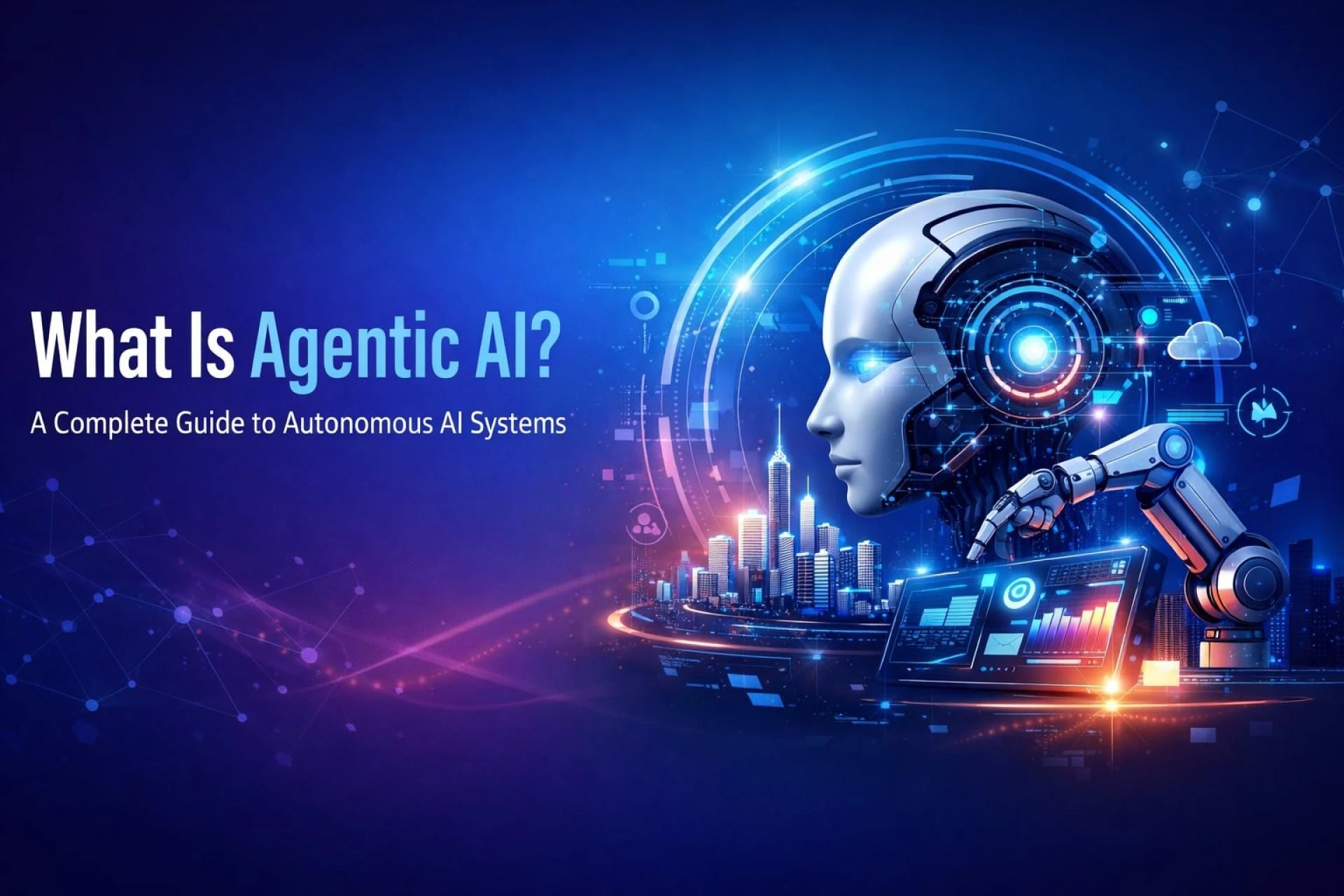

Artificial intelligence is no longer limited to predicting outcomes or responding to prompts. A new class of systems-designed to reason, plan, and act independently-has begun reshaping how organizations approach automation and decision-making. This shift is known as Agentic artificial intelligence, and it represents a fundamental change in how AI creates value.
Instead of executing isolated tasks, Agentic AI systems operate with intent. They pursue goals, adapt to changing conditions, and coordinate actions across tools, data sources, and workflows. For enterprises aiming to scale intelligently, understanding what is Agentic AI and how does it work is quickly becoming essential.
What Is Agentic AI?
At its core, Agent-based artificial intelligence refers to AI systems built around autonomous agents-software entities capable of making decisions and taking actions to achieve specific objectives.
Unlike traditional AI models that respond passively to inputs, Agentic AI systems:
- Interpret high-level goals
- Break those goals into executable steps
- Decide which tools or data to use
- Act independently across systems
- Evaluate outcomes and adjust behavior
When people ask “what is Agentic AI?”, the simplest answer is this: it is AI designed to operate with agency, not just intelligence.
How Agentic AI Works: A Practical Breakdown
Understanding what is Agentic AI and how does it work requires looking at how its components interact rather than focusing on a single model.
1. Goal Definition
Agentic AI starts with an objective-such as resolving a customer issue, optimizing a supply chain, or monitoring infrastructure health.
2. Reasoning and Planning
The system evaluates the goal, identifies dependencies, and creates a step-by-step plan. This planning capability is what separates Agentic AI from basic automation.
3. Tool and System Interaction
Agentic AI agents can interact with APIs, databases, applications, and even other agents to execute tasks in the real world.
4. Execution and Feedback
Actions are performed autonomously. Results are assessed, and the agent adapts its approach if outcomes differ from expectations.
This closed feedback loop enables Agentic AI systems to improve continuously without constant human instruction.
Agentic AI vs Traditional AI
One of the most common points of confusion is Agentic AI vs traditional AI. While both rely on data and algorithms, their operating models differ significantly.
| Traditional AI | Agentic AI |
| Task-oriented | Goal-oriented |
| Reactive | Proactive |
| Limited autonomy | High autonomy |
| Human-driven workflows | Self-directed workflows |
Traditional AI excels at prediction and classification. Agentic AI excels at orchestrating decisions and actions across complex environments.
How Is Agentic AI Different From Generative AI?
Another frequent comparison is how is Agentic AI different from generative AI.
Generative AI focuses on producing content-text, images, code, or audio-based on prompts. It is powerful but largely passive. Agentic AI, on the other hand, uses generative models as tools, not endpoints.
In practice:
- Generative AI creates outputs
- Agentic AI decides when, why, and how to use those outputs
This distinction is why Agentic AI is often described as the “conductor” rather than the “instrument.”
Benefits of Agentic AI for Enterprises
The benefits of Agentic AI for enterprises extend well beyond efficiency gains. Its real value lies in reducing complexity while increasing adaptability.
Key Advantages Include:
- End-to-end automation of multi-step workflows
- Faster decision cycles without sacrificing accuracy
- Reduced operational overhead
- Scalable intelligence across departments
- Improved resilience in dynamic environments
Enterprises adopting Agentic AI often find that it bridges the gap between strategy and execution—something traditional AI tools struggle to achieve.
Agentic AI Examples in Real-World Applications
The strongest proof of value comes from Agentic AI examples in real-world applications.
Customer Support Operations
Agentic AI agents can analyze customer intent, retrieve account data, initiate resolutions, and escalate only when necessary-without predefined scripts.
IT Operations and DevOps
Autonomous agents monitor systems, detect anomalies, apply fixes, and optimize resource usage with minimal human involvement.
Sales and Revenue Enablement
Agentic AI can qualify leads, personalize outreach, schedule follow-ups, and recommend next-best actions based on real-time engagement data.
Supply Chain Optimization
Agents dynamically adjust procurement, inventory, and logistics strategies in response to demand shifts or disruptions.
These use cases demonstrate how Agentic AI moves beyond assistance into independent execution.
Challenges and Considerations
Despite its promise, Agentic artificial intelligence is not plug-and-play.
Enterprises must address:
- Governance and decision boundaries
- Security and data access controls
- Transparency and auditability
- Human-in-the-loop oversight
This is why many organizations turn to Agentic AI consulting services to design frameworks that balance autonomy with accountability.
Why Agentic AI Consulting Services Matter
Building Agentic AI systems requires more than deploying models. It involves architecture design, workflow orchestration, risk management, and ongoing optimization.
Professional Agentic AI consulting services help organizations:
- Identify high-impact use cases
- Design agent architectures aligned with business goals
- Ensure compliance and ethical safeguards
- Integrate AI agents with existing enterprise systems
For enterprises serious about autonomous intelligence, expert guidance significantly reduces time-to-value.
Conclusion: From Intelligence to Agency
Agentic AI marks a decisive shift in how organizations leverage artificial intelligence. By moving from reactive tools to autonomous agents, businesses gain systems that not only analyze situations-but independently plan, decide, and act to achieve outcomes. Understanding what is Agentic AI, how it differs from generative and traditional AI, and where it delivers measurable value is the first step toward adoption.
For enterprises navigating complex, fast-changing environments, partnering with the Best Agentic AI consulting services ensures this transition is strategic, secure, and scalable. With the right consulting expertise, organizations can design governed AI agents, integrate them seamlessly into existing systems, and unlock intelligent autonomy that drives long-term operational and competitive advantage.
Sign in to leave a comment.