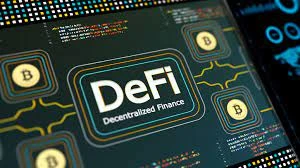

What is Decentralized Finance (DeFi)?
DeFi is a term for financial applications that use blockchains instead of banks.
Tips
DeFi, short for "decentralized finance," is a term that encompasses a group of financial tools built on a blockchain.The idea is to allow anyone with Internet access to lend, borrow, and bank without going through intermediaries.DeFi is one of the fastest-growing areas in the blockchain and decentralized web space.Bitcoin —a payment system where anyone on the planet can send money to anyone else—was just the beginning of the cryptocurrency revolution. The creators of DeFi applications aim to take accessibility one step further. Decentralized finance has been touted as a potential solution to lowering the barrier to entry for those who have difficulty accessing bank accounts. And more recently, it is being used by cryptocurrency owners for another purpose: to make more money.
What is DeFi?
Collectively, DeFi applications are financial products that run on a public blockchain, such as Ethereum. These products are permissionless, which means they don't use third parties. Instead of financial intermediaries such as brokers and banks, everything is automated in the protocol via smart contracts.
Do you want to request a loan? You don't need the bank to give you money. You can get a loan directly from your peers. Ready to bet on Bitcoin futures and other derivatives? Forget looking for a bookie. You can let the protocol take care of it. Do you want to exchange one asset for another? Decentralized exchanges can make it easy to trade without taking a big slice. What Is Decentralized Finance (DeFi)?
Who invented DeFi?
There is no single inventor of DeFi, but DeFi applications first appeared on top of Ethereum, which was invented by Vitalik Buterin. They have since expanded to other networks using smart contracts to automate transactions. Among them are Solana, Binance Smart Chain, and Avalanche.
Prominent venture capital firm Andreessen Horowitz led multi-million dollar investment rounds in both Compound and MakerDAO—pillars of today's DeFi ecosystem.
What's so special?
DeFi has several key features.
First, it's "open," which means you can use the apps by creating a wallet—often without displaying any identifying information, like name and address. This is theoretically (if not technologically) easier than having a bank account.
Second, funds can be moved almost instantly through a blockchain, so there is no waiting for the bank transfer to go through.
Third, the fees (for now, at least) are much better than traditional banks, although transaction costs vary depending on the blockchain network.
Lastly, DeFi apps work together like “Money Legos”. This “composability” allows anyone to create, modify, mix and match, link to, or build on top of any existing DeFi product without permission. Unfortunately, this feature may also be DeFi's biggest weakness, because if one key component, like the DAI stablecoin, becomes vulnerable or corrupted, the entire ecosystem built around DAI can come crashing down.
What can be done with DeFi?
There are three basic types of DeFi applications.
💰 Lend/borrow: If you own cryptocurrencies, you can lend them to a protocol like Aave or Compound in exchange for interest and/or rewards. You can also borrow digital assets from the protocol, which is especially useful if you want to make a trade. However, be careful! Most DeFi protocols use over-collateralization, which means you have to put up more than the amount you want to borrow; if the value of the asset falls too much, the protocol can take your collateral to prevent losses.
Many DeFi users use it as a way to earn assets through “yield farming,” where they lock funds into a pool of assets for rewards. Since interest rates vary by protocol and by asset, yield-savvy farmers move their assets around to take advantage of the best interest rates.
💱 Trading: With centralized exchanges like Coinbase and Binance, you trust the exchange to keep your assets safe for every trade. Decentralized exchanges remove the middleman so people can trade directly with each other. Also, DEXs like Uniswap and PancakeSwap allow people to list new tokens to trade. Lack of control increases risks, but also allows people to "get in early" on new assets before they reach the broader markets.
💸 Derivatives: Sometimes you don't want to limit yourself to trading specific currencies or tokens. Derivatives platforms, such as dYdX and Synthetix, allow you to do more than just spot trading. For example, users can make leveraged trades where they bet more than they have, or even create "synthetic assets" that mimic traditional stocks and commodities.
How are DeFi applications produced?
Anyone capable of writing smart contracts is capable of creating DeFi applications. There are several tools for testing and/or deploying smart contracts, including Truffle and Ganache for Ethereum. After downloading a framework to build smart contracts, a token can be created that allows a protocol to use the blockchain network. On Ethereum, this is an ERC20 token; in Solana, it is called SPL; and Binance Smart Chain has BEP20s.
Having a token allows the protocol to directly interact with the layer 1 currency of the blockchain. But projects have also promoted their tokens to push decentralization. The Compound lending protocol, for example, uses COMP as its governance token; those who own it can make decisions about the protocol code and treasury allocations.
How do you use DeFi products?
Anyone can use DeFi products by going to an application's website and connecting with a DeFi-enabled cryptocurrency wallet, such as MetaMask on Ethereum or Phantom on Solana. Most DeFi apps do not require users to give any personal information or sign up.
However, since the applications are built on a blockchain, you must use the coins of that blockchain to pay for the transactions. ETH is needed to pay for transactions on the Ethereum network, SOL is needed on the Solana blockchain, and so on.
The future of DeFi
As of November 2020, less than $20 billion of value was locked up in various DeFi products, most of them on Ethereum. The following year, it was worth over $260 billion, $19 billion of which came from Binance Smart Chain alone.
If the trend continues and the DeFi maximalists are right, this is just the beginning of a massive wave of DeFi. True believers argue that the advantages of an open, decentralized financial system are simply too compelling not to capture trillions of dollars of value.
But the challenges persist. In November 2021, risk management firm Elliptic estimated that DeFi users lost $10.5 billion to hacks and scams in the previous two years.
This type of news has drawn the attention of regulators. In August 2021, the Chairman of the US Securities and Exchange Commission, Gary Gensler, called for stricter regulation of DeFi, suggesting that some DeFi platforms might be in breach of securities laws. Months later, he argued that "without protections, I'm afraid it will end badly." Thailand's SEC has also come out in favor of regulation, suggesting that some DeFi projects might require a license to operate in the country.
And the Bank for International Settlements has gone a step further, warning that DeFi's vulnerabilities "outweigh those of traditional finance" and could even threaten global financial stability. The battle between DeFi supporters and its detractors is taking shape.

























Sign in to leave a comment.