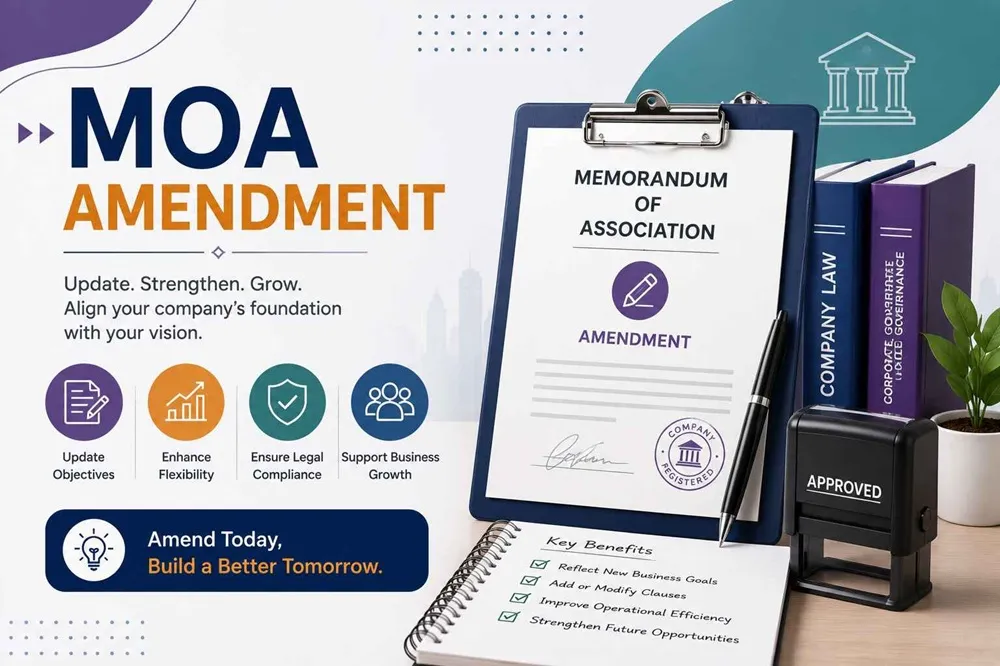


Every company begins its journey with a set of foundational documents that define its identity, purpose, and scope of operations. One of the most important among them is the Memorandum of Association, commonly known as the MOA. This document outlines the company's objectives, registered office details, authorized capital, and liability structure. It essentially acts as the company's constitution and establishes the limits within which the business can operate. As businesses grow, evolve, and adapt to market opportunities, the original provisions of the MOA may no longer reflect their operational reality. This is where an MOA amendment becomes necessary. Whether a company plans to expand into new business activities, change its name, increase its authorized capital, or shift its registered office to another state, a properly executed MOA amendment ensures that the company's legal documents remain aligned with its business goals. Understanding the MOA amendment procedure and the MOA clause modification process is essential for companies seeking to make structural changes while remaining compliant with corporate regulations.
Understanding the Meaning of MOA Amendment
An MOA amendment refers to any legally approved change made to the Memorandum of Association of a company. Since the MOA defines the company's legal framework, any alteration must follow prescribed procedures under the Companies Act. A MOA amendment may involve modifications to:
- Company name
- Registered office clause
- Object clause
- Liability clause
- Capital clause
- Subscription clause in specific situations
The purpose of the MOA amendment procedure in India is to ensure transparency and protect the interests of shareholders, creditors, regulators, and other stakeholders. The MOA clause modification process varies depending on the type of change being proposed. Some amendments require only shareholder approval, while others may need approval from regulatory authorities as well.
Why Companies Need MOA Amendments
Businesses rarely remain static. Market conditions change, customer demands evolve, and growth opportunities emerge. As a result, companies often need an MOA amendment to support new strategic directions. For example, a company initially incorporated for software development may later decide to offer consulting services, training programs, or digital marketing solutions. If these activities are not covered within the existing object clause, a MOA amendment becomes necessary. The MOA amendment procedure India provides a legal pathway for businesses to adapt while maintaining compliance. Similarly, the MOA clause modification process helps companies align their constitutional documents with operational requirements, ensuring that all business activities remain legally authorized.
Situations Where MOA Amendment Is Required
There are several circumstances where an MOA amendment becomes mandatory. Some of the most common situations include:
- Change in company name
- Expansion into new business activities
- Increase in authorized share capital
- Shift of registered office from one state to another
- Alteration of company objectives
- Restructuring of capital provisions
Whenever any of these changes affect the clauses of the Memorandum of Association, the company must initiate the MOA amendment procedure. The specific MOA clause modification process depends on the nature of the amendment and applicable regulatory requirements. Failure to update the MOA can create legal complications and compliance risks for the company.
MOA Amendment for Change in Business Objectives
One of the most common reasons for an MOA amendment is the need to revise business objectives. Many companies start with a narrow business focus. As opportunities emerge, they may wish to diversify products, services, or industries. Since the object clause defines the scope of permitted business activities, operating beyond its limits can create legal concerns. In such situations, the company must complete the MOA amendment procedure before undertaking new activities. The MOA clause modification process for object clause changes typically requires board approval, shareholder consent, and filing with the Registrar of Companies. This ensures that stakeholders remain informed about the company's revised direction and future plans.
MOA Amendment for Company Name Change
A company name represents its brand identity. Businesses may decide to change their name due to rebranding initiatives, mergers, acquisitions, market repositioning, or strategic expansion. When a company changes its name, an MOA amendment is necessary because the name clause forms part of the Memorandum of Association. The MOA amendment procedure for name changes generally involves obtaining name approval from regulatory authorities, followed by shareholder approval. The corresponding MOA clause modification process updates the legal documents to reflect the company's new identity. Without completing the required amendment process, the new name cannot be legally recognized.
MOA Amendment for Increase in Authorized Capital
As companies grow, they often require additional funding. One way to raise capital is by issuing additional shares. However, if the existing authorized share capital limit is insufficient, an MOA amendment becomes necessary. The capital clause in the Memorandum of Association specifies the maximum authorized capital of the company. Any increase beyond this limit requires completion of the MOA amendment procedure. The MOA clause modification process for capital increases typically includes board approval, shareholder consent, and filing prescribed forms with the Registrar of Companies. Updating the capital clause ensures that future share issuances remain legally valid.
MOA Amendment for Registered Office State Change
A company may decide to shift its registered office from one state to another due to expansion, operational convenience, cost considerations, or strategic business decisions. Since the registered office clause specifies the state in which the company is registered, such a move requires an MOA amendment. The MOA amendment procedure for interstate office transfers involves additional regulatory approvals compared to many other amendments. The MOA clause modification process ensures that all stakeholders, regulators, and government records reflect the company's new jurisdiction. Because multiple authorities may be involved, this type of amendment generally requires careful planning and documentation.
Key Approvals Required for MOA Amendment
Every MOA amendment involves certain approvals before it becomes legally effective. Common approvals include:
- Board of Directors approval
- Shareholder approval
- Special resolutions where applicable
- Regulatory approvals in specific cases
- Registrar of Companies filings
The MOA amendment procedure ensures that amendments receive proper authorization from decision-makers within the company. The exact MOA clause modification process may vary depending on the nature of the proposed change, but shareholder participation remains a critical component in most cases. These approvals promote transparency and corporate governance.
Documents Required for MOA Amendment
Documentation plays a central role in every MOA amendment. Depending on the type of amendment, companies may need:
- Board resolutions
- Special resolutions
- Notice of general meeting
- Explanatory statement
- Altered MOA copy
- Updated Articles of Association if required
- Regulatory approvals
The MOA amendment procedure relies heavily on accurate documentation. Errors or omissions can delay the MOA clause modification process and may result in rejection or resubmission of filings. Proper preparation helps ensure a smoother approval process.
Step-by-Step Overview of the MOA Amendment Procedure
While requirements vary based on the amendment type, the general MOA amendment procedure India follows a structured framework.
- Identifying the required amendment
- Conducting a board meeting
- Approving the proposed change
- Convening a shareholders' meeting
- Passing the necessary resolution
- Preparing amended MOA documents
- Filing prescribed forms with the ROC
- Obtaining approvals where required
The MOA clause modification process is designed to ensure legal validity and regulatory compliance. Every MOA amendment must be completed according to statutory requirements before the change becomes effective.
Common Challenges During MOA Amendment
Although the process is straightforward in principle, companies often face practical challenges. Some common issues include:
- Incomplete documentation
- Incorrect form filing
- Delayed approvals
- Regulatory objections
- Drafting errors
- Non-compliance with procedural requirements
A well-planned MOA amendment minimizes these risks. Understanding the MOA amendment procedure beforehand allows businesses to prepare effectively and avoid unnecessary delays. Professional assistance can also simplify the MOA clause modification process and improve filing accuracy.
Importance of Professional Guidance
Many business owners assume that an MOA amendment is simply a matter of updating a document. In reality, each amendment carries legal implications and procedural requirements.
- Legal review
- Drafting resolutions
- Documentation preparation
- Regulatory filings
- Compliance verification
- Approval tracking
Expert support helps businesses navigate the MOA amendment procedure more efficiently. It also reduces the likelihood of errors during the MOA clause modification process, saving time and preventing compliance complications. Professional guidance becomes particularly valuable for complex amendments involving multiple approvals.
How MOA Amendments Support Business Growth
A properly executed MOA amendment is more than a compliance exercise. It enables businesses to adapt, expand, and pursue new opportunities. Whether entering new markets, raising additional capital, changing operational structures, or redefining business objectives, companies rely on the MOA amendment procedure to align legal documentation with strategic goals. The MOA clause modification process ensures that these changes occur within a transparent and legally recognized framework. By keeping corporate records current, businesses can operate confidently while maintaining trust among investors, regulators, and stakeholders.
Conclusion
A MOA amendment is an essential corporate compliance activity that allows companies to update their foundational legal document as business requirements evolve. Whether the need arises from a name change, expansion into new business activities, an increase in authorized capital, or a shift in the registered office location, the amendment ensures that the company's legal framework accurately reflects its current operations. Understanding the MOA amendment procedure is crucial because every amendment must follow specific approval and filing requirements under corporate law. Likewise, familiarity with the MOA clause modification process helps businesses avoid compliance risks, delays, and legal complications. As companies grow and adapt to changing market conditions, maintaining an updated MOA becomes increasingly important. A carefully executed MOA amendment not only ensures regulatory compliance but also supports long-term business growth by providing the flexibility needed to pursue new opportunities while operating within a legally recognized framework.



























Sign in to leave a comment.