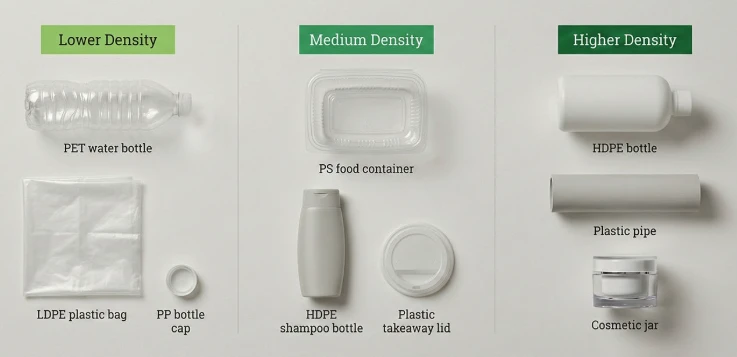

Have you ever noticed that some plastics float on water and others sink? The answer is a simple but powerful idea known as plastic density. Knowing how dense plastic is can help you make better decisions in your daily life, whether you're a student, a recycling fan, or just someone who wants to know more about everyday materials.
What is plastic density?
Plastic density is a measure of how much mass a piece of plastic has compared to its volume. It tells us how heavy or light a piece of plastic is for its size. Most of the time, it is measured in grams per cubic centimeter (g/cm³). For instance, the density of water is 1.0 g/cm³. Plastics that are less dense than this will float, and those that are denser will sink. A lot of people don't know how important this one thing is in our world.
How do you find out how dense plastic is?
It's easy to measure the density of plastic. Scientists and manufacturers divide the weight of a piece of plastic by its volume. The answer gives the density value. Plastics don't all look, feel, or act the same way because different types of plastics have different density levels. Two pieces of plastic that look the same on the outside can have very different densities on the inside.
Why does the density of plastic matter in daily life?
The density of plastic affects how a product is made and used. Because they are easy to handle and carry, lightweight plastics with low density are great for packaging food, water bottles, and bags. Construction pipes, flooring, and heavy-duty containers all use denser plastics where strength and durability are important. Every time you pick up a plastic item, its density has already affected how it was made and why it was chosen for that use.
Density of Plastic and Recycling
Plastic density is very useful for recycling. Recycling centers can easily separate different types of plastics by sorting them by density. This is also why plastic items have recycling codes from 1 to 7. Each number stands for a different kind of plastic with a different density range.
Different kinds of plastics and their density
- PET (Type 1) is often used to make water bottles and has a density range of 1.38 to 1.40 g/cm³.
- HDPE (Type 2) is often used to make milk jugs and pipes and has a density range of 0.94 to 0.97 g/cm³.
- PVC (Type 3) is often used to make flooring and cables and has a density range of 1.16 to 1.58 g/cm³.
- LDPE (Type 4) is the type of plastic that is most often used in plastic bags. Its density ranges from 0.91 to 0.94 g/cm³.
- PP (Type 5) is the type of plastic that is most often used in food containers. Its density ranges from 0.89 to 0.92 g/cm³.
In conclusion
Banyan Nation is the best partner for you if you want someone who cares about recycling plastic and uses science-based methods to make the world a cleaner place. They turn plastic waste into high-quality recycled materials that really make a difference.


























Sign in to leave a comment.