
The driving of piles plays an important role in the construction industry, serving as an essential structural support for various buildings and infrastructures. To reach stable soil or bedrock, this technique involves burying large columns or piles deep into the ground.
To prevent settlement, it is also necessary to transfer the weight of a building or structure to the deeper, stronger layers of the soil, ensuring stability and preventing the building or structure from shifting. Pile hammer equipment is especially beneficial in areas with challenging soil conditions, namely soft or loose soil, that may not be suitable for conventional foundations.
Structures can be built upon solid and reliable foundations, providing stability and durability. Moreover, pile driving is vital for supporting structures in coastal or waterlogged areas, especially in areas with low load-bearing capacity.
The article discusses the importance of pile driving for increasing the resilience and durability of buildings.
About Pile driving in construction
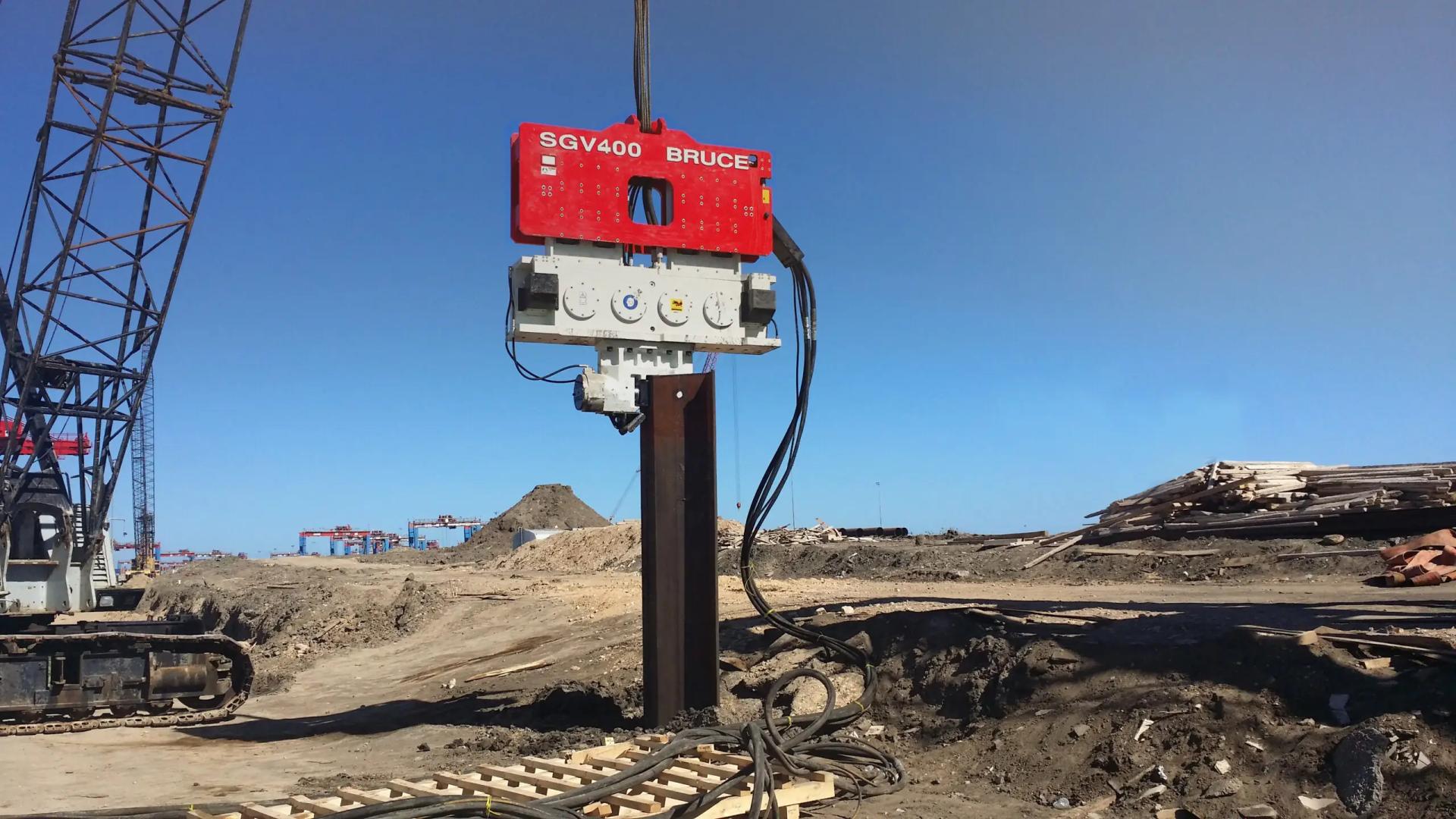
Pile driving is a construction technique used to build strong building foundations. A cylindrical pile is typically constructed from concrete, steel, or wood and installed in the ground through impact or vibration. For structures in difficult terrain, pilings are driven into the soil or bedrock for stability and support. It is often specialized machinery that generates the driving force needed to drive piles deep into the ground until they reach a stable stratum that can efficiently carry the structural load of the structure.
Due to the weak or inconsistent nature of some soil in certain areas, this method is crucial for areas where shallow foundations are impossible. By driving piles into the ground, the burden of the structure is transferred to deeper, more durable layers, preventing settlement of the building and ensuring its stability. A sturdy foundation is essential for long-lasting and safe structures, such as those built in coastal and waterlogged areas like bridges, high-rise buildings, and structures located in coastal areas or naturally waterlogged areas.
Choose pile driving equipment rental service to enjoy the perfect combination of quality and affordability.
Crucial importance of pile driving in construction to transform construction projects
The Pile Driving technique in construction involves drilling slender, long piles into the ground to support the structure. It is a method useful for addressing soil conditions, structural stability, and load-bearing capacity challenges. The following are some of the significances of pile driving in construction.
Building a solid foundation
A primary objective of pile driving is to ensure the stability of structures, especially in areas with challenging soil conditions. The load-bearing capacity of different soil types varies, making shallow foundations in areas with soft or loose soil unsuitable for supporting buildings. In construction, pile driving provides a solid foundation by penetrating weak surface soils and reaching more stable layers below the surface. As a result, settlement risks are minimized.
Capacity for bearing loads and structural stability
The purpose of pile driving is to transfer loads from a structure to the underlying soil or bedrock. By providing deep foundations for the building, the piles effectively distribute the structure's weight over a larger area. Consequently, excessive settlement is prevented, and the structure is safeguarded against long-term deterioration. Since piles can penetrate the ground, they prevent weak or compressible soil layers from getting in the way of heavy loads.
Waterfront and coastal construction challenges
Construction along coastal and waterfront areas requires pile driving of even greater importance. The foundation for structures like piers, docks, and bridges must resist the dynamic forces generated by waves, tides, and water. A structure's anchor is driven deeply into a river, lake, or ocean to ensure security. Due to their resistance to lateral forces, pilings are extremely important in environments such as this for providing stability and durability.
Preventing soil erosion and slope stabilization
The driving of piles is also beneficial in stabilizing slopes and preventing soil erosion. When a sloped or hilly terrain is encountered, piles can be installed to improve soil retention and prevent landslides on sloping or hilly terrain. A deep foundation is crucial in ensuring the structural integrity of roads, highways, and other elevated infrastructure structures.
Applications in geotechnical engineering
The pile driving technique is useful for both foundation and geotechnical purposes. When installing piles, you can take soil samples to see what's underneath. Engineers and geologists can use the information to gain a deeper understanding of the composition of the soil, allowing them to design suitable foundations.
Efficiency in urban areas
Sheet pile hammers are a practical solution for urban environments where space is often limited. Contrary to traditional spread footings requiring a wider area for footings, pile supports can be strategically positioned without consuming much space. As a result, pile driving saves space in densely populated areas and is an efficient construction method.
Adapting structures
The use of pile driving is a vital part of retrofitting existing structures as well. The foundation can be strengthened by adding piles when a building needs extra support because of changes in use, increased loads, or unstable soil conditions. Structures can be adapted over time to remain safe and functional.
Conclusion
Pile driving has a wide range of purposes in construction and is integral to the success and longevity of a wide range of buildings. Pile driving is an indispensable tool in the construction professionals' toolkit for stabilizing slopes, creating stable foundations, or making urban land more efficient. Its capability to solve complex geotechnical challenges makes structures resilient and enduring.










Sign in to leave a comment.