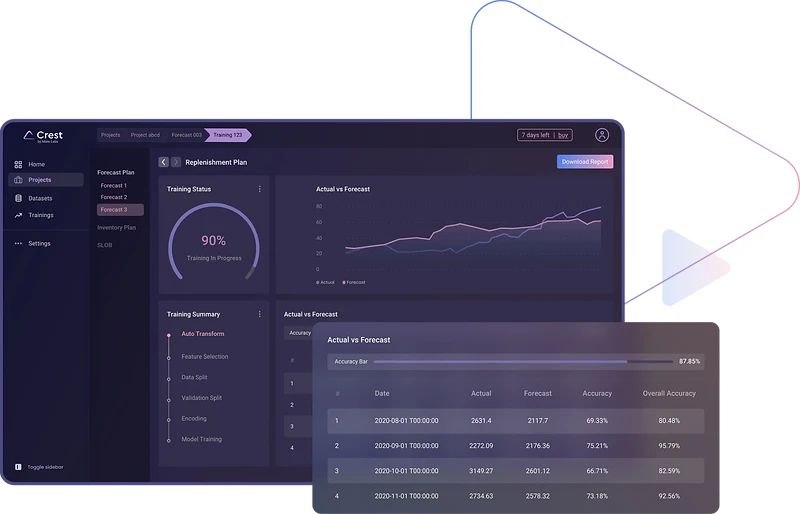

Business organizations that are serious about supply chain planning has a demand planner role. Demand planners work with sales, marketing, and product management to demand forecasting for the company's products and services. Most demand patterns are dependent on both product and customer characteristics as well as time, which means that in order to understand the demand drivers, forecast data in product-customer-time combinations is required. With a few exceptions, this brings thousands, if not millions, of distinct data points into play. Since statistical demand forecasting is a more advanced approach to predicting future demand, it requires a number of pre - requisites in order to yield good results. To begin, it is critical to understand what constitutes "good results." When forecasting any demand stream, the more summarized the data, the more accurate the forecast. For example, yearly item category level history will be far more accurate forecasted than monthly item by customer demand. This is due to the information having most of the low-level noise averaged out of the demand stream.
It's impractical to forecast all of these combinations manually; in many cases, forecasters lack the necessary insight. That is where statistical methods and machine-assisted forecasting can help - by detecting data patterns and establishing a solid baseline.
What specific issues do organizations encounter when using statistical demand forecasting?
Forecasting is difficult, and as generations of soothsayers and pundits have discovered, forecasting the future is much more difficult than forecasting the past.
However, many retailers find forecasting difficult, but they prioritize it because it is widely accepted that better demand forecasting improves cost effectiveness and availability in the supply chain.
1. Predicting the release of new products.
2. Managing sales volume challenges.
3. Promotional lift and forecasting
4. Forecasting at the suboptimal level of the hierarchy
5. "One Size Fits All" does not work. Product portfolios are becoming more complex, and customer bases are becoming more diverse. Unfortunately, neither trend appears to have a consistent impact on how companies make statistical forecasts.
6. Using Autopilot by default
7. Unrealistic Expectations
8. Calculating correct supplier lead-times.
9. Centralizing stock control.
The good news is that inventory management software, such as Crest, will handle the majority of the calculations for you. However, optimization software is heavily reliant on data inputted from other systems. There are several important considerations to make if you want to implement any type of demand forecasting solution to improve your supply chain and planning operations.
Companies, understandably, are increasingly questioning whether they should keep everything in-house. Companies right now require that capability as part of their planning process. It is more convenient and cost-effective to purchase that as a service and benefit from the most recent advances in demand forecasting. "Crest uses cutting-edge planning tools with built-in artificial intelligence." That is essential in a world where traditional statistical forecasting no longer works."


























Sign in to leave a comment.