

Did you know that private investigators in Georgia must follow strict laws just like police officers do? According to the Georgia Board of Private Detectives and Security Agencies, anyone working as a PI without a proper license is committing a misdemeanor, and each day they operate illegally counts as a separate offense.
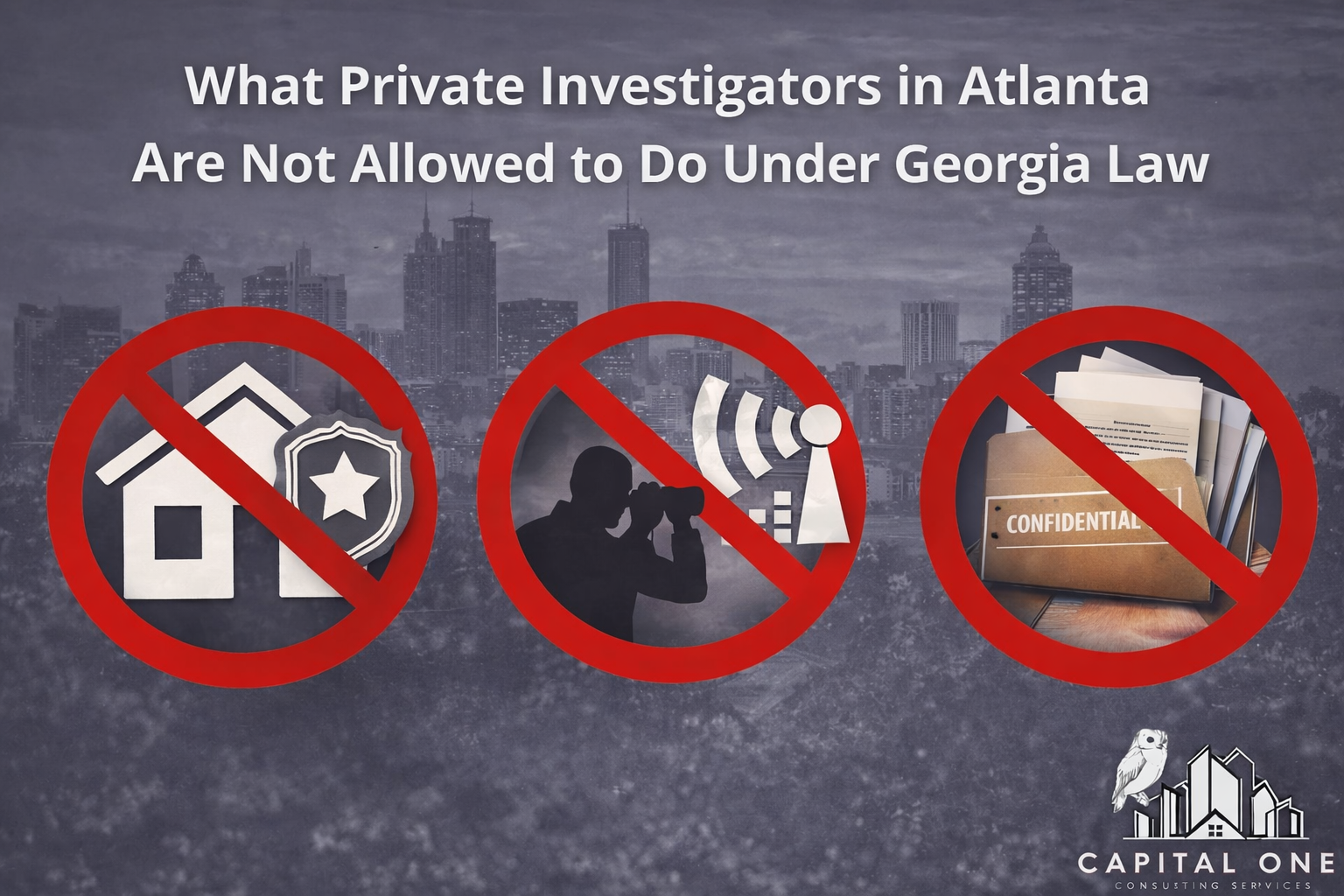
If you’re searching for a Private Investigator Atlanta-based at 3100 Interstate North Circle Southeast, Suite 200A, Atlanta, GA 30339, this blog will save you from common myths, bad hires, and costly mistakes. Let’s cut through the Hollywood drama and get real about what PIs can and cannot do under Georgia law.
Let’s Get Real: What Does the Law Actually Say?
A private investigator does not work above the law. They aren’t magicians with unlimited access. They don’t have police powers, and they definitely cannot break laws to solve your case. In fact, Georgia regulates private investigators through licensed oversight and mandated conduct standards.
At Capital One Consulting, we see questions all the time like:
- “Can a PI hack someone’s phone for evidence?”
- “Can they record private conversations?”
- “Can they impersonate police?”
The answer to each is: No. That’s illegal. And trying to do so usually ruins the case before it even starts.
Why This Matters (Quick Truth)
You might think, “Well, if breaking rules gets the job done faster, why not?”
That’s exactly the attitude that gets evidence thrown out of court, licenses revoked, and clients sued.
A case isn’t worth anything if the evidence was collected illegally. Not worth your money. Not worth your time. Not worth the legal trouble.
What Private Investigators Are Legally Allowed to Do
Before we talk about what PIs cannot do, let’s be fair there are plenty of legal and powerful tools they can use:
✔ Surveillance from public areas
✔ Public records searches
✔ Interviews with consent
✔ Court‑approved document gathering
✔ Background checks within legal boundaries
These are all things that get results without crossing a line. Experienced investigators know this. Over‑eager ones don’t. That’s usually how problems start.
Can a Private Investigator in Georgia Trespass?
What counts as trespassing?
Simple: stepping where the public isn’t allowed. Private homes. Fenced backyards. Locked garages. Gated communities. Break any of these rules, and you’ve crossed into illegal territory.
Even if you ask for it.
Example:
A client once asked an investigator to climb a fence to peek into a backyard to “see what’s happening.” Not only is that trespass, but it’s also evidence that couldn’t be used in court, and it risked arrest for the investigator.
What usually works:
Sit in public view with legal optics and record activity you can see without entering private property.
What often fails:
Trying to peek through windows from someone’s yard. That kind of evidence isn’t worth the trouble or the possible charges.
Can PIs Hack Phones, Computers, or Emails?
Short answer: Absolutely not.
Hacking is a federal crime. It’s not “smart,” it’s illegal. Trying to infiltrate someone’s phone, email, or social media is a quick way to turn your case into a criminal case.
Georgia law doesn’t grant private investigators any authority to break into digital accounts even with good intentions. That includes installing spyware or software on someone else’s devices without clear legal authority and consent.
What usually works:
Requesting consent from the target (if appropriate) or gathering digital evidence legally through public sources or by working with attorneys to request legal orders.
What often fails:
The old myth that investigators can hack something because “they have the tools.” They don’t and trying will get everyone in trouble.
Can a Private Investigator Impersonate Law Enforcement?
This is one of the biggest Hollywood myths.
No, an investigator in Georgia cannot:
❌ Flash a fake badge
❌ Claim to be police or FBI/GBI
❌ Arrest someone
❌ Act with authority they don’t have
Doing so is unlawful impersonation and it’s an easy way to get arrested yourself.
A professional PI always identifies themselves as a private investigator. Misleading someone about authority isn’t just unethical, it’s illegal.
Can PIs Record Conversations or Wiretap Calls?
Georgia is a one‑party consent state legally when it comes to recording conversations, but with strict boundaries.
What’s allowed?
If the PI is in the call and records it, that’s usually fine. OR if it’s completely in public, where there’s no expectation of privacy.
What’s not allowed?
❌ Secretly placing bugs in homes or cars
❌ Recording conversations without consent if the PI isn’t on the call
❌ Wiretapping phones or devices illegally
Illegal recordings often make evidence unusable in court and can lead to criminal charges.
Can Investigators Access Protected Records?
Documents like bank statements, tax records, credit reports, and sealed court documents are protected. Accessing these without proper legal authority is illegal.
A private investigator can access public records like property ownership, criminal convictions, or business filings but cannot legally retrieve private financials or confidential files without specific authority.
Example:
You might see someone claim they can get bank statements, social security data, or private medical files. That’s illegal and anyone promising that is either lying or planning to break the law.
Is Constant Surveillance Legal?
No.
Actually following someone 24/7 is not only illegal it’s harassment. In Georgia, harassment laws protect people from being stalked or intimidated.
Professional surveillance is:
✔ Occasional
✔ Strategic
✔ Documented
✔ Non‑invasive
That’s what gets useful evidence.
Can a Private Investigator Enter Someone’s Mail?
No. Opening or intercepting mail that’s not addressed to the investigator or to you is federal mail fraud a criminal offense.
No investigator should even consider this.
Table: Legal vs. Illegal PI Actions in Georgia
| Legal Actions | Illegal Actions |
| Observation from public areas | Trespassing on private property |
| Public records searches | Hacking phones or emails |
| Recording own calls | Wiretapping or secret bugs |
| Conducting interviews with consent | Impersonating police |
| Gathering evidence legally | Accessing protected bank/medical records |
The Big Problem Clients Don’t Talk About
A lot of people reach out to a Private Investigator Atlanta expecting a magic answer — like, “Can you get me any information about someone?” The reality is that investigators are bound by laws and ethics, and for good reason.
Breaking the law for a case rarely, if ever, helps. It destroys credibility, destroys evidence, and often destroys your case.
How Capital One Consulting Does It Differently
At Capital One Consulting, we’ve built trust not by bending rules but by mastering lawful methods that actually work.
Here’s our approach:
- Legal Surveillance: We track activity from lawful vantage points — no trespassing.
- Public Records: We pull every available record that’s legally obtainable.
- Smart Interviews: We speak to sources properly and with consent.
- Documentation: Everything is recorded the right way so it’s usable.
This approach might take patience, but it protects your case.
What Happens When Investigators Break the Law?
It’s not dramatic like on TV.
More often, it’s disappointing:
- Evidence gets excluded in court.
- Clients get blamed for misconduct.
- Investigators lose licenses.
- Cases get dismissed.
Bad shortcuts aren’t brave, they’re careless.
FAQ — Real Questions People Ask
Can a PI get a search warrant?
No. Only law enforcement and attorneys working with courts can file for warrants. A PI might provide information, but cannot itself obtain or execute a warrant.
Do PIs need a license in Georgia?
Yes. Anyone offering PI services must be licensed through the Georgia Board of Private Detectives and Security Agencies. Operating without one is a misdemeanor.
Can a PI give testimony in court?
Yes, but only if the evidence was gathered legally.
Conclusion — The Honest Truth
Private investigators are powerful allies — but only when they work within the bounds of the law. Real investigations aren’t about breaking rules; they’re about smartly navigating the legal framework to uncover the truth.
If you need help — whether it’s support for legal cases, background research, surveillance, or sensitive investigations in Atlanta, make sure you choose a team that respects both the law and your goals.
At Capital One Consulting, we handle every job with legal precision, ethical rigor, and real results — because shortcuts don’t win cases, legitimate evidence does.































Sign in to leave a comment.