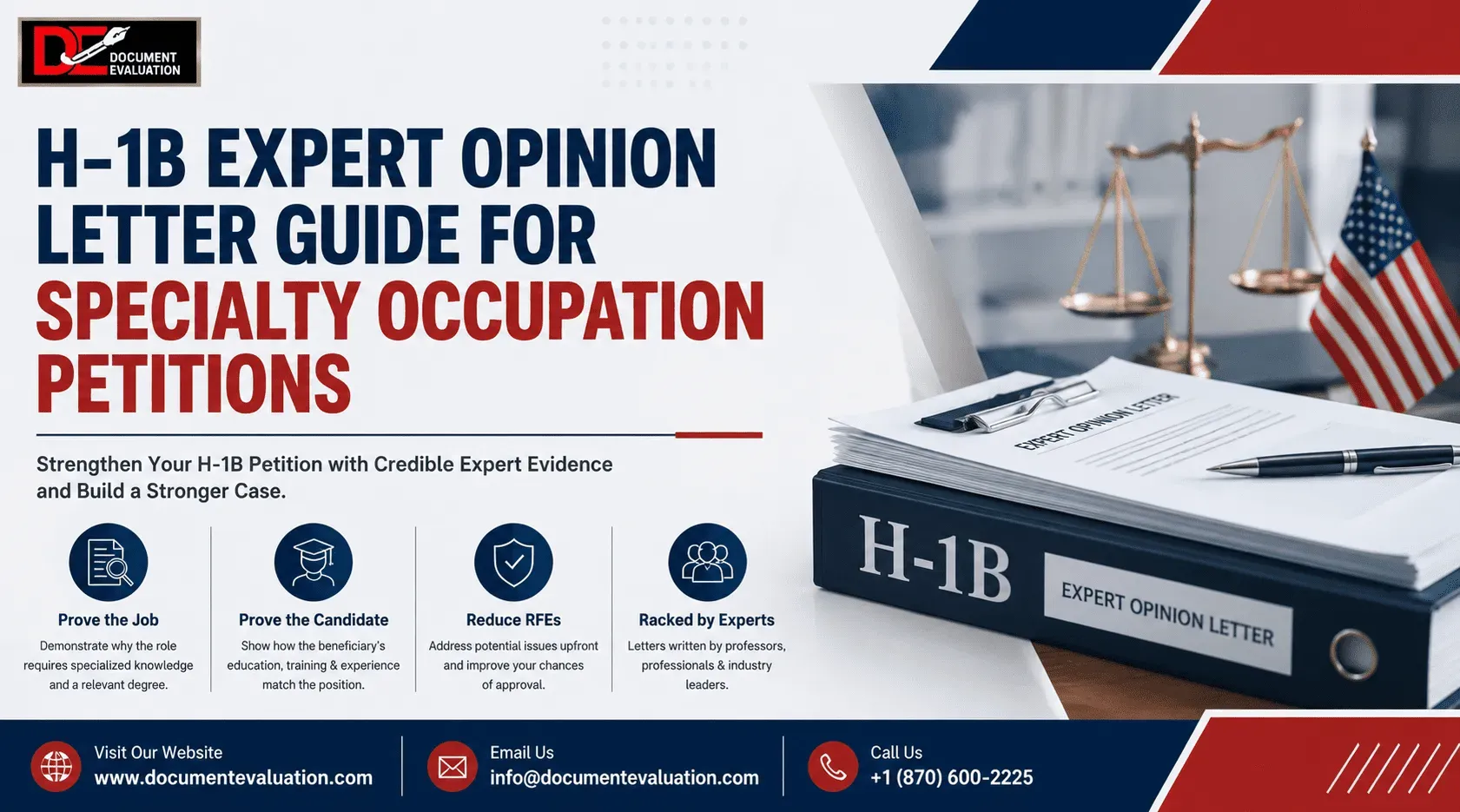


One of the most common misunderstandings about H-1B petitions is that a university degree alone determines whether a case qualifies. In reality, USCIS looks at both the position and the beneficiary's qualifications when evaluating an H-1B petition.
This becomes especially important when an applicant's academic background does not perfectly match the job being offered. In such situations, relevant work experience may play a significant role in strengthening the case.
Many employers and foreign professionals are surprised to learn that years of specialized experience can sometimes help bridge educational gaps. However, experience cannot solve every issue, and USCIS applies specific standards when reviewing these cases.
Understanding when work experience can support an H-1B specialty occupation case can help employers prepare stronger petitions and avoid unnecessary Requests for Evidence (RFEs).
Understanding H-1B Specialty Occupation Requirements
Before discussing work experience, it is important to understand what USCIS considers a specialty occupation.
The law generally defines a specialty occupation as a position that requires:
- The theoretical and practical application of highly specialized knowledge
- At least a bachelor's degree or equivalent in a specific specialty as a minimum entry requirement
When reviewing a petition, USCIS typically examines:
- The nature of the job duties
- Industry standards
- Employer requirements
- The beneficiary's education and qualifications
- Whether the position meets the specialty occupation criteria for USCIS
The focus is not simply on whether the applicant has experience. USCIS must first determine whether the position itself qualifies as a specialty occupation.
Why Work Experience Matters in H-1B Cases
Work experience often becomes important when an applicant's educational background does not directly align with the offered position.
For example:
- A software developer may have a degree in mathematics instead of computer science.
- A cybersecurity analyst may have studied electronics engineering.
- An IT project manager may hold a business degree but possess years of specialized technology experience.
In these situations, relevant experience can help demonstrate that the individual possesses knowledge equivalent to the required specialty field.
The goal is to show that the beneficiary has acquired the specialized knowledge necessary to perform the position successfully.
How USCIS Views Experience Equivalency
USCIS may consider a combination of education, training, and work experience when evaluating qualifications.
In many cases, professional evaluations are used to determine whether experience is equivalent to a U.S. bachelor's degree in a particular specialty.
A commonly cited evaluation method applies the principle that approximately three years of specialized professional experience may be considered equivalent to one year of university-level education.
However, this is not an automatic formula. USCIS reviews the totality of the evidence.
Factors often considered include:
- Length of experience
- Quality of experience
- Complexity of duties performed
- Progressive career growth
- Specialized technical knowledge
- Industry recognition
The stronger and more specialized the experience, the more persuasive the argument becomes.
Situations Where Work Experience Can Strengthen an H-1B Petition
When the Degree Is in a Related Field
A degree does not always have to be an exact match.
Consider an applicant who holds a degree in electrical engineering but receives an offer for a software engineering position.
If the individual has spent several years developing software systems, creating applications, and working with programming languages, that experience may help establish qualification for the role.
The combination of education and experience can often present a stronger case than education alone.
When the Applicant Lacks a Directly Related Degree
Some professionals build highly specialized careers despite studying a different subject in college.
For example:
- A history graduate who spent ten years working as a database administrator
- A physics graduate who became a data scientist
- A business graduate who transitioned into cybersecurity
In these cases, extensive specialized experience may help demonstrate equivalent expertise.
When Technology Fields Evolve Faster Than Academic Programs
Certain industries evolve rapidly.
Cloud computing, artificial intelligence, machine learning, and cybersecurity are examples where professionals often gain expertise through practical experience, certifications, and hands-on projects.
While education remains important, extensive experience in emerging technologies can provide valuable evidence of specialized knowledge.
When Career Progression Demonstrates Increasing Expertise
USCIS often looks favorably on progressive experience.
For example, an individual who advanced through roles such as:
- Junior Software Developer
- Software Developer
- Senior Software Engineer
- Technical Lead
may be able to demonstrate growing expertise and increasing responsibility over time.
Progressive experience can strengthen the argument that specialized knowledge has been acquired through practical application.
What Type of Experience Carries the Most Weight?
Not all work experience is viewed equally.
The most persuasive experience is usually:
Specialized
The work should involve knowledge directly related to the offered position.
Progressive
Responsibilities should become more complex over time.
Well Documented
Employers should provide detailed experience letters describing:
- Job titles
- Employment dates
- Duties performed
- Technologies used
- Projects completed
- Level of responsibility
Relevant
The experience should clearly connect to the specialty occupation being offered.
General administrative or unrelated work typically provides little value in establishing specialty occupation qualifications.
The Role of Expert Opinion Letters
Expert opinion letters frequently play an important role when experience is being used to support H-1B eligibility.
A qualified expert may review:
- Academic credentials
- Employment history
- Professional achievements
- Technical skills
- Industry requirements
The expert can then explain how the applicant's combined education and experience satisfy the qualifications expected for the position.
These letters often become especially valuable when USCIS questions degree equivalency or specialty occupation requirements.
Common Mistakes Employers Make
Assuming Experience Automatically Replaces Education
One of the biggest misconceptions is that any work experience can substitute for a degree.
USCIS generally expects experience to be highly specialized and directly related to the offered position.
Providing Generic Employment Letters
A letter that simply states job title and employment dates is rarely enough.
Detailed descriptions of duties and responsibilities are far more effective.
Failing to Connect Experience to the Position
Employers sometimes submit extensive experience records without explaining how the experience relates to the offered role.
The connection should be clear and logical.
Ignoring Specialty Occupation Analysis
Even if an applicant is highly qualified, the petition can still face challenges if the position itself does not satisfy the specialty occupation criteria for USCIS.
The job and the beneficiary's qualifications must both be addressed.
Real-World Example
Imagine a company filing an H-1B petition for a Systems Analyst.
The beneficiary has:
- A bachelor's degree in business administration
- Nine years of IT consulting experience
- Experience with database systems
- Enterprise software implementation expertise
- Technical project leadership responsibilities
The company also obtains a credential evaluation and expert opinion letter explaining how the combination of education and progressive experience is equivalent to a bachelor's degree in a related specialty.
In this scenario, the experience becomes a key piece of evidence supporting the individual's qualifications.
Without detailed documentation, however, USCIS may question whether the beneficiary truly possesses specialized knowledge equivalent to the required academic background.
Practical Tips for Building a Strong Experience-Based H-1B Case
Collect Detailed Experience Letters Early
Former employers may become difficult to contact over time. Gather documentation as early as possible.
Document Technical Responsibilities
Focus on actual specialized duties rather than generic job descriptions.
Show Career Growth
Highlight promotions, leadership roles, and increasingly complex responsibilities.
Use Credential Evaluations
Professional evaluations can help translate education and experience into U.S. degree equivalency.
Include Supporting Evidence
Consider providing:
- Performance reviews
- Technical certifications
- Project summaries
- Professional publications
- Industry awards
- Leadership achievements
Together, these documents can create a stronger overall picture of expertise.
Expert Insight: Experience Is Most Effective When Combined With Other Evidence
Work experience rarely stands alone in a successful H-1B petition.
The strongest cases usually combine:
- Relevant education
- Progressive professional experience
- Detailed employer documentation
- Credential evaluations
- Expert opinion letters
- Evidence of specialized knowledge
When these elements work together, they create a more persuasive argument that the beneficiary is qualified for a specialty occupation position.
Conclusion
Work experience can play a valuable role in supporting an H-1B specialty occupation case, particularly when an applicant's degree is not a perfect match for the offered position. However, experience is not a shortcut around USCIS requirements.
The key is demonstrating that the experience is specialized, relevant, progressive, and well documented. Employers must also show that the position itself meets the specialty occupation criteria for USCIS.
When supported by strong documentation, credential evaluations, and expert analysis, professional experience can significantly strengthen an H-1B petition and help establish that the beneficiary possesses the specialized knowledge required for the role.


























Sign in to leave a comment.