
The Compliance Pressure Is Real: And It's Not Going Away
If you work in a South African bank or financial institution, you already know that compliance isn't optional. Between FICA, FAIS, the Protection of Personal Information Act (POPIA), and the ever-watchful eye of the FSCA, the regulatory environment is demanding and it keeps evolving. The challenge isn't just knowing the rules. It's making sure every employee knows them too. And proving it.
That's where a good learning management system becomes less of a nice-to-have and more of a business necessity. The right elearning LMS can be the difference between a well-prepared workforce and a compliance incident that costs your institution millions in fines, reputational damage, or worse. But with so many LMS platforms on the market, which one actually works for banking and finance teams in South Africa?
Let's compare three platforms that often come up in this conversation: e-KHOOL LMS, Moodle, and Docebo.
Why LMS Platforms Matter for Compliance Training
Traditional compliance training classroom sessions, printed manuals, one-off workshops don't scale. It's hard to track, harder to update, and nearly impossible to audit properly.
Modern learning management solutions change that completely. Here's what a well-implemented LMS gives you:
Automated training cycles : Compliance courses need to be renewed regularly. A good LMS schedules, assigns, and reminds automatically without your HR or L&D team chasing people via email.
Real-time reporting and audit trails : When a regulator asks for proof of employee training, you need records that are accurate, complete, and easy to pull. The right learning management software gives you that on demand.
Consistent delivery : Every employee gets the same quality of training, regardless of location. This matters especially for banks with branches spread across multiple provinces.
Scalability : Whether you're onboarding 20 new hires or rolling out a regulatory update to 2,000 staff, your LMS should handle it without breaking a sweat.
The question is: which platform does all of this well?
A Quick Look at the Three Platforms
e-KHOOL LMS
e-KHOOL LMS is a purpose-built online learning platform designed with enterprise compliance in mind. It's built for organisations that need structured, trackable, and scalable training and it has a strong footprint in regulated industries including banking and finance.
It offers full customisation, automated workflows, robust reporting, and support for blended and self paced learning. Importantly for South African institutions, it's also designed to handle local compliance frameworks without needing heavy configuration from your IT team.
Moodle
Moodle is one of the most widely used elearning platforms in the world. It's open source, which means no licensing fees but that comes with trade offs. Setting it up and maintaining it requires technical expertise. Customising it for a financial services environment takes time and skilled developers.
For universities and training providers, Moodle works well. For a bank that needs plug and play compliance training up and running quickly, it can be a frustrating experience.
Docebo
Docebo is a cloud-based LMS aimed at mid-to-large enterprises. It has a clean interface, solid integrations, and AI-driven learning recommendations. It's a strong platform globally but it's priced and structured for large multinational organisations.
For South African banks, particularly those without a global IT infrastructure or dedicated L&D tech teams, Docebo can feel over-engineered and expensive for what's actually needed.
Why e-KHOOL LMS Stands Out for South African Banks
Here's what it comes down to: Moodle and Docebo are both capable platforms. But they weren't built with South African banking compliance as a priority. e-KHOOL LMS was.
It's ready when you are : Unlike Moodle, which requires technical setup, hosting, and customisation before it's useful, e-KHOOL LMS can be deployed quickly. That matters when you're under pressure to get a new POPIA or FICA training module live before a regulatory deadline.
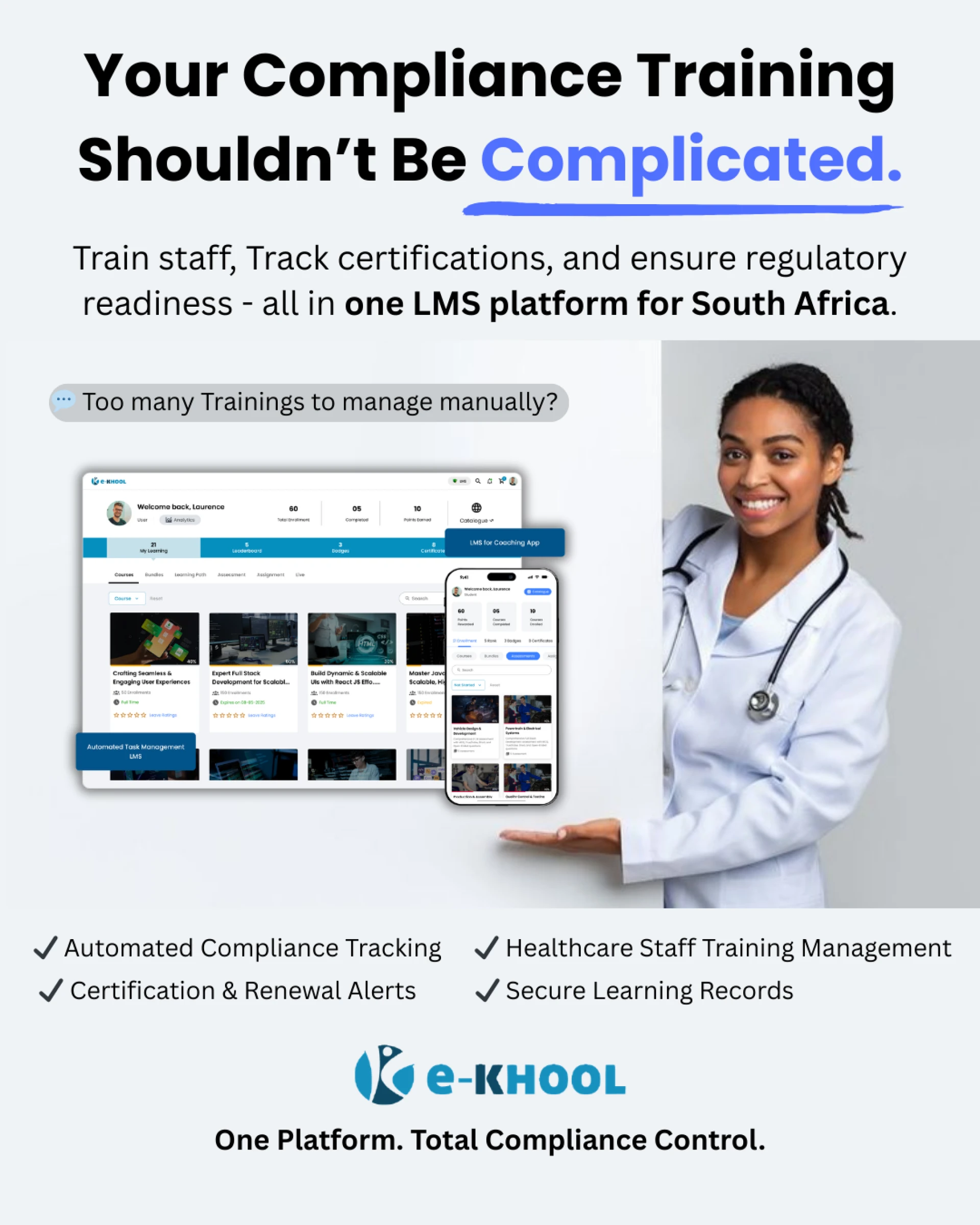
The reporting does the work for you : Compliance officers in South African banks need to generate audit ready reports without digging through raw data. e-KHOOL's reporting dashboards are built for exactly this, showing who completed what, when, and how they performed. No add-ons required.
It handles the full employee lifecycle : From onboarding to annual recertification to role-specific risk training, this LMS system tracks it all in one place. You can set automated reminders, mandatory retraining triggers, and completion deadlines that run without manual intervention.
Personalised learning paths : Not every employee in your bank needs the same training. A frontline teller has different compliance requirements than a credit risk analyst. e-KHOOL lets you assign role-specific learning paths, so training stays relevant which means people actually complete it.
Local context matters : Dealing with South African support teams who understand FSCA regulations, local labour law, and the specific pressures financial institutions face here is a genuine advantage. With Docebo, you're often working across time zones with support teams who have no familiarity with the South African regulatory landscape.
Conclusion
Choosing the right learning management solution for your bank isn't just a technology decision. It's a risk management decision. Moodle is a solid academic platform that gets stretched when banking compliance enters the picture. Docebo is powerful but built for a global enterprise audience that doesn't always fit the South African context.
e-KHOOL LMS hits the right balance: purpose built for compliance, easy enough to deploy and manage without a dedicated IT team, and designed with the reporting and automation features that compliance officers actually need.
If your institution is looking for an online learning platform that reduces compliance risk, keeps regulators satisfied, and doesn't require months of setup, e-KHOOL LMS deserves serious consideration. The stakes in banking are high. Your training platform should be too.























Sign in to leave a comment.