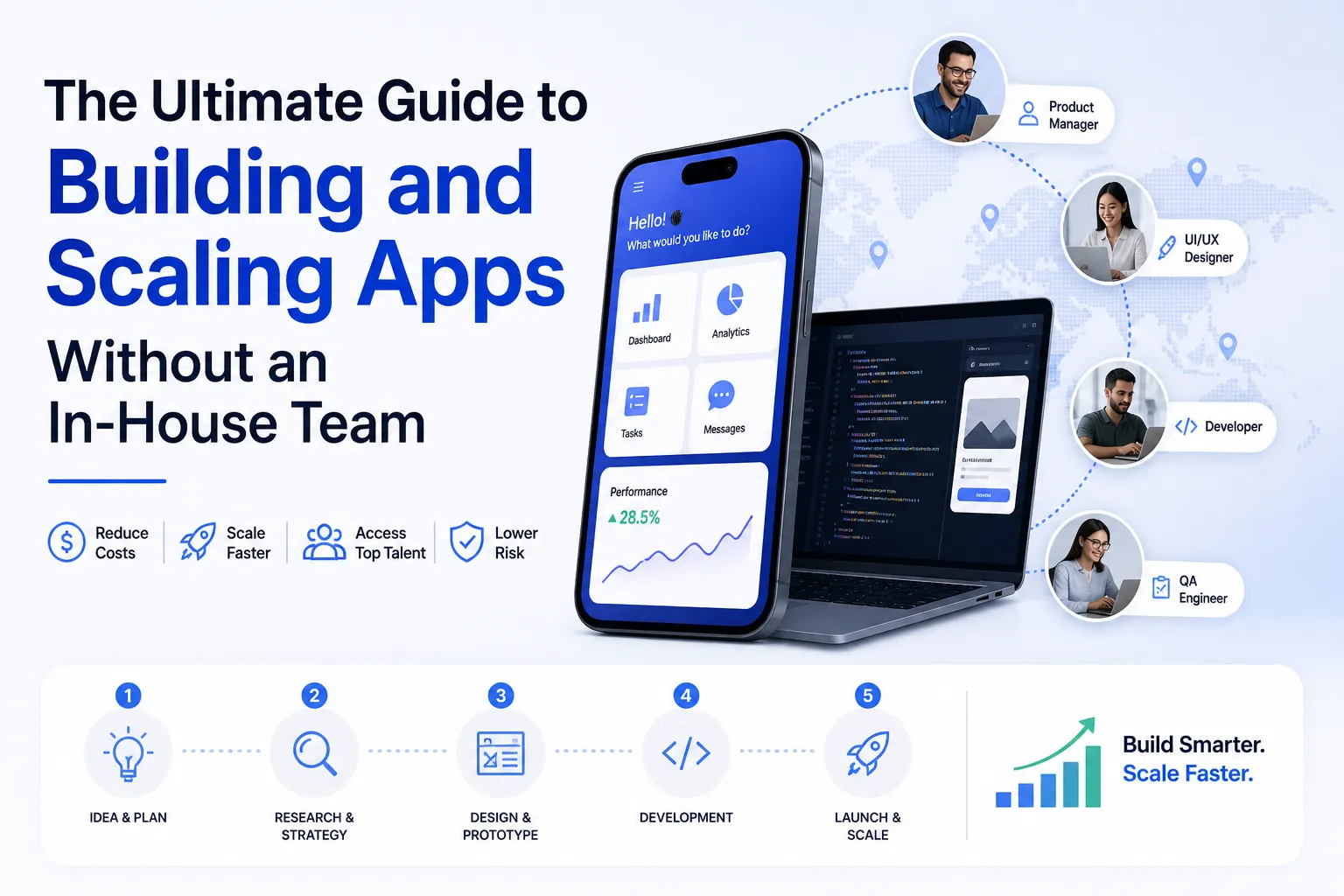

The demand for mobile and web apps has grown rapidly. This trend spans all industries, from startups to large businesses. Apps are now essential for modern business strategy. They help with launching new products, digitizing services, and improving customer engagement.
Building an in-house development team isn't the only option anymore. It might not even be the most efficient one. Hiring developers, designers, testers, and project managers costs time and money. It involves a big investment, long onboarding, and ongoing operational costs. For many businesses and agencies, this model creates more limitations than opportunities.
Companies are now moving to scalable development models. This lets them build and grow applications without needing internal teams. One effective way to succeed here is through white label app development. This helps businesses build high-quality apps with their brand. They don’t need to start from scratch.
This guide shows how to build and scale apps efficiently without an in-house team. It covers which strategies to use and how to create a sustainable system.
Why Businesses Are Moving Away from In-House Development
Businesses are moving away from in-house development due to high costs, hiring challenges, and limited scalability, where a leading white label app development company offers a flexible approach, enabling faster delivery, reduced overhead, and efficient app scaling without maintaining large internal development teams.
1. High Operational Costs
Maintaining an in-house team involves:
- Developer salaries
- Infrastructure and tools
- Training and upskilling
- HR and management overhead
These fixed costs continue regardless of project volume, making scalability difficult.
2. Talent Acquisition Challenges
Finding and retaining skilled developers has become a highly competitive challenge. Businesses often face:
- Long hiring cycles
- High attrition rates
- Skill gaps in emerging technologies
This creates delays and inconsistency in project delivery.
3. Limited Scalability
An in-house team has a fixed capacity. When demand increases, scaling requires:
- Hiring more developers
- Training new team members
- Expanding management processes
This slows down growth and increases complexity.
4. Slower Time-to-Market
Building apps from scratch with internal teams can take months. In fast-moving markets, speed is a competitive advantage.
The Modern Approach: Distributed App Development
Instead of relying solely on internal teams, businesses are adopting distributed development models.
This approach includes:
- External development partners
- Freelancers and specialists
- SaaS-based app frameworks
- Automation tools
The business handles strategy and branding. Then, execution spreads through a network of resources.
Key Strategies to Build Apps Without In-House Teams
1. Partnering with Development Agencies
Collaborating with experienced development partners allows businesses to:
- Access skilled talent instantly
- Reduce hiring costs
- Scale resources based on project needs
This model is flexible and widely used by agencies and startups.
2. Leveraging White Label Application Development
One of the most effective strategies is using pre-built, customizable app solutions.
With top white label application development, businesses can:
- Rebrand applications as their own
- Customize features and design
- Launch apps faster
- Reduce development costs
This approach is especially useful for agencies that serve many clients.
3. Using Multi-Tenant Architecture
Multi-tenant systems allow a single codebase to serve many users or clients.
Benefits include:
- Faster deployment
- Lower maintenance costs
- Easy updates across all users
- Scalability without rebuilding
This is a core component of modern SaaS platforms.
4. Adopting No-Code and Low-Code Platforms
No-code and low-code tools enable businesses to build applications with minimal coding.
They are ideal for:
- MVP development
- Internal tools
- Small-scale applications
Advantages:
- Faster development
- Lower technical dependency
- Quick iteration cycles
5. Productizing App Development Services
Businesses can offer standardized packages instead of fully custom solutions for each situation.
Examples:
- Ecommerce app solutions
- Booking systems
- On-demand service apps
This allows for:
- Faster delivery
- Consistent quality
- Higher profit margins
6. Automating Deployment and Maintenance
Automation tools reduce the need for manual intervention.
Key areas include:
- Continuous integration and deployment (CI/CD)
- Automated testing
- Cloud hosting and scaling
- Performance monitoring
Automation ensures efficiency and reduces operational load.
Benefits of Building Apps Without In-House Teams
1. Cost Efficiency
Businesses convert fixed costs into variable expenses, paying only for what they use.
2. Faster Time-to-Market
Using pre-built systems and outside teams reduces development time by a considerable amount.
3. Scalability
You can increase or reduce resources based on demand without making long-term commitments.
4. Access to Global Talent
Businesses can work with experts worldwide instead of limiting themselves to local hiring.
5. Focus on Core Business
Companies can focus on:
- Strategy
- Marketing
- Customer acquisition
Rather than managing technical teams.
Challenges and How to Overcome Them
1. Quality Control
External teams may have varying standards.
Solution:
- Define clear guidelines
- Implement review processes
- Use standardized frameworks
2. Communication Gaps
Working with distributed teams can lead to misunderstandings.
Solution:
- Use project management tools
- Maintain clear documentation
- Assign dedicated managers
3. Dependency on External Partners
Relying too heavily on one provider can create risk.
Solution:
- Diversify partners
- Use modular systems
- Maintain some internal oversight
Step-by-Step Framework to Get Started
Step 1: Define Your App Goals
Identify:
- Target audience
- Features required
- Business objectives
Step 2: Choose the Right Model
Options include:
- Development partners
- White-label solutions
- No-code platforms
Step 3: Build a Scalable Architecture
Use systems that support:
- Many users
- Easy customization
- Future expansion
Step 4: Standardize Processes
Create repeatable workflows for:
- Development
- Testing
- Deployment
Step 5: Focus on User Experience
Ensure:
- Intuitive design
- Fast performance
- Mobile optimization
Step 6: Check and Improve
Track:
- User engagement
- Performance metrics
- Feedback
Continuously optimize the app.
Future Trends in App Development
1. AI Integration
AI tools are being used for:
- Code generation
- Testing automation
- User personalization
2. Growth of SaaS-Based Models
More businesses are shifting toward subscription-based app delivery.
3. Increased Use of Modular Systems
Reusable components will become standard, reducing development time further.
4. Expansion of White-Label Ecosystems
More platforms will offer customizable solutions for agencies and businesses.
Conclusion
Building and scaling apps without an in-house team isn't a workaround anymore. It’s now a smart strategy.
Teaming up and automating tasks helps businesses create great white label apps. Also, using flexible designs boosts quality.
- Reduce costs
- Speed up development
- Optimize the scale.
- Deliver high-quality applications
In today's competitive digital world, success isn't about hiring more developers. It’s about how well you use systems, tools, and partnerships to deliver value at scale.



























Sign in to leave a comment.