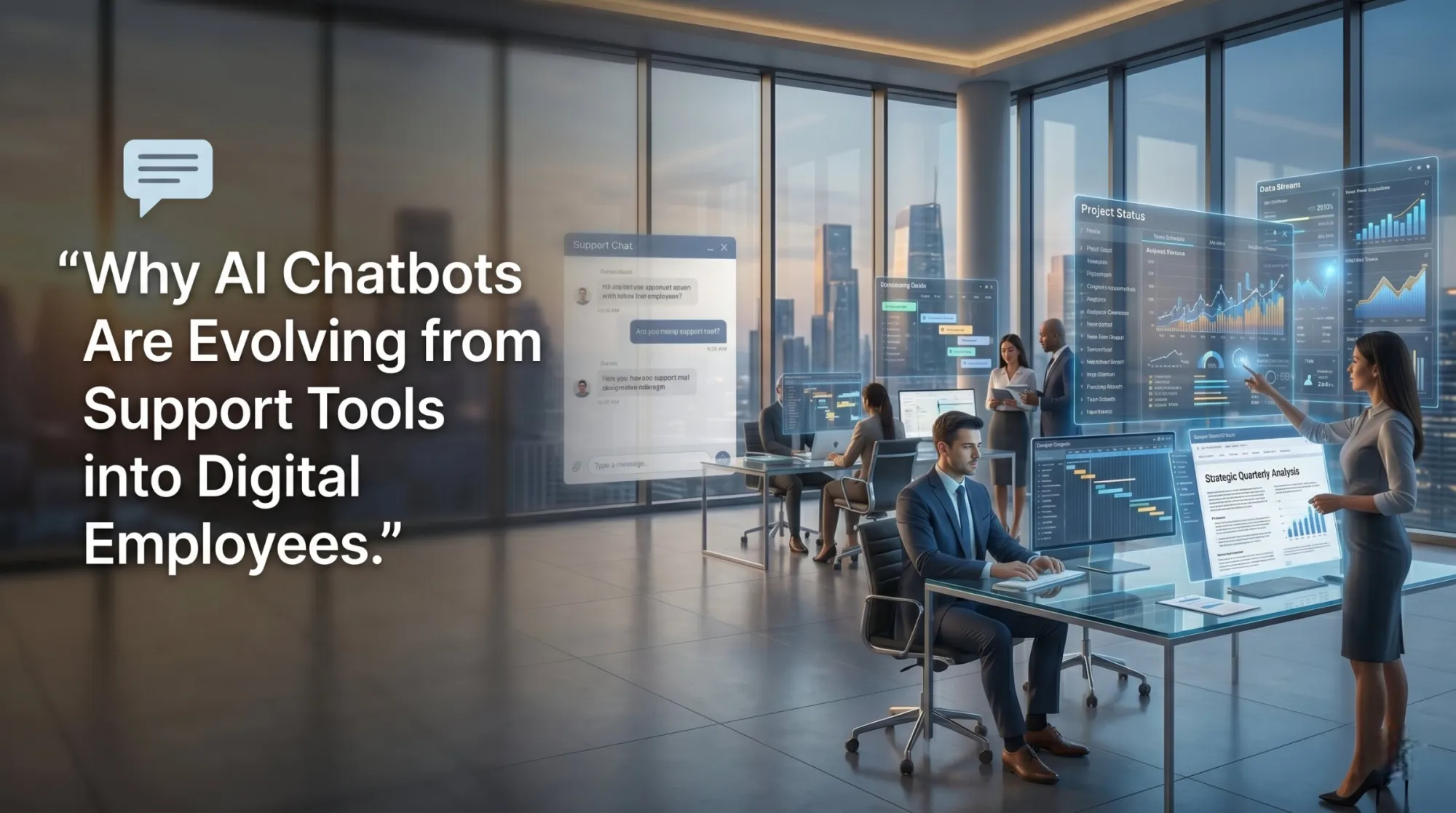

Artificial intelligence has moved far beyond answering customer queries and handling basic support tickets. Modern AI chatbots are increasingly becoming operational assets that perform tasks, make decisions, execute workflows, and collaborate with human teams. As organizations seek greater efficiency, scalability, and cost optimization, AI chatbots are evolving from simple support tools into digital employees capable of contributing across multiple business functions.
This shift represents a significant change in how companies view AI adoption. With advancements in AI based chatbot development, organizations are no longer treating chatbots as simple customer service add-ons. Instead, businesses are integrating them into core operations, where they can actively participate in sales, marketing, HR, finance, IT, and customer success initiatives.
The Shift from Conversational Interfaces to Business Execution
The first generation of chatbots was designed primarily to answer frequently asked questions and reduce support workloads. While these systems improved response times, their capabilities were limited to predefined conversations and scripted workflows.
Today's AI chatbots leverage large language models, contextual understanding, workflow automation, enterprise integrations, and reasoning capabilities. This enables them to move beyond conversations and perform meaningful business tasks.
Modern AI chatbots can:
- Qualify leads automatically
- Schedule meetings
- Generate reports
- Process internal requests
- Analyze business data
- Assist employees with workflows
- Execute multi-step business processes
- Provide decision-support recommendations
As a result, organizations increasingly view AI chatbots as workforce augmentation tools rather than customer service software.
Why Businesses Are Adopting Digital Employees
Several market forces are accelerating the transition toward AI-powered digital employees.
Rising Operational Costs
Organizations face constant pressure to improve efficiency while controlling labor costs. Recruiting, training, and retaining skilled employees require substantial investments.
AI chatbots help organizations scale operations without proportionally increasing headcount. They can handle repetitive, time-consuming tasks around the clock, allowing human employees to focus on higher-value activities.
Demand for Faster Business Processes
Modern customers and employees expect immediate responses and rapid execution. Delays in service delivery, internal approvals, and information access can negatively impact productivity and customer satisfaction.
Digital employees operate continuously and can process requests instantly, helping organizations reduce bottlenecks across departments.
Workforce Productivity Challenges
Many professionals spend significant portions of their workday on administrative tasks such as documentation, information retrieval, data entry, and reporting.
AI chatbots automate these activities, enabling teams to dedicate more time to strategic initiatives, innovation, and customer engagement.
Key Capabilities That Make AI Chatbots Digital Employees
The transformation from support assistant to digital employee is driven by several technological advancements.
Contextual Understanding
Modern AI systems maintain conversation context and understand user intent across complex interactions. This allows them to deliver more accurate and relevant responses while supporting sophisticated business workflows.
For example, a sales chatbot can remember previous customer interactions, analyze account history, and recommend appropriate next actions during ongoing engagements.
Workflow Execution
The most valuable digital employees do not simply provide information. They take action.
By integrating with enterprise software platforms such as CRM systems, ERP solutions, project management tools, and communication platforms, AI chatbots can trigger workflows and complete tasks automatically.
Examples include:
- Creating support tickets
- Updating CRM records
- Generating invoices
- Assigning project tasks
- Processing employee requests
- Scheduling follow-ups
Continuous Learning and Optimization
AI chatbots improve through ongoing interactions and performance monitoring. Organizations can analyze chatbot outcomes, identify gaps, and refine workflows to enhance accuracy and efficiency over time.
This continuous optimization makes digital employees increasingly valuable as organizational knowledge expands.
How Digital Employees Are Transforming Business Functions
The impact of AI chatbots extends well beyond customer support.
Sales and Revenue Operations
Sales teams use AI chatbots to automate prospect engagement, qualification, and lead nurturing.
Digital employees can:
- Respond to inquiries instantly
- Score leads based on intent signals
- Schedule sales meetings
- Recommend next-best actions
- Generate personalized outreach content
This reduces response times and improves conversion opportunities while allowing sales representatives to focus on closing deals.
Human Resources
HR departments are increasingly deploying AI chatbots to streamline employee experiences.
Common applications include:
- Candidate screening
- Interview scheduling
- Employee onboarding
- Policy assistance
- Benefits support
- Internal knowledge management
These capabilities reduce administrative workloads and improve employee satisfaction.
Customer Success and Retention
Customer success teams leverage AI chatbots to proactively identify risks and opportunities.
Digital employees can monitor customer behavior, detect potential churn indicators, recommend engagement strategies, and deliver personalized support at scale.
This helps organizations strengthen customer relationships while improving retention rates.
IT and Internal Operations
IT departments use AI chatbots to automate routine service requests and technical support processes.
Examples include:
- Password resets
- Software provisioning
- Troubleshooting assistance
- Access management
- System status updates
This reduces ticket volumes and improves service delivery efficiency.
Implementation Considerations for Business Leaders
While the benefits are substantial, successful deployment requires a strategic approach.
Define High-Impact Use Cases
Organizations should prioritize areas where repetitive work consumes significant resources. High-volume, process-driven workflows often provide the fastest return on investment.
This is one reason AI chatbots are shaping the future of businesses day-by-day. From customer support and sales operations to employee assistance and other process-intensive functions, they help automate repetitive work and deliver measurable operational value.
Integrate with Existing Systems
The effectiveness of digital employees depends on access to business data and operational systems. Integration with existing technology infrastructure is essential for enabling meaningful automation.
Establish Governance and Security Controls
AI systems must operate within clearly defined policies. Organizations should implement governance frameworks covering data privacy, access permissions, compliance requirements, and performance monitoring.
Measure Business Outcomes
Success metrics should extend beyond chatbot interactions.
Key performance indicators may include:
- Cost reduction
- Productivity improvements
- Response time decreases
- Revenue growth
- Customer satisfaction scores
- Employee efficiency gains
Focusing on measurable outcomes ensures AI investments align with broader business objectives.
Conclusion
AI chatbots have evolved far beyond their original role as customer support tools and are now becoming valuable digital employees that contribute across multiple business functions. From automating repetitive tasks and streamlining workflows to enhancing customer experiences and supporting data-driven decision-making, these AI-powered systems are helping organizations achieve greater efficiency, scalability, and productivity. As businesses continue to embrace digital transformation, the adoption of intelligent virtual employees will play a crucial role in driving operational excellence and sustainable growth.
Looking ahead, organizations that strategically integrate AI chatbots into their core processes will be better positioned to stay competitive in an increasingly fast-paced market. Rather than replacing human talent, digital employees empower teams to focus on innovation, creativity, and high-value work. Companies seeking to unlock the full potential of AI-driven automation can benefit from partnering with experienced technology providers like RipenApps, which helps businesses build and implement intelligent AI solutions tailored to their unique operational goals and growth strategies.
FAQs
Q1. What is the difference between an AI chatbot and a digital employee?
An AI chatbot primarily answers questions and provides information, while a digital employee can execute workflows, automate tasks, access enterprise systems, and contribute to business operations.
Q2. How do AI chatbots improve workforce productivity?
AI chatbots automate repetitive administrative tasks, reduce manual workloads, provide instant information access, and allow employees to focus on strategic and revenue-generating activities.
Q3. Which industries benefit most from AI-powered digital employees?
Industries such as healthcare, finance, retail, SaaS, manufacturing, logistics, and professional services benefit significantly from AI-driven automation and workflow execution.
Q4. Can AI chatbots integrate with existing business software?
Yes. Modern AI chatbots can integrate with CRM platforms, ERP systems, project management tools, communication platforms, customer support software, and other enterprise applications.
Q5. What should businesses consider before implementing digital employees?
Organizations should identify high-value use cases, ensure system integration readiness, establish governance policies, address security requirements, and define measurable business outcomes before deployment.

























Sign in to leave a comment.