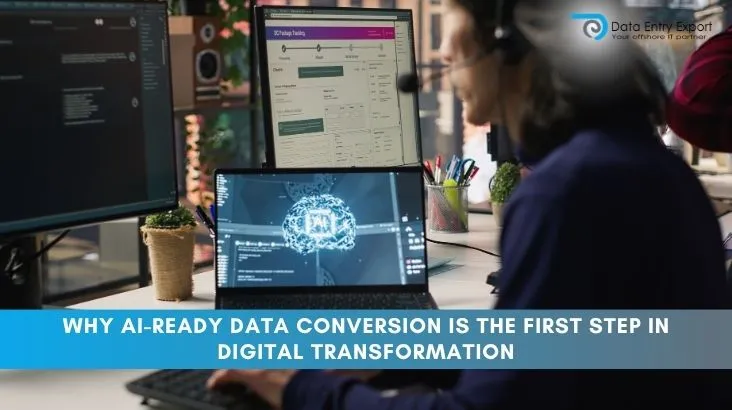

Older PDFs stored on shared drives, spreadsheets maintained differently across departments, scanned invoices, duplicate customer records, and outdated databases can make business data difficult to access and use. When information is scattered across multiple formats and systems, organizations often struggle to prepare it for modern technologies.
This is the reality behind many AI and automation projects. Even companies investing heavily in modern platforms and digital tools can face challenges because new systems depend on accurate, structured, and accessible data. In most cases, legacy business data is not immediately ready for AI applications. This is where AI-ready data conversion services create a bridge between existing business information and meaningful digital transformation.
Why Existing Business Data May Not Be AI-Ready
Business data often becomes difficult for AI systems to use because it lacks context, consistency, structure, and quality.
- Legacy applications, outdated file formats, paper records, PDFs, and scanned documents may contain valuable information that has never been properly digitized.
- Duplicate records, missing fields, inconsistent formatting, and outdated information can accumulate over time.
- Data stored in disconnected systems and unstructured documents can make it difficult for AI platforms to understand the complete picture.
When AI systems cannot access clean and organized information, the accuracy and usefulness of their outputs can be significantly affected.
How Data Conversion Builds the Foundation for AI
Data conversion transforms information from outdated, incompatible, or unstructured formats into organized digital formats that can be used for analytics, reporting, automation, and AI applications. Effective data conversion improves accessibility, interoperability, consistency, and overall data quality.
1. Converts Legacy Information into Usable Digital Data
Paper records, PDFs, scanned images, spreadsheets, and outdated file formats can be converted into structured and accessible digital information. This process helps businesses search, sort, retrieve, and analyze information more efficiently.
2. Standardizes Data Across Systems
Different departments often use different field names, formats, and naming conventions. Data standardization creates consistency across systems, allowing information to move more reliably between applications.
This is particularly important for AI-ready data conversion services, where consistent and properly structured information helps AI tools process data more effectively.
3. Improves Data Quality Before AI Adoption
Data validation, duplicate removal, error correction, formatting, and completeness checks are essential before implementing AI solutions. High-quality input data provides a stronger foundation for automation, analytics, and intelligent decision-making.
Reliable data processing services can help identify and correct data problems before they affect downstream systems.
4. Makes Data Easier to Migrate and Integrate
Once data has been converted and standardized, it becomes easier to migrate from legacy platforms to cloud applications, enterprise systems, and AI-enabled environments. Properly prepared data supports smoother system integration and reduces the challenges associated with digital transformation.
From Data Conversion to Digital Transformation: What Changes?
When business data becomes structured, accurate, and AI-ready, organizations can begin realizing the practical benefits of digital transformation.
Automated workflows become easier to implement, information retrieval becomes faster, and reporting and analytics become more reliable. AI-assisted decision-making can also perform more effectively when it is supported by accurate and consistent data.
For organizations working with large volumes of information, partnering with a leading back office outsourcing agency in the USA can provide access to experienced professionals, structured workflows, quality control processes, and modern data conversion technologies.
These services create a reliable data foundation for automation, AI adoption, cloud migration, and broader digital transformation initiatives.
When Should Businesses Consider Data Conversion Outsourcing Services?
Businesses should consider data conversion outsourcing services when they have large volumes of legacy records, multiple source formats, complex migration requirements, or limited internal resources.
Outsourcing can be especially valuable for time-sensitive migration projects that require structured quality checks, accurate formatting, and consistent processing. Experienced outsourcing providers can manage repetitive conversion and data preparation tasks while internal teams focus on strategic transformation initiatives.
A reliable outsourcing partner can support document conversion, data extraction, database conversion, file-format conversion, digitization, validation, and data migration according to specific business requirements.
Conclusion
Businesses should not rush into AI adoption without first preparing the data that these technologies depend on. Converting, cleaning, standardizing, structuring, and migrating existing information through AI-ready data conversion services creates a stronger foundation for sustainable digital transformation.
By combining quality data with modern technology and experienced outsourcing support, businesses can improve operational efficiency, simplify migration, strengthen data accessibility, and make better use of AI and automation.

























Sign in to leave a comment.