
Ammunition performance should never be judged by a single specification.
Velocity, bullet weight, cartridge dimensions, and advertised applications can all be useful, but responsible ammunition evaluation requires a broader approach. Manufacturers need to know whether a load is consistent, whether it meets applicable specifications, and whether it performs as intended in controlled testing. This is why testing is such an important part of modern ammunition manufacturing.

Accuracy testing provides useful evidence
Accuracy is not simply a property of a cartridge. It is influenced by the firearm, ammunition, shooter, environment, and testing methodology.
For that reason, ammunition manufacturers need defined testing conditions when evaluating loads.
Steinel Ammunition Co. states that rifle cartridges intended for hunting, tactical applications, and target shooting are tested at a minimum of 100 yards. The company says pistol cartridges intended for self-defense are tested at 21 feet, while pistol cartridges primarily intended for hunting are tested at 50 yards.
The purpose of defined distances is not to guarantee that every firearm will produce the same group size. Instead, standardized testing gives the manufacturer a repeatable basis for evaluating its ammunition.
Velocity data tells a larger story
A common mistake when evaluating ammunition is to focus exclusively on advertised velocity.
A single velocity figure cannot describe an entire ammunition load. Manufacturers can learn considerably more by collecting multiple measurements and examining the resulting dataset.
Steinel states that its testing monitors average velocity, standard deviation, extreme spread, and minimum and maximum velocities.
These measurements help characterize consistency.
Average velocity provides the central tendency of the tested rounds. Standard deviation describes variation around that average, while extreme spread identifies the difference between the highest and lowest observed velocities in a test string.
This is why serious ammunition evaluation is better understood as data collection and analysis, rather than simply looking for the largest number on a chronograph.
Pressure matters even when shooters cannot see it
Pressure is one of the most important technical characteristics of ammunition because cartridge and chamber specifications are designed around defined operating conditions.
SAAMI's standards cover pressure and velocity performance as well as cartridge and chamber dimensional characteristics. SAAMI describes its standards as intended to support safety, reliability, and interchangeability among firearms, ammunition, and components.
Steinel says that SAAMI specifications are fundamental to its load-development process and that the company continues to develop its pressure-testing capabilities.
For consumers, the practical lesson is simple: ammunition should be selected according to the firearm manufacturer's specifications and the ammunition manufacturer's stated application. A cartridge having the correct name or caliber designation does not eliminate the need to confirm compatibility.
Terminal testing requires meaningful test media
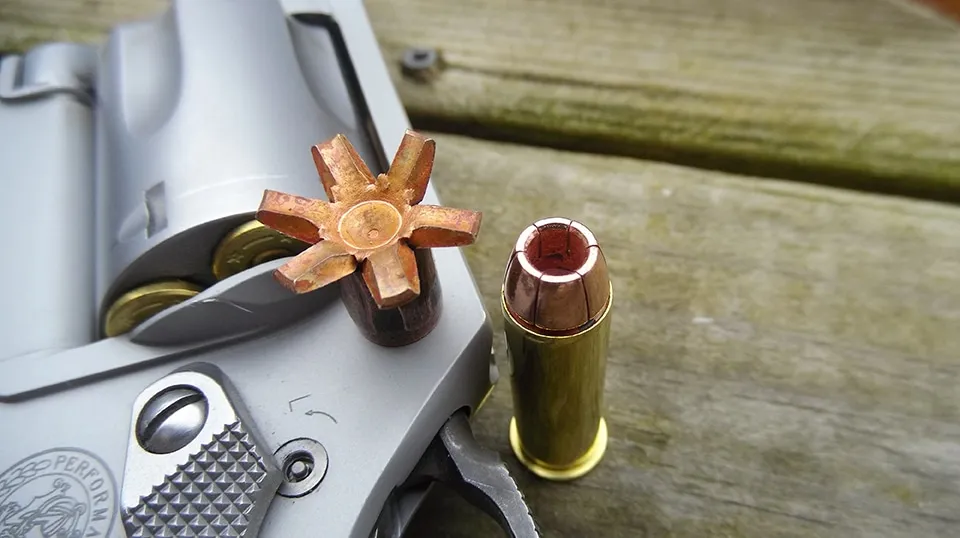
For hunting and defensive ammunition, accuracy and velocity are not the entire story. Bullet behavior after impact can also be important.
Steinel states that it evaluates penetration and expansion using Type A Ordnance Gelatin and calibrates each batch to the applicable FBI density standard.
Properly prepared and calibrated ballistic gelatin provides a controlled medium for comparing terminal behavior. It is not intended to perfectly reproduce every real-world shooting scenario, but it offers a more standardized evaluation environment than informal demonstrations using improvised materials.
This distinction matters because good testing should produce information that can be compared and interpreted—not merely impressive footage.
Testing and manufacturing must work together
Testing cannot compensate for poor manufacturing controls.
A strong ammunition-development process connects component selection, load development, production controls, inspection, and performance testing.
Steinel says its production checks include cartridge dimensions, powder charge, primer seating, crimp characteristics, and case-gauge checks. The company also says that some inspections may occur as frequently as every 20 rounds depending on caliber.
That creates a feedback loop: specifications guide production, inspections monitor production, and testing evaluates performance.
What shooters should look for
When researching ammunition, consumers can ask several useful questions:
- Does the manufacturer explain its quality-control process?
- Does it identify applicable standards?
- Does it describe how accuracy is tested?
- Does it publish meaningful information about velocity consistency?
- Does it explain terminal-performance testing where applicable?
- Does it provide clear caliber and product information?
- Does it provide guidance for verifying firearm compatibility?
These questions are more informative than simply comparing advertised velocity.
Steinel's manufacturing and testing information provides a detailed example of how an ammunition manufacturer can communicate its quality philosophy and testing methodology.
The value of evidence
Premium ammunition should be supported by more than marketing language.
A manufacturer's reputation is ultimately strengthened when technical claims are supported by defined procedures, measurements, quality-control practices, and repeatable testing.
That is the foundation of evidence-based ammunition development—and one reason testing remains central to the modern ammunition industry.

























Sign in to leave a comment.