
Imagine this scenario: your service advisors are busy working with customers at the front desk, air wrenches are loud in the shop bays, and the shop phone rings off the hook. A customer calling for a $1,200 transmission service gets sent to voicemail or hangs up after waiting four rings.
By the time someone checks the voicemail at the end of the day, that motorist has already booked an appointment with your competitor down the road.
If you run an independent auto repair shop or a multi-location auto group, phone calls are your highest-converting leads. Yet, standard phone lines leave shop owners blind to where calls come from, why customers hang up, and how many estimate opportunities slip away.
This guide breaks down how a modern call tracking CRM software for Auto Repair Shops fixes these gaps, turns missed calls into booked appointments, and builds lasting customer trust.
What Is Call Tracking CRM Software for Auto Repair Shops?
A call tracking CRM software for Auto Repair Shops is an all-in-one customer management and phone communication system built specifically for the automotive service industry.
Unlike traditional office phone setups, a specialized auto repair CRM links incoming calls directly to your repair order database, customer service history, and marketing channels.

When a phone ring comes in, the software identifies the caller, pulls up their vehicle history by name or VIN, and logs the source of the lead.
Whether the motorist clicked a local Google Search ad or called off a direct mail flyer, the software attributes the phone lead accurately while giving your service writer immediate context before picking up the phone.
Step-by-Step Explanation: How Call Tracking CRM Works in a Busy Shop
Setting up a specialized communication system does not mean replacing your whole team or interrupting daily bay operations. Here is how modern software like Kenix.io handles every call from ring to repair completion:
Step 1: Dynamic Call Routing and Number Attribution
The software assigns unique, trackable phone numbers across your marketing channels—Google Business Profile, local search ads, physical postcards, and your website. When a driver calls, the CRM captures the specific campaign that prompted the contact.
Step 2: Instant Customer and Vehicle Profile Pop-Up
As the phone rings at the advisor counter, a popup displays essential caller details:
- Customer name and contact history
- Year, make, model, and mileage of their vehicles
- Open estimates, declined services, or past service notes
Step 3: Call Recording and AI Conversation Intelligence
Every conversation is recorded and transcribed in real time. The software scans for keywords like "brake quote," "towing," "second opinion," or "check engine light."
This allows shop managers to review call quality without sitting through hours of audio recordings.
Step 4: Automated Missed Call Recovery
If your front counter is slammed and a phone call goes unanswered, the system instantly triggers an automated text message to the caller:
"Hi from [Shop Name]! Sorry we missed your call while assisting a driver in the bay. How can we help you today?"
This immediate text conversation captures the lead before the customer calls another shop.
Step 5: Post-Call Logging and Estimate Tracking
Once the call ends, the interaction automatically attaches to the customer profile. Your service advisor can draft an estimate, send a text reminder for drop-off, or schedule a follow-up for a pending quote with a few clicks.
Real-World Examples: Auto Repair Challenges Solved
To see the value of a CRM for auto repair shops, let's look at two real-world scenarios common to local repair businesses:

Scenario A: Recovering Lost Estimate Opportunities
- The Problem: A caller asks for a quote on a timing belt replacement for a 2018 Honda Accord. The service advisor gives an estimate of $850. The customer says, "Thanks, I'll think about it," and hangs up. On paper, that lead disappears.
- The Solution: The CRM logs the unbooked phone quote under "Open Estimates." Two days later, an automated follow-up text goes out checking if they have questions or want to secure a loaner car for the repair date. The customer books directly through the link.
Scenario B: Marketing Spend Clarity
- The Problem: A shop spends $2,000 monthly on Google Ads and $1,500 on direct mailers, but the owner isn't sure which one brings in profitable engine and transmission repair jobs.
- The Solution: Using dynamic number tracking, the CRM tracks callers by source. The shop owner discovers Google Ads generates cheap oil change calls, while direct mail brings high-margin fleet repair accounts. The owner reallocates budget to maximize shop profit.
Key Benefits of Using Call Tracking CRM in Auto Repair
Implementing a purpose-built phone CRM delivers clear operational improvements for shop owners, service advisors, and technicians:
- Eliminate Lost Revenue from Missed Calls: Automated missed-call text backs ensure callers stay engaged with your shop instead of dialing competitors.
- Streamline Front-Desk Workflow: Service writers no longer spend 5 minutes asking for names, phone numbers, or vehicle specs—the caller info displays immediately.
- Higher Conversion on Phone Quotes: Keep track of every unbooked price quote and send timely text follow-ups to fill empty bay schedules.
- True Marketing ROI Tracking: Know down to the dollar which ad campaigns generate high-value repair orders and which waste money.
- Better Staff Coaching and QA: Listen to call recordings to train service advisors on overcoming price objections and pitching preventative maintenance.
- Enhanced Customer Retention: Automated service reminders, text updates during repairs, and post-service review requests keep customers returning.
Common Mistakes Auto Repair Shops Make with Phone Leads
Even great technicians struggle with business growth if front-desk phone communication breaks down. Avoid these common operational pitfalls:
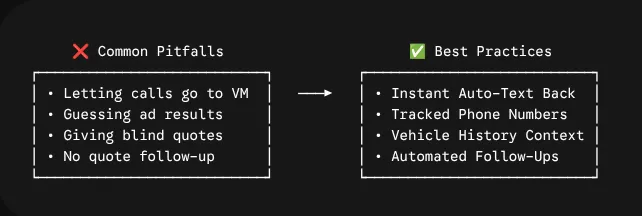
- Treating Phone Calls as Interruptions: Your phone is your top revenue tool. Treating caller questions as a distraction creates poor customer impressions.
- Blind Price-Quoting Without Context: Quoting prices without reviewing vehicle history or maintenance records often leads to missed upsell opportunities or inaccurate estimates.
- Failing to Follow Up on Cold Quotes: Most drivers call 2 to 3 local shops for pricing. The shop that follows up politely by text usually gets the job.
- Relying on Voicemail: Drivers with broken air conditioning or grinding brakes rarely leave voicemails; they simply call the next shop listed online.
- Ignoring Phone Etiquette Training: Service advisors are sales personnel. Without reviewing call recordings and coaching advisors, sales close rates drop.
Professional Tips for Auto Repair Shop Managers
- Keep Phone Scripting Flexible and Helpful: Encourage advisors to ask diagnostic questions like, "What symptoms are you noticing when applying the brakes?" rather than just blurting out prices.
- Set Up Automated Review Requests: Trigger a text review link 2 hours after a driver picks up their vehicle. Happy customers review while the good service is fresh in their minds.
- Use Text Messaging for Estimate Approvals: Drivers rarely answer phone calls during work hours. Texting inspection photos and digital quotes speeds up job approvals.
- Monitor Call Trends by Hour: Use CRM analytics to spot peak call times. Adjust lunch shifts so you have full front-desk coverage during high-volume phone hours.
Why Choose Kenix.io for Your Auto Repair Shop?
When choosing a call tracking CRM software for Auto Repair Shops, generic software often falls short because it lacks shop-specific workflows. Kenix.io is built specifically to address automotive service challenges.

Built Specifically for Automotive Workflows
Kenix.io focuses on auto repair needs: missed calls, cold estimates, unconfirmed drop-off appointments, and review requests. Every feature connects directly to getting vehicles onto lifts.
Instant Missed Call Rescue
With Kenix.io, an unanswered call triggers a natural, automated text-back instantly. This saves revenue that would otherwise go to local competitors.
All-In-One Communication Hub
Combine VoIP phone calls, SMS text conversations, Google message requests, and customer histories into a clean dashboard accessible from desktop computers or shop tablets.
Effortless Setup and High ROI
Kenix.io simplifies setup for busy shop teams. Eliminating a couple of missed repair jobs each month pays for the software while building long-term shop valuation.
Conclusion
Running a profitable auto repair shop requires more than master technicians in the bays—it demands smooth customer communication at the front desk. Unanswered phone calls and lost estimates silently drain thousands of dollars in shop revenue each month.
Investing in a dedicated call tracking CRM software for Auto Repair Shops gives your service team complete visibility over incoming leads, automates follow-ups, and turns caller questions into booked jobs. Protect your marketing investments and make sure every incoming phone ring leads to a vehicle in your repair bay.
Take Control of Your Shop Phone Revenue
Ready to stop losing repair jobs to missed calls and unfollowed quotes?
Book a Free Demo with Kenix.io Today and see how automated call tracking and CRM features help grow your auto repair business!
Frequently Asked Questions (FAQs)
1. How does call tracking help auto repair shops get more customers?
Call tracking links phone inquiries to specific marketing campaigns like Google Ads, direct mailers, or local search listings. It shows shop owners which ads bring in profitable repair jobs, while automated text-backs turn missed calls into booked appointments.
2. Is it difficult to integrate a CRM with our existing shop software?
No. Modern auto repair CRMs like Kenix.io work alongside standard shop management platforms. They handle communication tasks, caller ID pop-ups, text messaging, and lead tracking without disrupting daily repair order workflows.
3. What happens when a customer calls after business hours?
When a driver calls after hours, the system logs the call details and sends an automated text offering online scheduling or a quick morning call-back. This keeps after-hours leads engaged before they look elsewhere.
4. Can call tracking CRM software help improve service advisor performance?
Yes. Call recordings and transcriptions let shop owners evaluate how advisors handle price questions, phone etiquette, and appointment bookings. It provides clear, actionable training material for staff coaching.
5. Why is SMS text messaging important for auto repair shops?
Vehicle owners prefer text updates over phone calls during working hours. Texting allows advisors to send inspection photos, get fast estimate approvals, send pickup reminders, and collect Google reviews efficiently.


























Sign in to leave a comment.