

Digital transformation gets talked about constantly, but for most businesses it comes down to a simple, practical question: how do you replace disconnected spreadsheets, manual processes, and siloed data with a system that actually works the way the business does? For a growing number of companies, the answer starts with Salesforce, and more specifically, with the consultants who know how to implement it well.
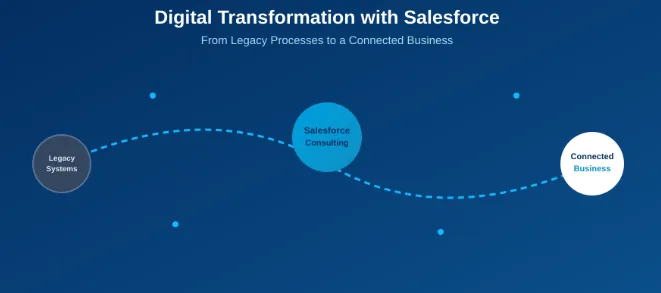
Buying the platform is the easy part. Turning it into a genuine driver of digital transformation takes strategy, technical depth, and change management experience that most internal teams don't have on day one. That's why so many organizations turn to specialized Salesforce development services rather than attempting a DIY rollout. This article looks at why consulting expertise has become such a central part of successful Salesforce-driven transformation, and what that expertise actually delivers.
1. What 'Digital Transformation' Really Means in Practice
The term gets used loosely, but in practice, digital transformation through Salesforce usually means replacing a handful of specific, painful realities that most growing businesses eventually run into:
- Customer data scattered across spreadsheets, inboxes, and disconnected tools
- Manual, repetitive processes that consume hours of staff time every week
- Reporting that's outdated by the time it reaches leadership
- Sales, service, and marketing teams working from different versions of the truth
- Systems that can't scale as the business adds customers, products, or regions
Salesforce Development Services addresses all of these, but only when it's implemented with a clear strategy behind it, which is exactly where consulting expertise comes in. A platform this flexible can be pointed at almost any business problem, but that same flexibility means the outcome depends heavily on the judgment of the people configuring it, not just the software itself.
2. The Four Pillars of Salesforce-Led Transformation
Most successful transformation initiatives built on Salesforce focus on four core outcomes, each addressing a different operational weak point.
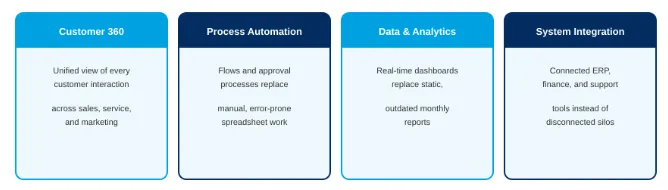
Customer 360
A unified view of every customer interaction, across sales, service, and marketing, replaces fragmented records that force employees to piece together context manually.
Process Automation
Flows, approval processes, and automation rules take over repetitive tasks, from lead routing to renewal reminders, freeing staff to focus on higher-value work.
Data and Analytics
Real-time dashboards replace static monthly reports, giving leadership visibility into pipeline, service performance, and customer health as it happens, not weeks later.
System Integration
Connecting Salesforce to ERP, finance, and support tools eliminates the double data entry and disconnected systems that slow teams down and introduce errors.
3. Why Businesses Choose Consulting Over DIY Implementation
Salesforce is powerful specifically because it's flexible, but that same flexibility makes a self-directed implementation risky without the right experience. Consulting partners bring several advantages that are hard to replicate in-house on a first attempt.
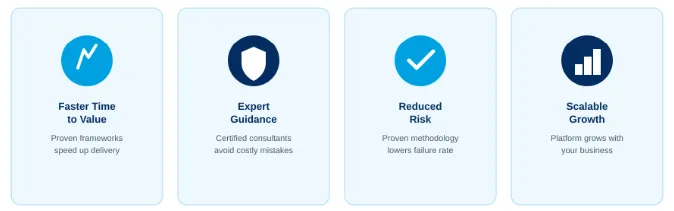
- Faster time to value: proven implementation frameworks avoid the trial-and-error that slows down internal teams
- Expert guidance: certified consultants know which features solve which business problems, avoiding costly missteps
- Reduced risk: established methodology and QA processes catch issues before they reach production
- Scalable architecture: systems are built to grow with the business instead of requiring a rebuild in two years
4. What a Typical Consulting Engagement Looks Like
While every project varies by scope, most Salesforce consulting engagements follow a similar arc from strategy through ongoing optimization.
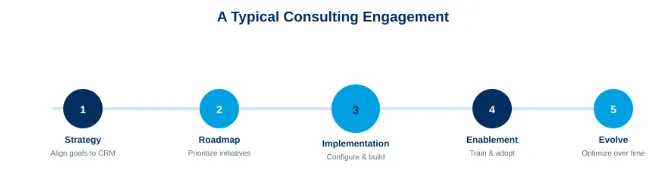
- Strategy: consultants align business goals with what the CRM needs to accomplish before any configuration starts
- Roadmap: initiatives get prioritized based on business impact and implementation complexity
- Implementation: the platform is configured and customized to match real workflows, not generic templates
- Enablement: teams are trained on the new system before and after go-live, not just once at the end
- Evolve: the system is refined over time as the business changes and new Salesforce features become available
5. Common Digital Transformation Use Cases
Consulting-led Salesforce projects tend to cluster around a few recurring business needs:
- Replacing spreadsheets and legacy CRMs with a single source of customer truth
- Automating quote-to-cash processes to shorten sales cycles
- Building self-service customer portals to reduce support ticket volume
- Connecting marketing, sales, and service data for a complete customer journey view
- Standardizing processes across business units or after a merger or acquisition
6. Choosing the Right Consulting Partner
Not all consulting relationships deliver the same results. A few signals separate strong partners from ones that simply configure features without addressing the underlying business problem:
- A discovery process that starts with business goals, not a features checklist
- Relevant industry experience, since a nonprofit's needs differ significantly from a manufacturer's
- Transparent, outcome-based project scoping instead of vague, open-ended engagements
- A clear plan for user adoption and training, not just technical delivery
- Willingness to recommend simpler solutions instead of upselling unnecessary customization
The right partner treats Salesforce as a means to a business outcome, not the end goal itself, and that mindset shows up in how they scope and run the engagement.
7. Measuring the Return on a Transformation Investment
Consulting engagements aren't cheap, and businesses reasonably want to know whether the investment paid off. A few metrics consistently show up in successful transformation projects:
- Reduction in time spent on manual, repetitive administrative tasks
- Faster sales cycle length from lead to closed deal
- Improvement in data accuracy and completeness across customer records
- Higher customer satisfaction scores tied to faster service response times
- Adoption rate among end users, tracked in the months following go-live
Businesses that track these metrics from the start of the engagement, rather than trying to reconstruct them after the fact, get a much clearer picture of whether the transformation is delivering the results it was meant to.
Conclusion
Digital transformation doesn't happen just because a business buys a new platform. It happens when that platform is implemented with a clear strategy, configured around real workflows, and adopted by the people who use it every day. That combination is difficult to achieve without experience, which is why consulting expertise has become such a central part of successful Salesforce rollouts.
For businesses serious about turning Salesforce into a genuine transformation driver rather than an expensive database, partnering with experienced Salesforce development services is often what makes the difference between a platform that gets used and one that gets abandoned within a year. The investment in the right guidance upfront tends to pay for itself many times over in adoption, efficiency, and the quality of the data leadership relies on to make decisions.



























Sign in to leave a comment.