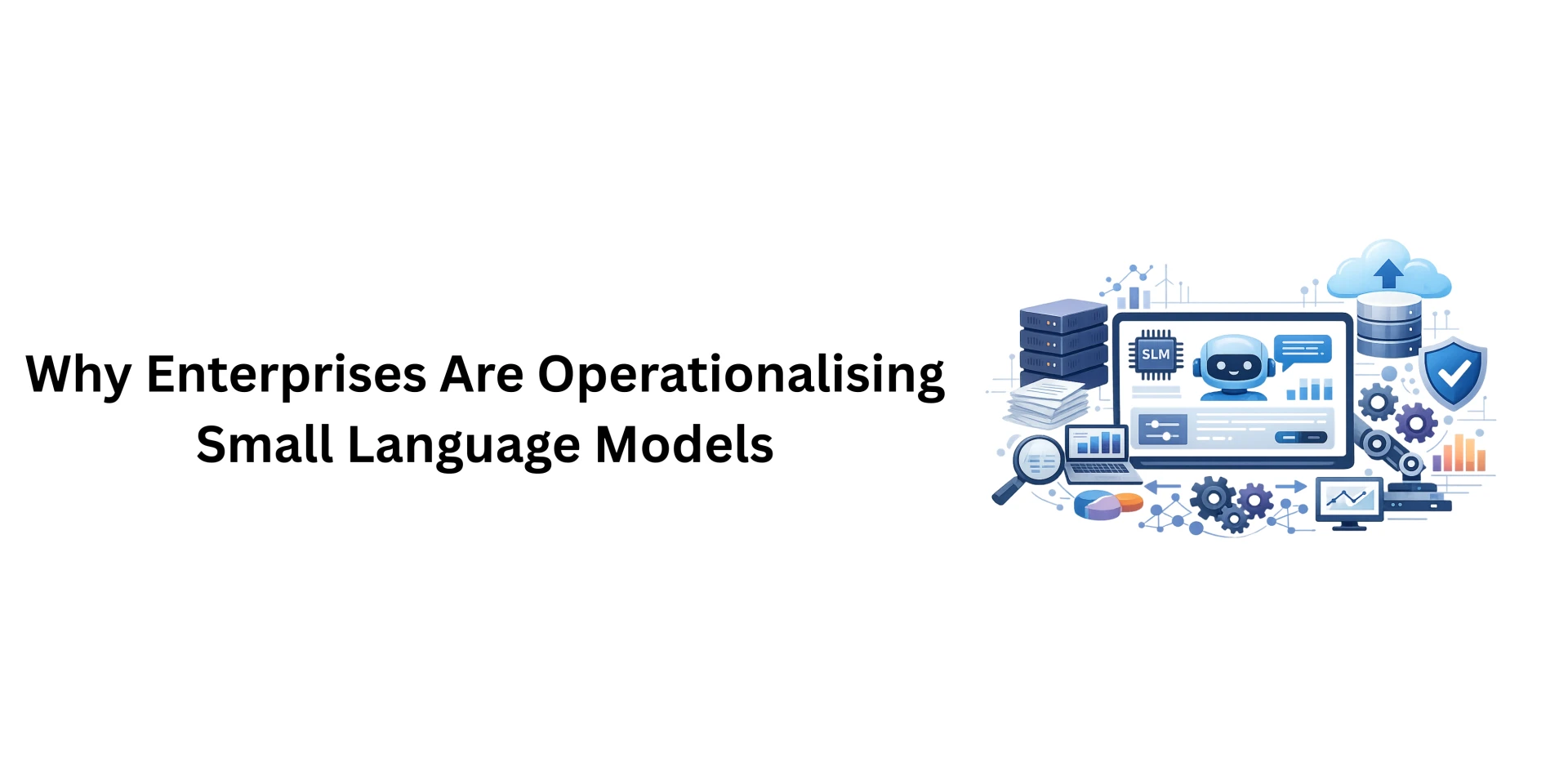

Businesses are quickly transitioning from AI experimentation to actual, production-level implementations. Small language models (SLMs) are currently being prioritised by many organisations for actual industrial application, even though large language models (LLMs) initially attracted attention. Cost effectiveness, security needs, and the necessity for dependable performance in specialised workflows are the main forces behind this change.
SLM deployment is becoming a viable option to operationalise AI without the complexity and cost of large models as companies concentrate on scalable AI initiatives.
What are Small Language Models?
"Small language models" are tiny AI models designed to do specific jobs efficiently. Unlike large general-purpose models, SLMs are designed for particular use cases such as document classification, customer assistance automation, knowledge retrieval, and workflow automation.
They can frequently be implemented within private infrastructure and require less processing power due to their lower size. Because of this, SLM deployment is very appealing to businesses that value operational control, privacy, and performance.
List of Reasons Enterprises Operationalizing Small Language Models
Lower Infrastructure and Inference Costs
Cost control is one of the main reasons businesses are operationalising SLMs. Due to high latency, cloud inference costs, and GPU needs, running large AI models at scale can quickly become costly.
SLM deployment, on the other hand, drastically lowers operating expenses. Smaller models can operate on normal enterprise infrastructure and require less computer power. As a result, businesses may expand AI applications without worrying about unforeseen cloud costs.
This cost advantage turns into a significant strategic advantage for businesses handling dozens or millions of AI interactions per day.
Improved Management of Enterprise Data
Data security and compliance remain top priorities for companies deploying AI technologies. Strict laws apply to several industries, such as finance, healthcare, and legal services.
With SLM implementation, organisations can host and run models within their own infrastructure or in secure environments. This ensures that confidential company data never gets out of secure networks.
By operationalising SLMs, businesses can better control how data is handled, stored, and accessed, a critical step in maintaining regulatory compliance.
Quicker Performance and Lower Latency
Enterprise AI systems often require real-time responses. Corporate knowledge assistants, customer support systems, and process automation solutions cannot afford long response times.
Because SLMs are more efficient and compact, they offer faster inference speeds. As a result, SLM implementation is ideal for production environments where responsiveness directly affects user experience and productivity.
Additionally, firms may incorporate AI more thoroughly into operational workflows without slowing down business processes thanks to lower latency.
Personalisation for Business Processes
The flexibility of small language models is another important benefit. Businesses typically require AI systems that are tailored to particular business tasks rather than a model that comprehends everything.
Organisations can tailor SLMs to comprehend internal documents, industry terminology, and workflow needs through targeted training and fine-tuning.
SLM deployment is very successful for jobs like compliance analysis, document summarisation, enterprise search, and automated reporting because of this degree of specialisation.
Adoption of Scalable and Useful AI
For many businesses, operationalising AI is more about implementing dependable solutions that provide quantifiable value than it is about creating the largest model.
SLMs give businesses a workable approach to integrate AI into regular operations. SLM adoption enables businesses to transition from testing to actual operational effect with controllable infrastructure requirements, robust data governance, and speedier performance.
Small language models are turning out to be the cornerstone of scalable, safe, and economical enterprise AI strategies as companies continue to incorporate AI into essential operations.
Sign in to leave a comment.