
Email remains one of the most important communication channels for businesses. Every day, organizations receive customer inquiries, sales requests, partnership proposals, invoices, internal discussions, and support tickets through email. While email is essential for business operations, managing a growing inbox manually has become increasingly difficult. Employees often spend hours reading, organizing, and replying to emails, leaving less time for strategic and revenue-generating work.
This is why more businesses are adopting AI Email Assistants. These intelligent tools use artificial intelligence to organize inboxes, draft accurate responses, prioritize urgent messages, and automate repetitive email tasks. Instead of replacing employees, AI acts as a productivity partner that helps teams work faster while maintaining high-quality communication.
Whether you're running a startup, a small business, or a large enterprise, investing in an AI Email Assistant can transform the way your organization handles email communication.
The Growing Challenge of Email Management
As businesses expand, the number of emails they receive grows significantly. Customer support teams must respond quickly to inquiries, sales teams need to follow up with leads, HR departments manage recruitment emails, and management handles communication with clients and partners.
When all these emails arrive in a single inbox, it becomes difficult to identify which messages require immediate attention. Important emails may be overlooked, response times increase, and employees spend valuable hours manually organizing conversations.
Traditional email filters can separate messages into folders, but they cannot understand the meaning or urgency behind an email. This is where AI makes a significant difference by analyzing the content and context of every conversation.
What Is an AI Email Assistant?
An AI Email Assistant is software powered by artificial intelligence and Large Language Models (LLMs) that helps businesses automate email management. Instead of simply filtering messages based on keywords, it understands the complete email thread, identifies the sender's intent, and performs actions based on that understanding.
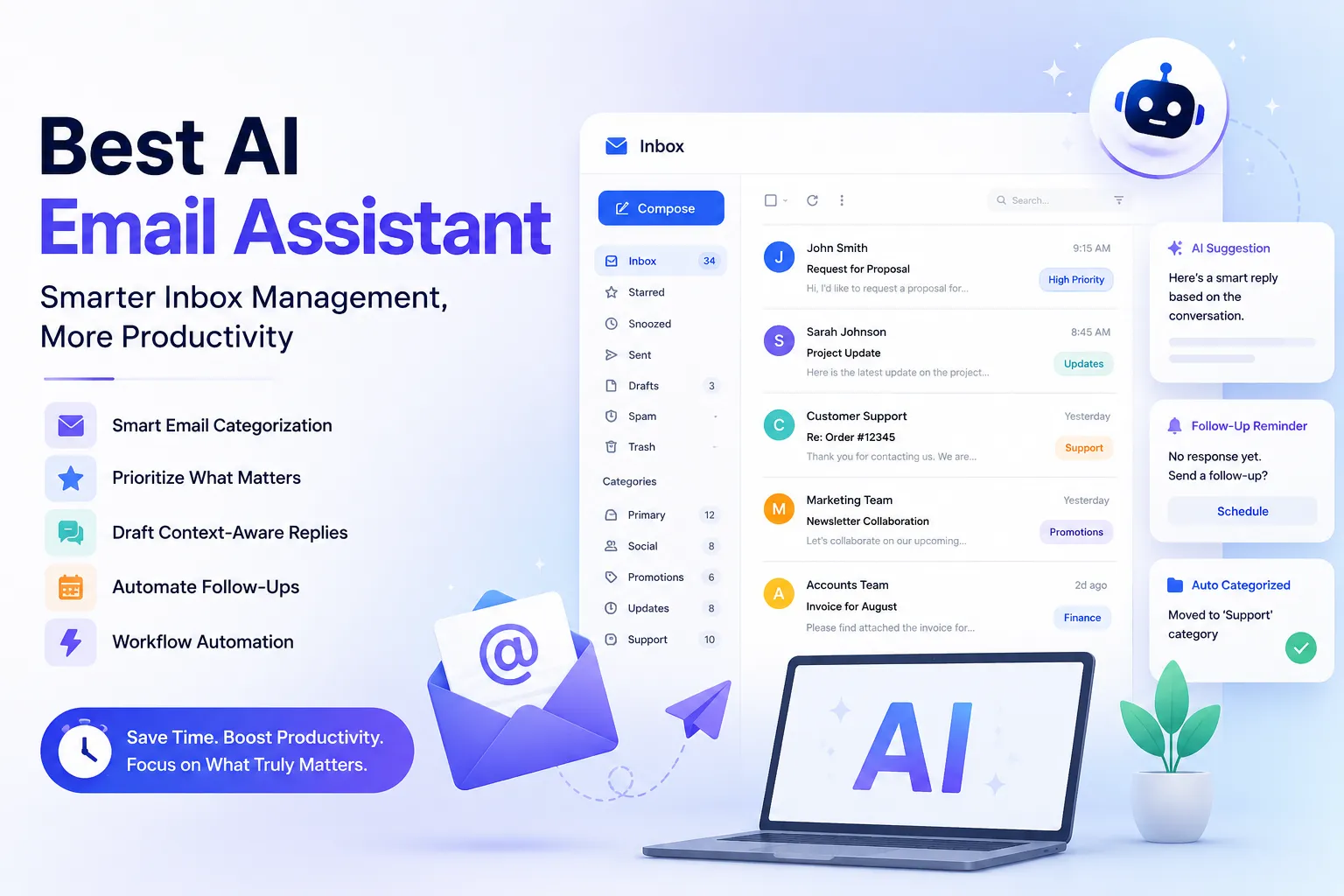
Modern AI email assistants can categorize emails, generate context-aware replies, prioritize urgent conversations, schedule follow-ups, and even trigger automated workflows. Many advanced solutions also include a human approval system, allowing employees to review AI-generated responses before they are sent.
This combination of automation and human oversight helps businesses improve efficiency without sacrificing communication quality.
How AI Email Assistants Improve Business Productivity
One of the biggest reasons businesses adopt AI email assistants is to reduce the time employees spend managing their inboxes. Rather than manually reading every email, AI automatically organizes messages into categories such as customer support, sales, finance, internal communication, or marketing.
This intelligent categorization makes inboxes easier to manage and helps employees locate important conversations quickly.
AI also identifies urgent emails by analyzing the message content, sender information, previous interactions, and conversation history. High-priority emails appear at the top of the inbox, ensuring that critical requests receive immediate attention while less urgent messages can be handled later.
By eliminating repetitive inbox management tasks, employees can focus on solving customer problems, closing sales, and completing high-value work.
Smarter Email Replies with Artificial Intelligence
Writing professional email responses takes time, especially when employees need to review long email threads before replying. AI Email Assistants simplify this process by analyzing the entire conversation and generating replies that match the context.
Instead of sending generic templates, AI creates personalized drafts that require only minor adjustments before sending. Businesses can also train the assistant using internal documentation, FAQs, product information, and brand guidelines so that every response maintains a consistent tone and delivers accurate information.
This not only improves productivity but also ensures customers receive faster and more professional communication.
Automating Repetitive Email Tasks
Many daily email activities are repetitive and consume unnecessary time. Customer support teams repeatedly answer common questions, sales teams send follow-up emails, and employees manually forward messages to the appropriate department.
AI Email Assistants automate these routine processes. They can send acknowledgment emails, schedule follow-ups, categorize incoming requests, create support tickets, notify internal teams, and route emails to the correct department automatically.
For example, if a customer asks about order tracking or password recovery, the AI assistant can instantly provide the appropriate response without waiting for a team member. This reduces response times while allowing employees to focus on complex customer interactions that require human expertise.
Choosing the Right AI Email Assistant
Not every AI Email Assistant offers the same capabilities. Before selecting a solution, businesses should clearly define their objectives. Some organizations need better customer support automation, while others focus on sales communication or internal collaboration.
It is also important to evaluate how accurately the AI understands conversations and generates responses. Testing the software through a free trial or live demonstration provides valuable insight into its real-world performance.
Integration is another critical factor. The ideal AI Email Assistant should connect seamlessly with platforms such as Google Workspace, Microsoft 365, CRM software, Slack, help desk systems, and other productivity tools already used by your organization.
Finally, businesses should prioritize solutions that provide strong security features, encrypted communication, role-based access, and compliance with industry standards to protect sensitive business information.
Why Businesses Are Moving Toward AI-Powered Communication
The role of artificial intelligence in business communication continues to grow. Companies are no longer using AI simply to save time—they are adopting it to improve customer experiences, increase employee productivity, and build more efficient communication systems.
AI Email Assistants help organizations respond faster, reduce manual workloads, maintain consistent messaging, and manage increasing email volumes without expanding their teams. As AI technology continues to evolve, businesses that adopt intelligent email automation today will be better prepared to handle future communication challenges.
Solutions like Triage by Antigravity Apps demonstrate how AI can simplify inbox management by combining intelligent automation with human oversight. This approach allows businesses to automate repetitive email tasks while maintaining complete control over customer communication.
Conclusion
Managing email manually is becoming increasingly difficult as businesses grow and communication volumes continue to rise. Employees spend valuable time organizing inboxes, writing repetitive responses, and tracking follow-up emails instead of focusing on meaningful business activities.
An AI Email Assistant solves these challenges by intelligently organizing inboxes, prioritizing important messages, generating context-aware replies, automating repetitive workflows, and improving response times. Rather than replacing employees, AI empowers teams to communicate more efficiently and deliver better customer experiences.
For businesses looking to improve productivity, reduce manual effort, and modernize their communication process, adopting an AI Email Assistant is no longer just an advantage—it is becoming a necessity for long-term business success.






















Sign in to leave a comment.