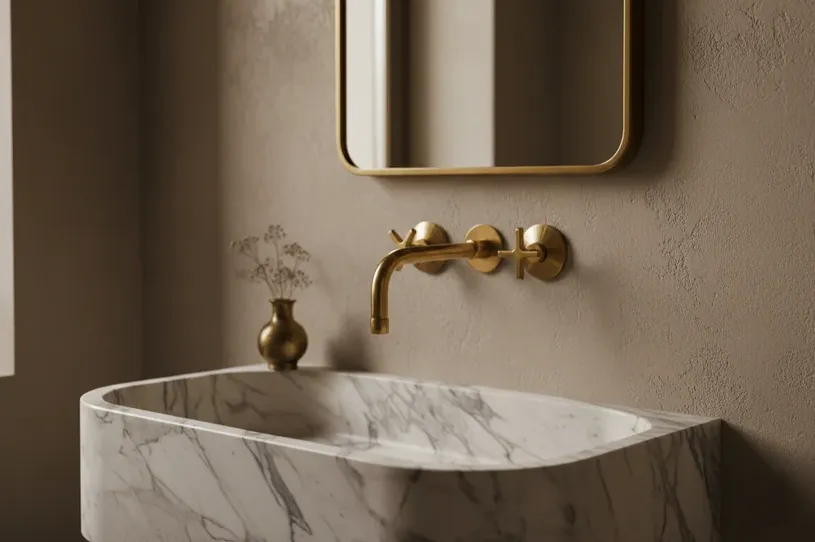

Walk into most big-box showrooms and every faucet on the wall looks the same: identical finish, identical shine, identical everything. That's not an accident — it's the entire point of mass production. But it's also exactly why those fixtures rarely age well, and why more homeowners are turning to handmade alternatives, especially when it comes to modern brass bathroom faucets, for something with real substance behind it.
Here's what actually separates a handmade brass faucet from something stamped out on an assembly line.
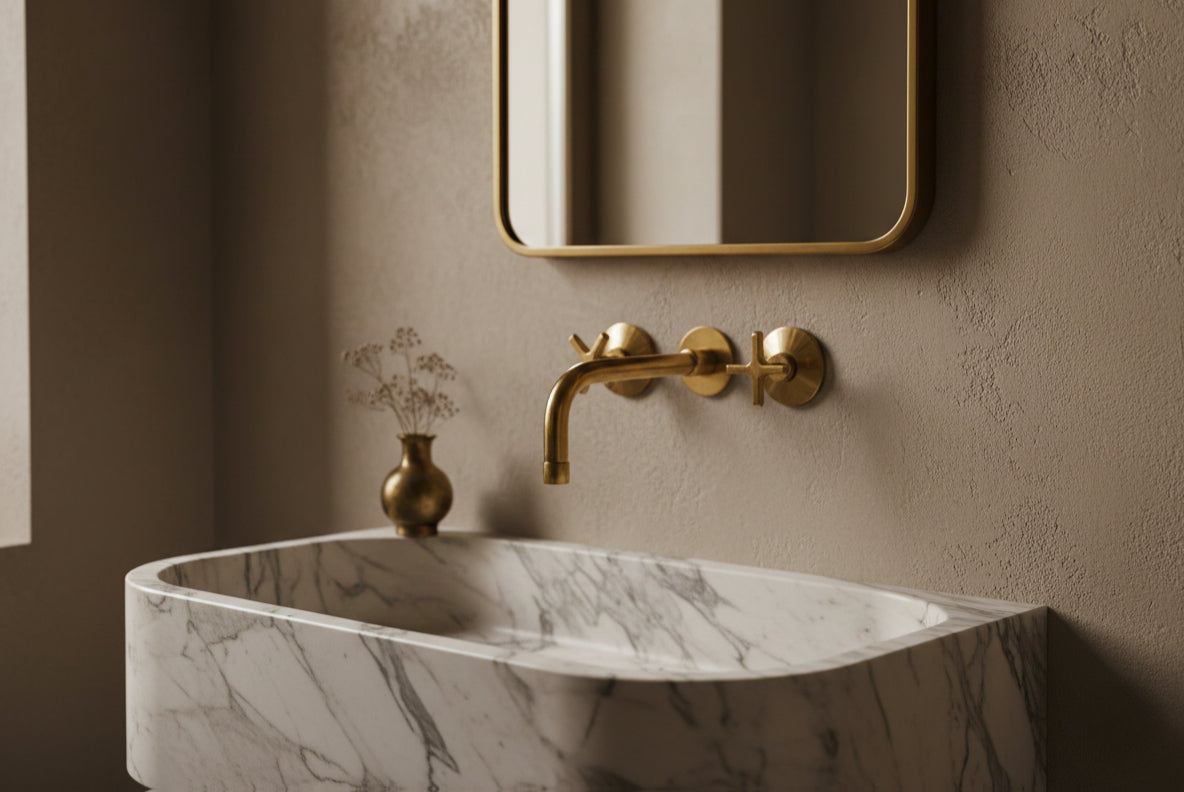
1. Solid Material vs. Plated Coating
Most mass-produced "brass" fixtures aren't solid brass at all. They're zinc alloy or steel with a thin brass-colored coating sprayed or plated on top. That coating can chip, flake, or wear through within a year or two, exposing the dull metal underneath.
Handmade fixtures, by contrast, are cast from solid brass all the way through. There's no coating to fail because there's nothing hiding underneath it — what you see is what the entire piece is made of. This is one of the biggest reasons well-made modern brass bathroom faucets simply hold up longer than their mass-produced counterparts.
2. Built to Patina, Not to Fake It
Mass-produced fixtures are often lacquered to lock in a uniform, factory-fresh shine. The problem is that lacquer degrades unevenly over time — cracking, yellowing, or peeling in patches, which looks far worse than natural wear ever would.
Hand-finished, unlacquered brass is designed to do the opposite: it's meant to darken and develop character with use. Every water spot and fingerprint becomes part of a finish that deepens rather than deteriorates. It's a feature that mass production can't replicate, because it requires real, untreated brass and time — not a factory coating.
3. Individual Craftsmanship vs. Identical Copies
A mass-produced faucet is engineered to be indistinguishable from the next thousand units off the line. A handmade piece, cast and finished by an individual artisan, carries small variations — a slightly different hammer mark, a subtle asymmetry — that make it genuinely one of a kind.
This is especially true of pieces made using traditional techniques, like the hand-cast, hand-finished modern brass bathroom faucets produced by artisans in Morocco, where each fixture passes through skilled hands rather than a machine press. That human touch is precisely what gives handmade brass its depth and warmth compared to anything stamped from a mold.
4. Better Internal Components
Cutting corners on the visible finish is often paired with cutting corners inside the fixture — cheaper valves, thinner threading, and seals that wear out fast. Mass-produced fixtures are frequently built to a price point, not a lifespan.
Artisan-made brass faucets, on the other hand, tend to be built by makers who take as much pride in the internals as the exterior, since a beautifully finished faucet that leaks in six months isn't a good faucet at all. Solid brass construction also naturally resists corrosion better than plated alternatives, which means fewer replacements down the line.
5. A Story Behind the Object
There's also something mass production simply can't offer: provenance. A handmade fixture comes from a place, a tradition, and a person — not a factory line. That story adds a layer of value that goes beyond function, turning a bathroom fixture into a small piece of craft history in your home.
The Bottom Line
Mass production optimizes for speed and uniformity. Handmade brass optimizes for durability, individuality, and a finish that actually improves with age. If you're weighing options for a renovation, it's worth remembering that the cheaper, shinier faucet on the shelf often costs more in the long run — in replacements, in flaking finishes, and in a look that never quite feels special.




















Sign in to leave a comment.