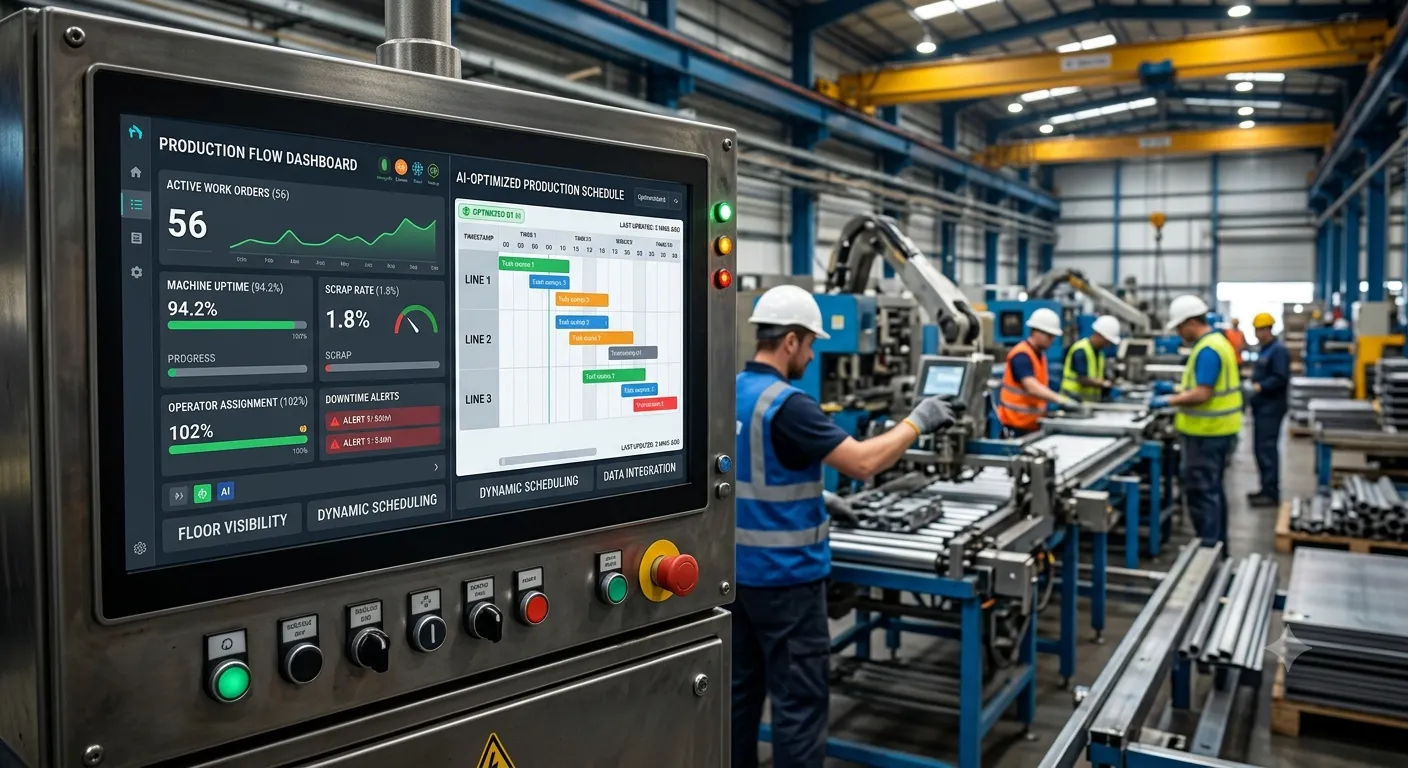

Manufacturers are moving past pilot projects and into production-grade digital systems. Shop-floor data, quality traces, predictive maintenance signals, and supply-chain events all need to flow into applications that operators and managers can actually use. The conversation has shifted from whether digital tools work to how quickly and reliably they can be built, integrated, and scaled.
In my experience working with industrial clients, the combination of MongoDB, Express.js, React, and Node.js consistently removes friction that older multi-language stacks introduce. Below I address the questions manufacturing technology leaders ask most often when they evaluate hiring dedicated MERN talent.
Why does the manufacturing sector need modern web stacks now?
Legacy MES and ERP interfaces were rarely designed for continuous data streams from sensors, PLCs, and IoT gateways. Operators still need clear, responsive screens; planners need live inventory and order status; quality teams need traceable records that update in near real time.
A single-language JavaScript stack reduces hand-offs between front-end and back-end teams. That matters when a production line change must be reflected in the dashboard the same day. Node.js handles concurrent connections without blocking, which is essential for dashboards that stream machine telemetry. MongoDB stores both structured production records and the semi-structured event data that IoT devices generate, eliminating the constant schema gymnastics that relational systems often impose.
Hidden Brains has delivered manufacturing software development services for Industry 4.0 programs that combine industrial automation, cloud, MES, and IoT. The same principles apply whether the system is a full MES layer or a modular production-management module.
What makes the MERN stack a strong fit for industrial software?
Four characteristics stand out for manufacturing workloads:
- Unified JavaScript across the stack. Developers move between UI components and API endpoints without switching languages or mental models. Code reviews cover the full request path. Onboarding is faster when the same language is used everywhere.
- Component-driven React interfaces. Reusable components for work-order cards, OEE gauges, quality alerts, and equipment status keep the front end consistent and maintainable as new production cells are added.
- Flexible document storage. MongoDB’s document model maps naturally to bills of materials, process recipes, quality inspection results, and sensor time-series collections. Schema evolution does not require multi-week migration projects.
- Real-time capability. Node.js and modern React patterns support live updates for floor-control screens, exception alerts, and collaborative planning boards without the overhead of older polling architectures.
These traits directly support the capabilities listed under Hidden Brains’ manufacturing offerings: resource planning and allocation, product order management, product quality control and traceability, predictive maintenance, and complete floor-control management.
How does MERN support real-time production and supply-chain systems?
Manufacturing systems rarely live in isolation. They exchange data with ERP, WMS, quality systems, and external suppliers. MERN’s HTTP-first design and JSON-native data flow simplify those integrations.
In practice I see three patterns that work well:
- Shop-floor control and MES layers. React dashboards consume live streams from Node.js services that aggregate PLC and IoT data stored in MongoDB. Operators see order progress, equipment status, and quality holds without leaving a single interface.
- Supply-chain visibility. Document models hold supplier data, shipment events, and demand signals. APIs expose the same data to partner portals so that exception management and demand-supply matching become near real-time rather than daily batch processes.
- Predictive and analytical views. MongoDB time-series collections feed Node.js workers that surface failure probabilities and recommended maintenance windows. React charts and alert panels present the results to maintenance and production managers.
Because the entire stack speaks JSON, the transformation cost between layers stays low. That reduces latency and the number of integration points that can break when a new machine or supplier is added.
When should manufacturers hire dedicated MERN stack developers?
Hire dedicated MERN talent when any of the following conditions apply:
- The existing internal team is already stretched across multiple languages and cannot absorb a new full-stack initiative without delaying other programs.
- The project requires rapid iteration on operator-facing interfaces while simultaneously hardening back-end services for continuous operation.
- Integration with existing MES, ERP, or IoT platforms must happen in parallel with new feature development.
- The organization wants a single, accountable team that owns the full stack rather than coordinating separate front-end and back-end vendors.
Hidden Brains’ hire remote MERN stack developers model is built for exactly these situations. Clients can onboard pre-vetted remote talent within 3–5 days. Engagement models range from dedicated developers to full project teams, giving manufacturing IT leaders control over cost and velocity.
The same engagement can cover enterprise web applications, API development, migrations from legacy platforms, and ongoing maintenance so that the system remains current as production requirements evolve.
What results can manufacturers expect from a focused MERN engagement?
From the manufacturing programs I have observed, the measurable outcomes cluster around three areas:
- Faster delivery of usable interfaces. Unified JavaScript and component reuse shorten the cycle from requirements to operator-ready screens.
- Lower long-term maintenance cost. One language and one data format reduce the specialist headcount needed to keep the system running and evolving.
- Tighter integration with Industry 4.0 data sources. Document storage and non-blocking I/O make it practical to keep production, quality, and supply-chain views synchronized.
Hidden Brains has been delivering software solutions since 2003. The company holds CMMI Level 3, ISO 9001:2015, and ISO/IEC 27001:2022 certifications, providing process and security baselines that industrial clients require. Teams work against the concrete manufacturing capabilities listed on the Manufacturing Software Development Services page—production management, supply-chain management, MES functions, inventory optimization, and BI & analytics—so that the technical stack remains subordinate to operational outcomes.
If you are evaluating how a MERN-based approach would map onto your current production and supply-chain systems, feel free to reach out. A short technical discussion is usually enough to identify where dedicated MERN developers would deliver the highest return.
Deploy applications for your manufacturing operations with a remote MERN team that can be onboarded within 3–5 days.























Sign in to leave a comment.