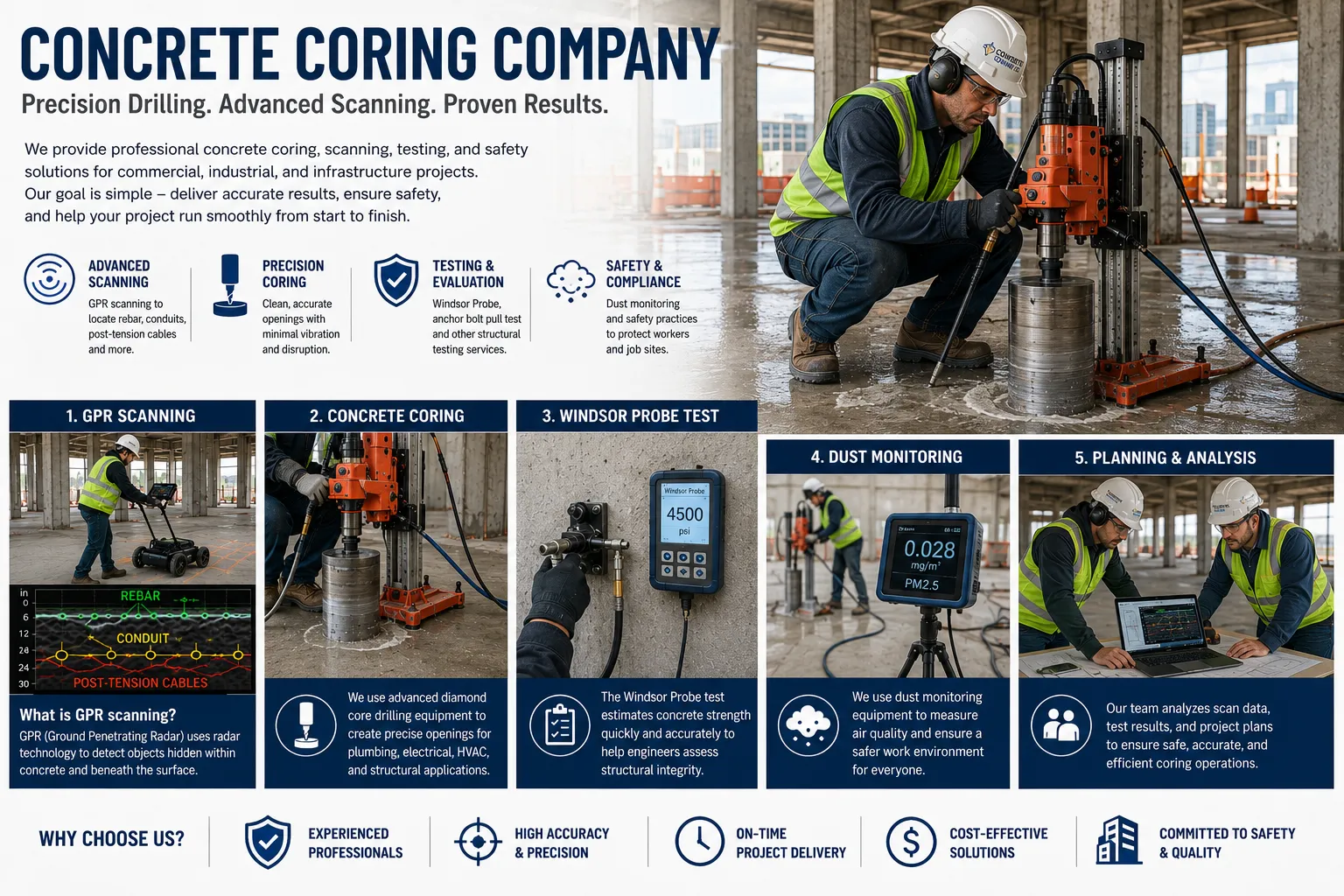
A professional concrete coring company plays a critical role in modern construction by providing precise drilling, structural investigation, and safety-focused solutions for commercial, industrial, and infrastructure projects. From understanding what is GPR scanning to using technologies such as the Windsor Probe and advanced dust monitoring systems, experienced coring specialists help contractors complete projects safely, efficiently, and with minimal risk to existing structures.
The Growing Importance of Concrete Coring in Construction
Construction and renovation projects often require modifications to existing concrete structures. Whether installing plumbing, electrical conduits, HVAC systems, or communication networks, creating openings in concrete must be done with precision.
Concrete coring uses diamond-tipped drilling equipment to create clean, circular openings without causing excessive vibration or structural damage. Unlike traditional demolition methods, coring provides a controlled solution that preserves structural integrity while meeting project requirements.
Today, concrete coring is used in:
- Commercial building renovations
- Healthcare facilities
- Manufacturing plants
- Educational institutions
- Transportation infrastructure
- Government facilities
As projects become more complex, hiring a qualified concrete coring company has become essential for both safety and efficiency.
What Does a Concrete Coring Company Do?
A concrete coring company specializes in drilling precise openings through concrete walls, floors, ceilings, foundations, and structural components.
Services typically include:
Core Drilling
Diamond core drilling creates smooth openings for:
- Plumbing systems
- Electrical conduits
- Fiber optic installations
- HVAC equipment
- Mechanical upgrades
Concrete Scanning
Before drilling begins, technicians inspect concrete structures to locate hidden hazards.
Structural Testing
Many coring companies also perform testing and evaluation services to help engineers assess structural conditions.
Safety and Compliance Support
Professional contractors follow industry standards to reduce risks and maintain regulatory compliance.
What Is GPR Scanning and Why Is It Important?
Understanding GPR Technology
One of the most common questions in construction is: What is GPR scanning?
Ground Penetrating Radar (GPR) is a non-destructive technology that uses electromagnetic waves to identify objects hidden within concrete and subsurface materials.
GPR scanning can detect:
- Reinforcing steel (rebar)
- Post-tension cables
- Electrical conduits
- Plumbing lines
- Voids
- Embedded objects
Practical Example
Imagine a contractor preparing to install new plumbing lines through a post-tension concrete slab.
Without scanning, drilling could strike a tension cable and cause significant structural damage. GPR scanning identifies the cable location beforehand, allowing the drilling team to adjust the coring path safely.
This proactive approach reduces risks, prevents costly repairs, and protects project schedules.
Benefits of GPR Scanning
- Improved worker safety
- Reduced structural damage
- Faster project planning
- Lower repair costs
- Better decision-making
For modern construction projects, GPR scanning is considered a best practice before any cutting, coring, or demolition activity.
The Role of the Windsor Probe in Structural Evaluation
What Is a Windsor Probe?
The Windsor Probe is a testing method used to estimate the compressive strength of hardened concrete.
The process involves driving a specially designed probe into the concrete surface and measuring its penetration depth. The resulting data helps engineers assess concrete quality and strength.
Why Contractors Use Windsor Probe Testing
Engineers often use Windsor Probe testing when:
- Evaluating existing structures
- Verifying concrete strength
- Assessing aging buildings
- Supporting rehabilitation projects
- Investigating structural performance
Practical Example
A warehouse owner plans to install heavy industrial equipment on an older concrete slab.
Before proceeding, engineers use a Windsor Probe test to determine whether the slab can safely support the new loads. The results provide valuable information for project planning and risk management.
Dust Monitoring: A Critical Safety Component
Why Dust Monitoring Matters
Concrete drilling, cutting, and coring can generate airborne dust particles. Some of these particles may contain respirable crystalline silica, which presents health risks when inhaled over extended periods.
This is where dust monitoring becomes essential.
Dust monitoring measures airborne particle concentrations and helps ensure compliance with workplace safety standards.
Benefits of Dust Monitoring
- Improved worker health protection
- Regulatory compliance
- Reduced environmental impact
- Better jobsite safety
- Enhanced project documentation
Modern Dust Control Practices
Professional concrete coring companies often combine dust monitoring with:
- Wet drilling techniques
- Vacuum collection systems
- Air quality assessments
- Personal protective equipment (PPE)
These measures help create safer working environments while maintaining operational efficiency.
Why Experience Matters When Choosing a Concrete Coring Company
Not all contractors have the same level of expertise.
An experienced concrete coring company provides:
Advanced Equipment
Modern drilling systems deliver greater accuracy and efficiency.
Skilled Technicians
Experienced operators understand structural considerations and project-specific requirements.
Integrated Scanning and Testing
Combining GPR scanning, Windsor Probe testing, and coring services creates a comprehensive approach to project safety.
Strong Safety Programs
Established companies prioritize safety training, documentation, and regulatory compliance.
Real-World Applications of Concrete Coring
Healthcare Facilities
Hospitals often require new utility penetrations while maintaining uninterrupted operations.
Commercial Buildings
Office renovations frequently involve coring for plumbing, electrical, and HVAC upgrades.
Industrial Facilities
Manufacturing plants rely on precise drilling for equipment installation and infrastructure improvements.
Infrastructure Projects
Bridges, tunnels, airports, and transportation systems use coring for maintenance and modernization projects.
Future Trends in Concrete Coring and Structural Investigation
Technology continues to transform the construction industry.
Emerging innovations include:
- AI-assisted scan interpretation
- 3D subsurface mapping
- Digital project documentation
- Advanced radar imaging
- Real-time dust monitoring systems
- Automated reporting platforms
These advancements improve efficiency while supporting safer construction practices.
Key Takeaways
- A professional concrete coring company provides precise drilling solutions for construction and renovation projects.
- Understanding what is GPR scanning helps project teams appreciate the importance of locating hidden hazards before drilling.
- Windsor Probe testing helps evaluate concrete strength and structural performance.
- Dust monitoring protects workers and supports regulatory compliance.
- Combining scanning, testing, and coring improves project safety, accuracy, and efficiency.
- Experienced contractors reduce risks and help prevent costly construction mistakes.
Conclusion
A qualified concrete coring company delivers much more than drilling services. Through advanced technologies such as GPR scanning, Windsor Probe testing, and dust monitoring, these specialists help construction teams make informed decisions while protecting structures, workers, and project budgets. As construction projects become increasingly complex, investing in experienced professionals and proven technologies remains one of the most effective ways to ensure successful outcomes.
Frequently Asked Questions
1. What is a concrete coring company?
A concrete coring company specializes in drilling precise openings in concrete structures using diamond core drilling equipment.
2. What is GPR scanning?
GPR scanning uses radar technology to locate hidden objects within concrete and subsurface materials.
3. Why is GPR scanning important before coring?
It helps identify rebar, conduits, post-tension cables, and other embedded elements before drilling.
4. What is the Windsor Probe used for?
The Windsor Probe is used to estimate the compressive strength of hardened concrete.
5. Is Windsor Probe testing destructive?
It is generally considered a semi-destructive testing method because it creates small probe penetrations.
6. What is dust monitoring in construction?
Dust monitoring measures airborne particles generated during construction activities to protect worker health.
7. Why is dust monitoring important during concrete coring?
It helps reduce exposure to harmful dust and supports compliance with safety regulations.
8. Can concrete coring damage structural elements?
When combined with proper scanning and planning, coring can be performed safely with minimal structural impact.
9. What industries commonly use concrete coring services?
Construction, healthcare, manufacturing, infrastructure, education, and government sectors frequently use coring services.
10. How do I choose the right concrete coring company?
Look for experience, advanced equipment, safety programs, scanning capabilities, and a strong reputation for quality work.
























Sign in to leave a comment.