
There's a moment on every construction site that separates experienced teams from the rest. It's not when the heavy equipment arrives. It's not when the concrete gets poured. It's the quiet moment before any of that — when someone asks, "Do we actually know what's inside this structure?" The answer today lives in gpr concrete scanning, precision drilling, and verified anchor testing — three disciplines that have quietly become non-negotiable on serious job sites.
That question used to be answered with old blueprints, educated guesses, and a fair amount of luck. Today, it's answered with technology, data, and a disciplined approach to pre-work investigation. Concrete core drilling companies and ground penetrating radar service providers like ConcreteInsight are changing the way construction professionals think about concrete, safety, and due diligence — and pull test anchors verification is the final piece that proves the work was done right.
This post is for the project managers, structural engineers, facility directors, and site supervisors who want to understand exactly what modern concrete investigation looks like — and why skipping it is one of the most expensive mistakes a team can make.
The Problem With Concrete Is That You Can't See Through It
Concrete is one of the most trusted materials in construction history. It's strong, durable, and versatile. It's also completely opaque. And inside virtually every concrete slab, wall, column, or foundation, there's a hidden network of reinforcing steel, post-tension cables, electrical conduits, plumbing lines, and sometimes voids or honeycombing that no one documented properly.
When crews cut, core, or drill into concrete without knowing what's there, the results range from inconvenient to catastrophic. Severed post-tension cables can cause immediate structural compromise. Damaged conduits mean electrical hazards and expensive remediation. Nicked rebar leads to corrosion pathways that weaken a structure for years. None of these outcomes are acceptable — and all of them are entirely preventable.
That's the fundamental case for gpr concrete scanning: see what's there before you touch it.
What GPR Concrete Scanning Actually Does
Ground-penetrating radar works by emitting high-frequency radio waves into a concrete surface and measuring what reflects back. Different materials — steel, air, plastic, water — each return a distinct signal. A trained technician reads those signals in real time, building a picture of everything embedded in the concrete up to several inches deep.
GPR concrete scanning is non-destructive, which means no damage to the structure during investigation. It's fast — a typical slab can be scanned in a fraction of the time traditional investigative methods would take. And it's accurate enough to locate rebar at specific depths, identify conduit runs, flag post-tension cables, and detect internal voids that might otherwise go unnoticed until they become a serious structural problem.
ConcreteInsight operates ground penetrating radar service on commercial, industrial, and infrastructure projects of all scales. From a single-room renovation requiring a few core holes to a multi-floor hospital expansion with hundreds of penetrations planned, their ground penetrating radar service delivers the site intelligence teams need to proceed with confidence. The data doesn't just get collected — it gets interpreted, documented, and communicated clearly to everyone involved in the project.
Core Drilling: Where Precision Meets Execution
Scanning tells you what's there. Core drilling is what happens next — and it needs to happen with the same level of care and precision.
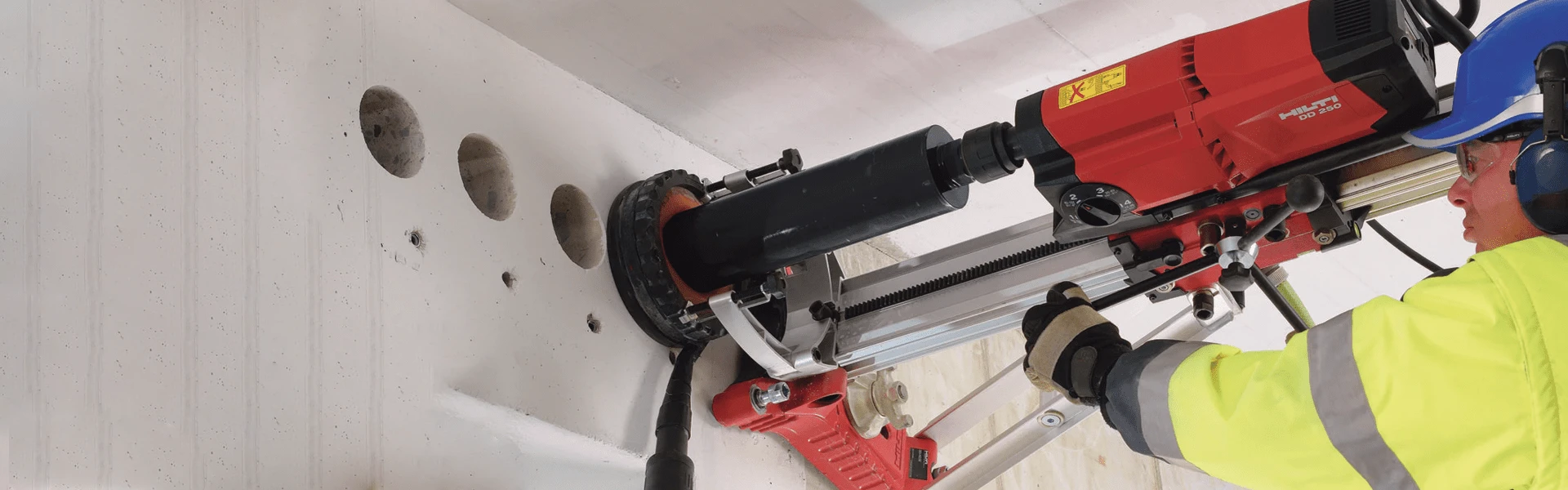
Concrete core drilling companies handle the physical creation of circular openings through concrete for mechanical, electrical, plumbing, and structural purposes. The applications are everywhere: drain lines through basement slabs, conduit pathways through walls, anchor installation holes, HVAC penetrations, and structural sample extraction for compressive strength testing.
What separates good concrete core drilling companies from average ones isn't just equipment — it's integration. The best teams don't treat scanning and drilling as two separate jobs handed off between contractors. They treat them as one continuous workflow. ConcreteInsight operates exactly this way. Their drilling crews work from the scan data, not around it. Every hole location is informed by what the GPR revealed. Every depth is planned. Every cut is deliberate.
That integration eliminates the single biggest risk in core drilling: surprise. No unexpected rebar strikes mid-drill. No conduit damage halfway through a wall. Just clean, precise, planned penetrations completed on schedule and within scope.
ConcreteInsight's core drilling capability spans a wide diameter range and handles reinforced slabs, post-tensioned decks, and heavily congested concrete that would stop less experienced crews cold. Horizontal drilling, angled drilling, overhead work — their teams are equipped and trained for the full range of site conditions.
Pull Test Anchors: The Step That Proves Everything
Here's where a lot of projects get sloppy — not out of negligence, but because the work looks done. The anchors are installed. The epoxy has cured. Everything seems solid. Why would you need to test?
Because appearances don't transfer loads. Verified performance does.
Pull test anchors — formally known as anchor pull testing or tensile load testing — apply a calibrated force to an installed anchor to confirm it can carry its specified load without failure or excessive displacement. The test is simple in concept: a hydraulic device pulls on the anchor with a predetermined load, and the result is documented. Pass or fail. Load achieved or not.
The reasons an anchor might fail a pull test are numerous: contaminated holes that prevented proper epoxy bonding, incorrect installation depth, base concrete that's weaker than specified, or product that wasn't suited to the application. None of these failures are visible to the naked eye. All of them are revealed by pull test anchors testing before the structure goes into service.
ConcreteInsight conducts anchor pull testing to project specifications and applicable standards, documenting every test with load values, displacement readings, pass/fail results, and photographic records. For safety-critical installations — overhead supports, seismic restraints, façade anchors, heavy equipment mounts — this documentation isn't optional. It's the paper trail that proves the work was done right.
Why Integration Is the Real Advantage
The strongest argument for working with ConcreteInsight isn't any single service. It's the way those services connect.
GPR concrete scanning informs the drilling. The drilling creates clean, accurate holes for anchor installation. Pull test anchors verification confirms the anchors perform as specified. Each phase feeds the next, and the team executing the work carries knowledge from one stage into the other.
That continuity is rare. Most projects involve separate subcontractors for each phase — a scanning company, a drilling crew, an independent testing firm. Each handoff is a potential gap: in communication, in documentation, in accountability.
ConcreteInsight closes those gaps. One point of contact. One coordinated team. One complete record of the investigation, execution, and verification.
If your next project involves any work on or through concrete — and most projects do — the smartest investment you can make is in knowing exactly what you're dealing with before the work begins. ConcreteInsight brings gpr concrete scanning, precision work from experienced concrete core drilling companies, trusted ground penetrating radar service, and rigorous pull test anchors verification together in a single, seamless engagement.

























Sign in to leave a comment.