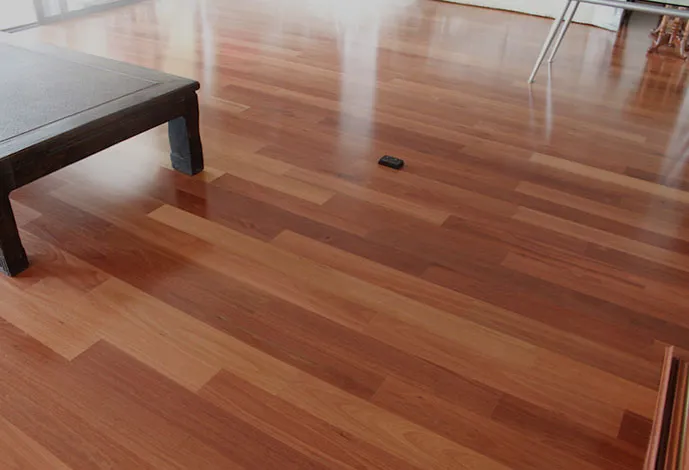

Here's the thing about buying laminate flooring — it looks like a simple decision until you're actually standing in a showroom (or scrolling through a website at midnight) trying to figure out why two products that look almost identical are priced $20 per square metre apart.
Nobody explains the stuff that actually matters. The sales pitch focuses on how good it looks. The product listing gives you numbers without context. And by the time you've installed it and something goes wrong, it's a bit late to ask questions.
So here's what I wish someone had explained upfront.
The AC rating is the number that actually matters
Most first-time buyers focus on thickness and price. Understandable — but the number that really tells you how long a laminate floor will hold up is the AC rating.
AC stands for Abrasion Class. It's a standardised rating system that measures how resistant the wear layer is to scratching, scuffing, and general foot traffic. The scale runs from AC1 to AC5, and the difference is significant.
AC1 and AC2 are for very light residential use — think a spare bedroom that gets used twice a year. AC3 is the minimum for a proper living area. AC4 is what you want for busy households, hallways, and anywhere that sees real daily traffic. AC5 is commercial grade — it's tough, but you're probably not running a supermarket.
For most Australian homes? AC4 is the sweet spot. Products like the Cottage Oak Long Boards with AC4 wear layer sit at this level and will handle a normal household without showing premature wear. Buying AC2 because it's cheaper and then wondering why it looks scratched after 18 months is one of the most common first-timer mistakes.
8mm or 12mm — and why it's not really about durability
People assume thicker means better. It's a reasonable assumption. But the wear layer — which is what determines scratch resistance — is the same thickness regardless of whether the board is 8mm or 12mm. The extra thickness in a 12mm board is mostly HDF core, not wear surface.
What the extra thickness actually gives you is a better underfoot feel (12mm is noticeably less "hollow" sounding when you walk on it), better tolerance for minor subfloor imperfections, and slightly better thermal and acoustic insulation.
For a room with a very flat, smooth subfloor, 8mm is fine and it'll cost you less. For an older home where the subfloor has some variation, or for anyone who finds the tap-tap-tap of a thin laminate annoying, 12mm is worth the extra spend. The 12mm Calm Collection range at $23/m² is a good example of what's available at the mid-range without going premium.
Underlay is not optional — and the cheap stuff costs you later
The laminate itself gets most of the attention and budget. The underlay gets treated like an afterthought. This is backwards.
A good underlay does three things: it provides a moisture barrier between your slab and the floor (critical on concrete), it cushions the boards to reduce that hollow sound, and it smooths over very minor subfloor variation so the floor sits flat.
Buy the wrong underlay and you'll end up with a floor that sounds like a drum, one that shifts because there's nothing holding it stable, or — worst case — one that starts to lift and warp because moisture crept up from below.
The Floor Depot stocks underlay specifically matched to floating floors — ask which one suits the product you've chosen before you checkout. It's a $5/m² decision that protects a $20/m² investment.
The expansion gap is real and you can't skip it
Every piece of laminate flooring installation advice mentions expansion gaps. Most first-timers nod along and then push the boards right up against the skirting anyway.
Laminate is a floating floor — it expands and contracts with temperature and humidity. If there's no gap at the perimeter, the floor has nowhere to go. In summer, when a Melbourne house heats up, that floor will buckle. Not might buckle. Will buckle.
The gap should be 8–10mm around the entire perimeter — against every wall, every door frame, every fixed cabinet. It gets covered by skirting or scotia trim so you won't see it once the room is finished. But it has to be there.
Clearance stock is often genuinely excellent — with one condition
The Floor Depot is a clearance outlet. A lot of the laminate on the site is end-of-line or manufacturer overstock — meaning it's the same quality product, just no longer being made in that colourway or spec. That's why prices like $17/m² exist for something like the Ovation Oak 12mm.
The one condition: make sure there's enough stock to cover your job — plus 10% for cuts and waste. Clearance stock doesn't get restocked. If you underorder and run short, you might not be able to match it later. Measure carefully, add your buffer, and order it all at once.
That's really the only catch with clearance flooring. Otherwise, it's just a good deal.
The Floor Depot's laminate flooring range starts from $15/m² with free samples available — $3 shipping. Preston showroom open Tuesday and Thursday 9am–5pm, Saturday by appointment.






















Sign in to leave a comment.