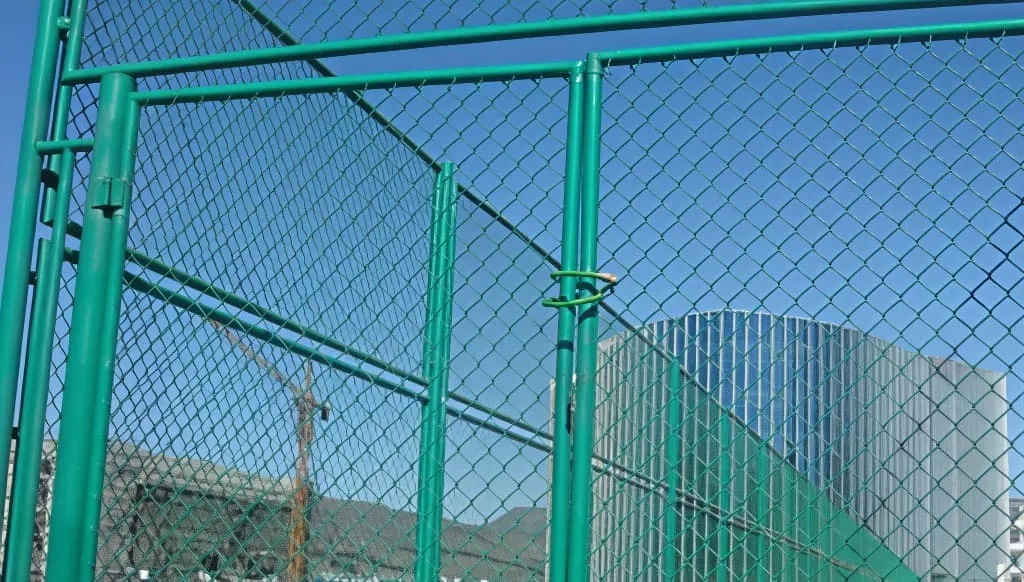

Chain link and welded wire are the two most widely used wire fencing formats across residential, commercial, agricultural, and industrial applications. From a distance they can look similar — both are metal mesh, both are cost-effective, both are durable. Up close, the differences in how they're constructed translate into meaningfully different performance characteristics depending on what the fence needs to do.
Here's a clear comparison of both formats across the factors that actually determine which one is right for a specific project.
How They're Made: The Core Difference
Chain link fence is made from a single continuous wire woven in a spiral pattern to create interlocking diamond-shaped openings. The resulting fabric is flexible — it can be bent, stretched, and manipulated without breaking. This flexibility is both a structural characteristic and an installation advantage.
Welded wire fence is made from individual wires arranged in a grid pattern — horizontal and vertical wires crossing at right angles — and fused together at each intersection point. The resulting panel is rigid. It holds its shape under pressure and doesn't flex the way chain link does.
This fundamental difference in construction — flexible vs rigid — drives most of the practical differences between the two products.
Security and Structural Integrity
For applications where security against forced entry is the primary concern, welded wire panels offer an advantage. The rigid construction means the fence panel holds its shape under lateral force — pushing against a welded wire panel distributes the force across multiple weld points simultaneously, making the fence harder to deform or push through.
Chain link fence is flexible and can be pushed or pulled to create temporary gaps if the fence is not tensioned correctly, or if the wire gauge is lighter than the security requirement demands. For high-security applications, a heavier gauge chain link with proper tensioning significantly reduces this vulnerability — but at equivalent wire gauges, welded wire is generally considered more resistant to deformation.
For low-to-medium security applications — residential perimeters, agricultural boundaries, sports fields, school playgrounds — the security difference between the two is largely academic. Both provide effective deterrence at appropriate specifications.
Flexibility and Terrain Adaptability
This is where chain link fence has a clear practical advantage.
Chain link fabric can follow uneven terrain — sloping ground, contoured landscapes, irregular boundary lines — by racking the mesh to follow the grade. This makes it significantly easier to install on sites that aren't flat without leaving gaps at ground level or requiring complex post work to accommodate level changes.
Welded wire panels are rigid and don't rack. On sloped terrain, they must be stepped — each panel set at a fixed height, creating a stepped profile that leaves triangular gaps at the base on a slope. These gaps may need to be filled with additional material depending on the application. On flat or gently sloping ground this isn't a significant issue. On significantly undulating sites, it adds installation complexity and cost.
For rural, agricultural, and boundary fencing applications across varied terrain, chain link's adaptability is a genuine operational advantage.
Mesh Uniformity and Containment
For applications involving animal containment — dog kennels, livestock fencing, and wildlife exclusion — the uniformity of welded wire panels is an advantage.
Welded wire maintains consistent mesh opening dimensions across the entire panel. The openings don't stretch or deform under load. This matters when containing animals that may push against the fence, dig at the base, or attempt to squeeze through mesh openings — the consistent geometry of welded wire doesn't create weak points or larger openings under pressure.
Chain link mesh can distort slightly if an animal pushes consistently against one area, particularly at lighter wire gauges. At heavier gauges, this is less of a concern — but for applications where mesh consistency under animal pressure is important, welded wire is the more reliable choice.
Visual Appearance
Welded wire panels have a cleaner, more geometric appearance than chain link. The right-angle grid pattern reads as more structured and deliberate, which suits applications where the fence is visible and aesthetics matter — garden boundaries, residential perimeters in upscale areas, commercial frontages.
Chain link's diamond pattern is immediately recognisable and reads as more utilitarian. For applications where security function is the primary message — industrial yards, construction sites — this is appropriate. In residential or commercial settings where the fence is part of the visual landscape, chain link may require screening with vegetation or privacy slats to achieve the desired appearance.
Both formats are available with PVC coating in various colours, which significantly improves the visual presentation of chain link in particular. A black PVC-coated chain link fence reads very differently from a standard galvanized one.
Cost Comparison
Chain link is generally less expensive than welded wire at equivalent specifications, primarily because the manufacturing process is simpler and the material weight per square metre tends to be lower. For large perimeter fencing projects where hundreds of metres are required, this cost difference can be significant.
Welded wire panels can also be more expensive to install on complex terrain due to the stepping requirement — the additional labour and supplementary materials needed to manage grade changes adds to the total installed cost.
For budget-constrained projects with straightforward terrain, chain link typically delivers more metres of fence per dollar spent.
A Practical Decision Summary
Choose chain link fence when:
- The site has uneven or sloping terrain
- The project covers a large perimeter and cost per metre matters
- Flexibility in the fence line is required
- Sports fields, highways, school perimeters, or general security applications
Choose welded wire fence when:
- Rigid panel structure and mesh uniformity are required
- Animal containment is a primary function
- The fence is highly visible and geometric appearance matters
- Flat terrain makes panel stepping straightforward
For many applications — particularly agricultural boundaries, general residential perimeters, and mid-security commercial fencing — either product would perform adequately. The decision comes down to site conditions, containment requirements, appearance, and budget.
AoYuan Fence manufactures chain link fence in galvanized, PVC-coated, and stainless steel options alongside temporary fencing, livestock fencing, dog kennels, and swimming pool fences — ISO 9001 and CE certified, with export to Australia and worldwide.



























Sign in to leave a comment.