
Digital marketing in India has evolved from brand visibility exercises to revenue-driven systems. Businesses no longer invest in online campaigns simply to “be seen.” They expect measurable outcomes: leads, sales, app installs, subscriptions, and repeat customers.
However, achieving digital growth in 2026 is more complex than running ads on social media or search engines. Algorithms change frequently. Competition increases daily. Customer acquisition costs fluctuate. Data privacy standards are becoming stricter. Attribution models are more advanced.
In this environment, guesswork is expensive.
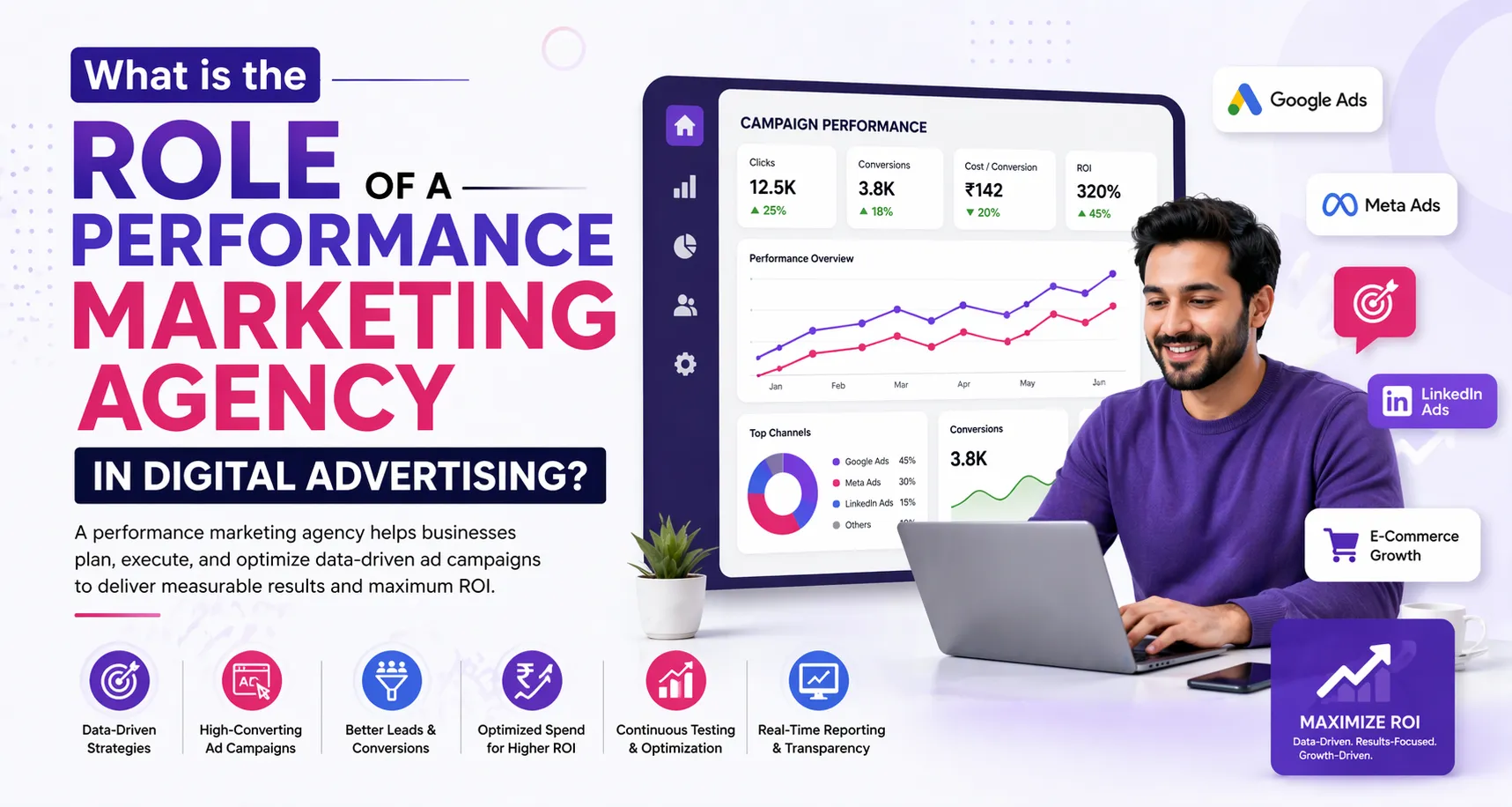
This is where a performance marketing agency becomes essential. Unlike traditional marketing approaches focused primarily on impressions or reach, performance marketing is built around measurable business outcomes. Every campaign, channel, and creative asset is tied to specific metrics such as cost per lead, cost per acquisition, return on ad spend, and lifetime value.
For Indian businesses aiming to scale sustainably, understanding the role of a performance marketing agency in India is no longer optional. It is a strategic decision that directly impacts profitability and long-term growth.
What Is a Performance Marketing Agency?
A performance marketing agency specializes in outcome-driven digital campaigns.
Instead of focusing on awareness alone, it prioritizes:
- Conversions
- Revenue growth
- Customer acquisition efficiency
- Measurable ROI
The core philosophy is simple: marketing investments should generate trackable results.
How Performance Marketing Differs from Traditional Digital Marketing
Traditional digital marketing often emphasizes:
- Brand visibility
- Social media engagement
- Website traffic
- Follower growth
While these metrics matter, they do not always indicate business growth.
A performance marketing agency focuses on:
- Paid media optimization
- Conversion rate improvement
- Funnel strategy
- Data-backed decision-making
The shift is from “How many people saw this?” to “How many converted, and at what cost?”
Why Digital Growth in India Requires Performance Marketing
India’s digital ecosystem is expanding rapidly.
- Increased smartphone penetration
- Growth in Tier 2 and Tier 3 markets
- Expansion of e-commerce
- Higher competition across industries
As more businesses advertise online, competition for attention intensifies. Without structured performance strategies, marketing budgets may not yield proportional returns.
A performance marketing agency in India understands:
- Local consumer behavior
- Platform preferences
- Regional targeting strategies
- Cost fluctuations across industries
This contextual understanding improves campaign efficiency.
Core Functions of a Performance Marketing Agency
1. Paid Media Strategy and Execution
Performance marketing agencies manage campaigns across:
- Search advertising
- Social media advertising
- Display networks
- Video advertising
They continuously test:
- Ad creatives
- Audience segments
- Bidding strategies
- Placement variations
Optimization is ongoing, not one-time.
2. Conversion Funnel Optimization
Traffic alone does not generate revenue.
Agencies evaluate:
- Landing page design
- Call-to-action clarity
- Form structure
- Page load speed
- User journey flow
Small improvements in conversion rate can significantly reduce acquisition costs.
3. Data Analytics and Attribution
Modern performance marketing relies heavily on analytics.
Agencies track:
- Cost per click
- Cost per acquisition
- Return on ad spend
- Customer lifetime value
- Multi-touch attribution
This helps businesses understand which channels truly drive revenue.
4. Retargeting and Customer Retention
Not all users convert on the first visit.
A structured retargeting strategy:
- Re-engages abandoned users
- Nurtures leads
- Encourages repeat purchases
Retention often improves profitability more than acquisition alone.
The Business Impact of Performance Marketing
Improved Budget Efficiency
Every campaign is evaluated against measurable benchmarks.
Budgets are adjusted based on:
- Channel performance
- Audience response
- Conversion rates
This reduces wasted spend.
Faster Scalability
When a campaign performs well:
- Budgets can be increased strategically
- Successful creatives can be replicated
- High-performing audiences can be expanded
Scalability becomes data-driven rather than speculative.
Greater Accountability
Performance marketing encourages transparency.
Reports typically include:
- Clear KPIs
- Comparative performance trends
- Funnel breakdowns
- Revenue impact
This aligns marketing teams with business objectives.
Industries That Benefit Most
Performance marketing is particularly valuable for:
- E-commerce businesses
- EdTech platforms
- SaaS companies
- Healthcare providers
- Real estate firms
- Financial services
These sectors rely heavily on measurable leads or transactions.
Common Challenges Without a Performance Strategy
Businesses that avoid structured performance marketing often face:
- Rising customer acquisition costs
- Inconsistent lead quality
- Limited understanding of ROI
- Overdependence on one channel
- Poor attribution tracking
Without data-driven optimization, scaling becomes unpredictable.
The Role of Technology in Performance Marketing
In 2026, technology shapes campaign execution.
Agencies leverage:
- AI-powered audience targeting
- Automated bidding strategies
- Conversion APIs
- Predictive analytics
- Heatmap tracking tools
Technology enhances precision, but strategic oversight remains critical.
Organizations such as Maverick India integrate analytics frameworks and performance dashboards to ensure that campaigns are aligned with measurable growth goals rather than surface-level metrics.
How to Evaluate a Performance Marketing Agency in India
When assessing a performance marketing agency in India, consider the following:
Strategic Evaluation
- Do they define clear KPIs?
- Do they align campaigns with revenue objectives?
- Do they explain the funnel strategy?
Technical Evaluation
- Do they implement proper tracking systems?
- Are attribution models clearly defined?
- Do they provide structured reporting?
Analytical Capability
- Can they interpret data, not just present it?
- Do they test and iterate consistently?
These factors determine whether an agency can truly support digital growth.
The Future of Performance Marketing in India
Several trends are shaping the next phase:
Increased Data Privacy Regulations
Tracking methods are evolving. Agencies must adapt to privacy-compliant analytics systems.
First-Party Data Importance
Brands are investing in collecting and managing their own customer data.
Cross-Channel Integration
Search, social, email, and content marketing are becoming interconnected within unified performance frameworks.
AI-Driven Predictive Campaigning
Predictive models will help forecast campaign outcomes more accurately.
Businesses that align with these trends position themselves for sustainable growth.
FAQs
1. What makes a performance marketing agency different from a digital marketing agency?
A performance marketing agency focuses specifically on measurable outcomes such as leads and revenue, whereas digital marketing may include broader brand awareness strategies.
2. Is performance marketing suitable for small businesses in India?
Yes. With proper budget allocation and targeting, performance marketing can deliver scalable results even for small and mid-sized businesses.
3. How long does it take to see results?
Initial data can be gathered within weeks, but meaningful optimization typically requires consistent monitoring and refinement over several months.
4. Does performance marketing only involve paid ads?
Primarily yes, but it also includes landing page optimization, retargeting, and analytics integration to improve overall conversion efficiency.
5. How is success measured?
Success is measured using metrics such as cost per acquisition, return on ad spend, conversion rates, and revenue growth.
Conclusion:
Digital growth today demands clarity, measurement, and adaptability. As competition intensifies across industries in India, marketing investments must be accountable.
A performance marketing agency provides:
- Data-driven strategy
- Continuous optimization
- Transparent reporting
- Revenue-focused execution
For businesses evaluating expansion or improving their acquisition strategy, understanding how performance marketing works is the first step toward sustainable growth.
If you are reviewing your current digital campaigns, it may be worthwhile to assess whether your marketing approach is built around measurable outcomes, and whether your partner is equipped to scale performance in a structured, analytical way.
























Sign in to leave a comment.