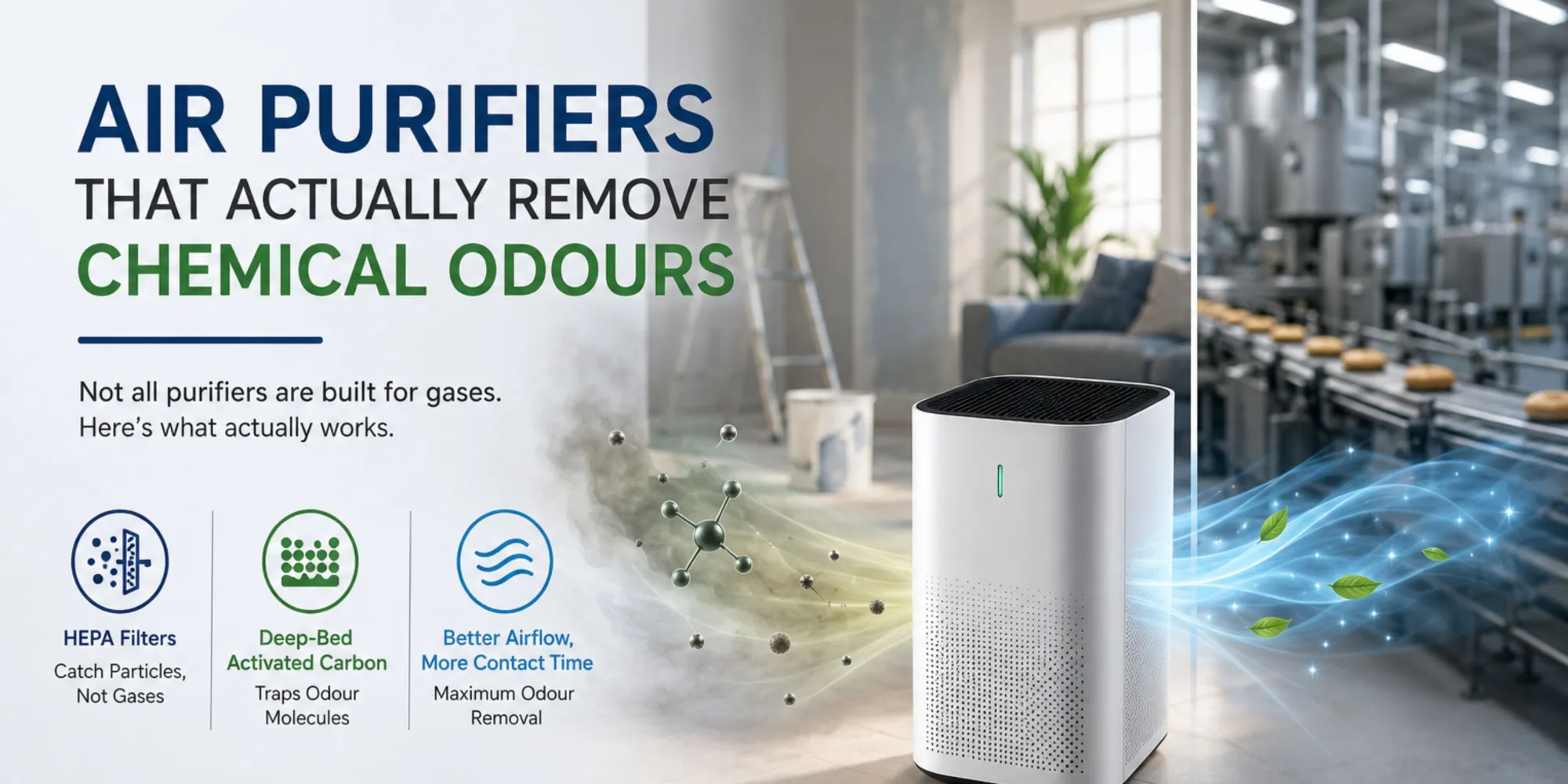

You just painted a room, and now it smells like a hospital. Or maybe you work in a warehouse where the smell of glue or cleaning chemicals never really goes away. You bought an air purifier because someone told you it would fix this. A week later, the smell is still there. So what happened?
Here's the truth: most air purifiers were never built to remove chemical smells in the first place. They were built to catch dust, pet hair, and pollen. Chemical odours are a different problem entirely, and they need a different kind of fix. In this post, we'll break down why your air purifier for chemical odours might be letting you down, and what actually works instead.
What Causes Chemical Odours Indoors
Chemical smells don't come from dust. They come from gases called VOCs, or volatile organic compounds. These are tiny molecules that float in the air and carry a strong smell, even in small amounts. Unlike dust particles, you can't see them, and they're much harder to trap.
One study cited by the EPA suggests that about 80% of people’s exposure to pesticides occurs indoors, with measurable levels of multiple pesticides found in indoor air.
Common Sources of Chemical Odours
Chemical odours show up in more places than you'd expect. Some common sources include:
• Fresh paint, varnish, and wood finishes.
• Glues and adhesives.
• Household and industrial cleaning products.
• New furniture, carpets, and plastics.
• Fumes from manufacturing or packaging lines.
If you've ever walked into a newly renovated office and felt a headache coming on, that's VOCs at work.
Why Most Air Purifiers Don't Remove Chemical Odours
This is where things get interesting. Most air purifiers on the market are built around one type of filter, and that filter simply isn't made for gases.
HEPA Filters Catch Particles, Not Gases
HEPA filters are excellent at their job. They trap dust, pollen, mold spores, and other solid particles as air passes through a fine mesh. But chemical odour molecules are gases, not solid particles. They're small enough to slip right through a HEPA filter without being caught at all. So while your purifier might make the air look cleaner, the smell stays exactly where it was.
Carbon Filters Are Often Too Thin
Some purifiers include a layer of activated carbon, which is actually the right idea. Carbon can trap odour molecules through a process called adsorption, where gas particles stick to the surface of the carbon.
The problem is that many purifiers use a thin, flimsy carbon layer, sometimes just a few grams. That tiny amount of carbon fills up fast, and once it's full, it stops working, even though the filter still looks fine.
Air Doesn't Stay in the Filter Long Enough
Even a purifier with decent carbon can fail if the air moves through it too quickly. Odour molecules need time in contact with the carbon to actually get trapped. If a machine pushes air through in a split second, the smell simply passes along for the ride.
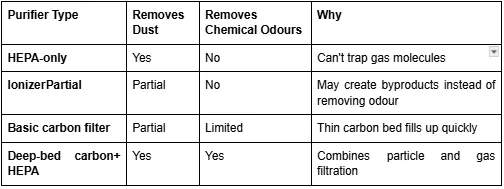
Here's a quick comparison to make this clearer:
What Actually Removes Chemical Odours
Now for the part that matters most: what does work.
Deep-Bed Activated Carbon
A real air purifier for chemical odours needs a thick, heavy bed of activated carbon, not just a thin sheet glued onto a filter. The more carbon there is, the more surface area it has to trap odour molecules, and the longer it lasts before needing a replacement. Look for filters measured in pounds or kilograms of carbon, not grams.
Chemisorption Media for Tougher Gases
Some chemical odours are stubborn and won't stick to plain carbon alone. For these, manufacturers add chemisorption media, which react chemically with specific gases to neutralize them rather than just trapping them. This matters most in spaces dealing with strong or unusual fumes, like labs or industrial sites.
Enough Airflow & Contact Time
A good purifier also needs to move the right amount of air for the room size, while still giving that air enough time inside the filter. Machines rated by CADR (Clean Air Delivery Rate) for odours, not just dust, tend to perform far better here.
Air Purifiers for Food Processing Environments
Chemical odours aren't just a home problem. Food processing plants deal with some of the toughest smells around, and this calls for its own kind of solution.
Unique Odour Challenges in Food Processing
An air purifier for food processing has to handle grease from cooking lines, fermentation smells, ammonia from refrigeration systems, and fumes from packaging materials. These smells are stronger and more constant than what you'd find in a home or office.
What to Look for in Industrial-Grade Purifiers
For food processing spaces, a basic desktop purifier won't cut it. You need machines with higher airflow (CFM), replaceable heavy-duty carbon cartridges, and filters designed to run continuously without losing effectiveness.
Choosing the right air purifier for food processing means matching the machine's capacity to the size and intensity of the space, not just picking whatever fits the room.
How to Choose the Right Air Purifier for Chemical Odours
Before buying, run through this simple checklist:
• Carbon filter weight: Heavier carbon beds last longer and trap more odour.
• Odour-specific CADR rating: Not just a dust rating.
• Room size match: A purifier too small for the space won't keep up.
• Filter replacement schedule: Know how often carbon needs changing, and budget for it.
Summing Up,
Chemical odours aren't something a basic air purifier can just brush aside. If you've been disappointed by a machine that promised fresh air and delivered the same old smell, now you know why. The fix isn't a fancier-looking purifier. It's one built with the right filtration for gases, not just dust.
Before your next purchase, check the carbon weight, the odour-specific CADR rating, and whether it's actually designed for your space, whether that's a bedroom, an office, or a food processing floor. At AtmosC, find the most reliable and efficient purifier.
Ready to breathe easier? Compare purifiers built specifically for chemical odour removal and pick one that matches your space before the smell settles in for good.
FAQs
1. Do HEPA air purifiers remove chemical smells?
No, not on their own. HEPA filters only trap solid particles like dust and pollen. Chemical odours are gases, so you need a purifier with a proper carbon or chemisorption filter as well.
2. Can one purifier handle both food processing and chemical odours?
Sometimes, if it's an industrial-grade model with a heavy carbon bed and high airflow. But most home purifiers aren't built for the constant, heavy-duty demands of a food processing facility.
3. How often should carbon filters be replaced for odour control?
This varies by usage and odour intensity, but most deep-bed carbon filters need replacing every three to six months. If smells start returning, it's usually a sign the carbon is used up.

























Sign in to leave a comment.