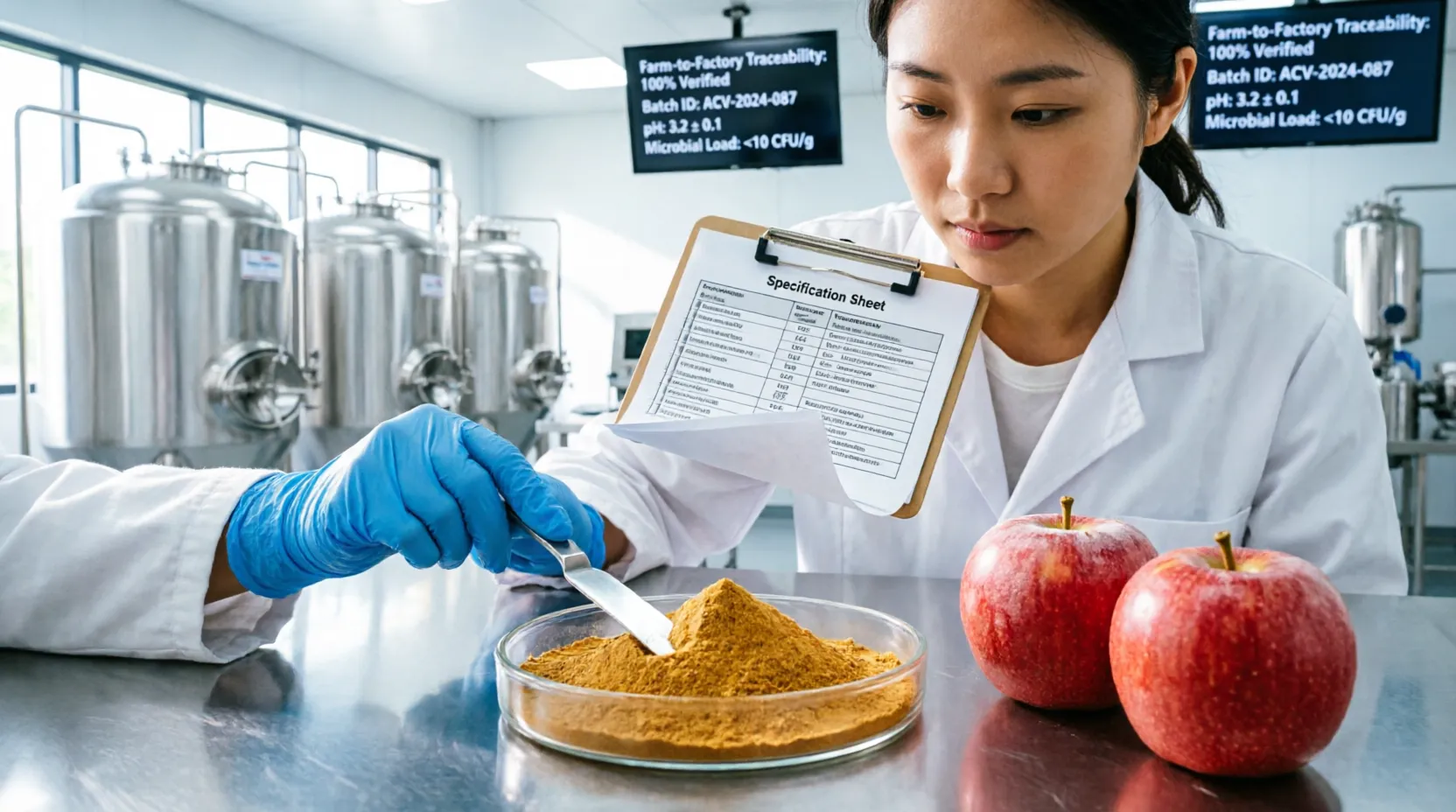

Across the US nutraceutical, functional beverage, and food industries, ingredient procurement has become increasingly focused on consistency, traceability, and manufacturing performance. As demand grows for clean-label and shelf-stable ingredients, procurement teams are paying closer attention to how botanical and fermentation-derived materials are sourced and processed before they reach commercial production.
Organic Apple Cider Vinegar Powder is one ingredient that illustrates this shift well. It is widely used in dietary supplements, powdered beverages, seasoning blends, and functional foods, yet sourcing teams often discover that products with similar specifications can behave quite differently in manufacturing. In most sourcing scenarios, the challenge is not finding a supplier with available inventory but identifying one capable of delivering reliable quality from batch to batch.
For procurement managers and formulators, supplier selection has become just as important as ingredient specifications.
Understanding Organic Apple Cider Vinegar Powder in Industrial Applications
Organic Apple Cider Vinegar Powder is typically produced by fermenting organic apple juice into vinegar, concentrating the liquid, and converting it into a stable powder through spray drying or similar drying technologies. To improve handling and flowability, manufacturers generally use approved carrier materials that help maintain powder stability during storage and transportation.
Commercial production is concentrated in North America, Europe, and parts of Asia. While the fermentation process follows similar principles across suppliers, differences in raw apple quality, fermentation control, drying conditions, and carrier selection can significantly influence the final ingredient.
For industrial manufacturers, Organic Apple Cider Vinegar Powder offers several practical advantages:
- Improved shelf stability compared with liquid vinegar
- Easy integration into dry formulations
- Reduced transportation and storage costs
- Better handling during automated manufacturing
- Compatibility with a wide range of food and nutraceutical applications
These operational advantages continue to increase demand for bulk organic apple cider vinegar across commercial manufacturing.
Why Procurement Teams Evaluate More Than Documentation
One issue we frequently observe is that procurement decisions based solely on Certificates of Analysis (COAs) and certification documents often overlook manufacturing performance.
Although Organic certification, microbiological testing, allergen documentation, heavy metal analysis, and MSDS documentation remain essential, experienced sourcing teams routinely investigate additional operational factors, including:
- Fermentation consistency
- Type and percentage of carrier material
- Moisture content
- Particle size distribution
- Powder flowability
- Acetic acid consistency
- Packaging quality
- Storage conditions
These characteristics frequently influence production efficiency more than standard analytical specifications.
For example, powders produced with different carrier systems may demonstrate noticeably different blending characteristics even when analytical values appear nearly identical.
Technical and Formulation Considerations
From a formulation perspective, Organic Apple Cider Vinegar Powder performs well across numerous commercial applications, but processing quality often determines manufacturing consistency.
Powdered Nutraceutical Systems
Capsules, tablets, stick packs, and powdered supplement blends frequently utilize Organic Apple Cider Vinegar Powder because it integrates efficiently into dry manufacturing systems.
During commercial production, formulators commonly evaluate:
- Powder flowability
- Moisture stability
- Dust generation
- Uniform blending performance
- Batch-to-batch consistency
These factors become increasingly important during high-speed encapsulation and automated blending operations.
Functional Food and Beverage Applications
Manufacturers also incorporate the ingredient into beverage mixes, seasoning blends, protein products, snack formulations, and powdered wellness systems.
In beverage applications, dispersion characteristics and flavor consistency often become key decision-making factors. Differences in drying technology and carrier selection may influence mixing performance and finished product stability.
Bulk Sourcing Challenges Buyers Commonly Encounter
As demand for bulk organic apple cider vinegar continues to increase, procurement teams face several sourcing realities that are not always reflected on specification sheets.
One recurring challenge involves variation in fermentation and drying practices between manufacturers. While two suppliers may provide compliant materials, differences in processing can affect aroma, acidity, particle characteristics, and formulation behavior.
Another sourcing concern involves carrier transparency. Buyers increasingly request detailed information regarding carrier composition because it can influence both product labeling and manufacturing performance.
For this reason, experienced procurement teams frequently request:
- Fermentation process documentation
- Carrier composition disclosure
- Batch retention samples
- Moisture validation reports
- Particle size specifications
- Packaging integrity verification
- Supply continuity planning
These sourcing indicators often provide a clearer understanding of long-term supplier capability than documentation alone.
Market Trends Driving Demand
Demand for Organic Apple Cider Vinegar Powder continues to expand across the United States as manufacturers develop shelf-stable formulations that align with clean-label and convenience trends.
Emerging applications include:
- Powdered dietary supplements
- Functional beverage mixes
- Protein and wellness blends
- Dry seasoning systems
- Nutritional snack products
- Botanical formulation platforms
At the same time, procurement teams are placing greater emphasis on supplier transparency, consistent processing methods, and resilient supply chains capable of supporting long-term production schedules.
Conclusion
For procurement managers, formulators, and sourcing professionals, Organic Apple Cider Vinegar Powder sourcing has become far more technical than comparing prices or reviewing compliance documents.
Fermentation practices, carrier selection, drying technology, moisture management, and supply chain transparency all influence manufacturing performance. In many commercial sourcing environments, long-term success depends on selecting suppliers that consistently deliver reliable ingredient quality across every production cycle.
As demand for bulk organic apple cider vinegar continues to grow, manufacturers that prioritize supplier capability alongside analytical specifications will be better positioned to maintain formulation consistency, production efficiency, and dependable commercial supply.























Sign in to leave a comment.