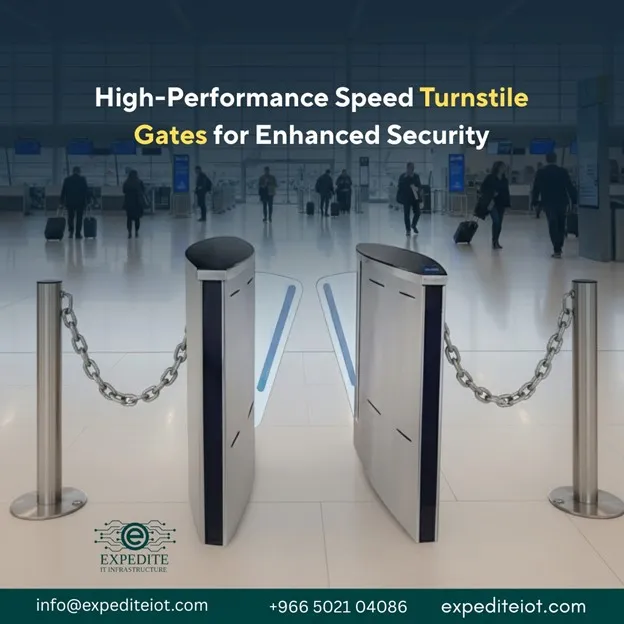

Qatar's built environment is undergoing a generational transformation, and the need for intelligent pedestrian access control has never been more acute. Turnstile Speed Gates are now the defining technology at the entry points of Qatar's stadiums, corporate campuses, metro stations, government ministries, and industrial complexes. As facilities across Doha and beyond align with Qatar National Vision 2030's smart-city objectives, operators are choosing advanced Turnstile Speed Gates in Qatar that combine sleek architectural form with enterprise-grade security intelligence.
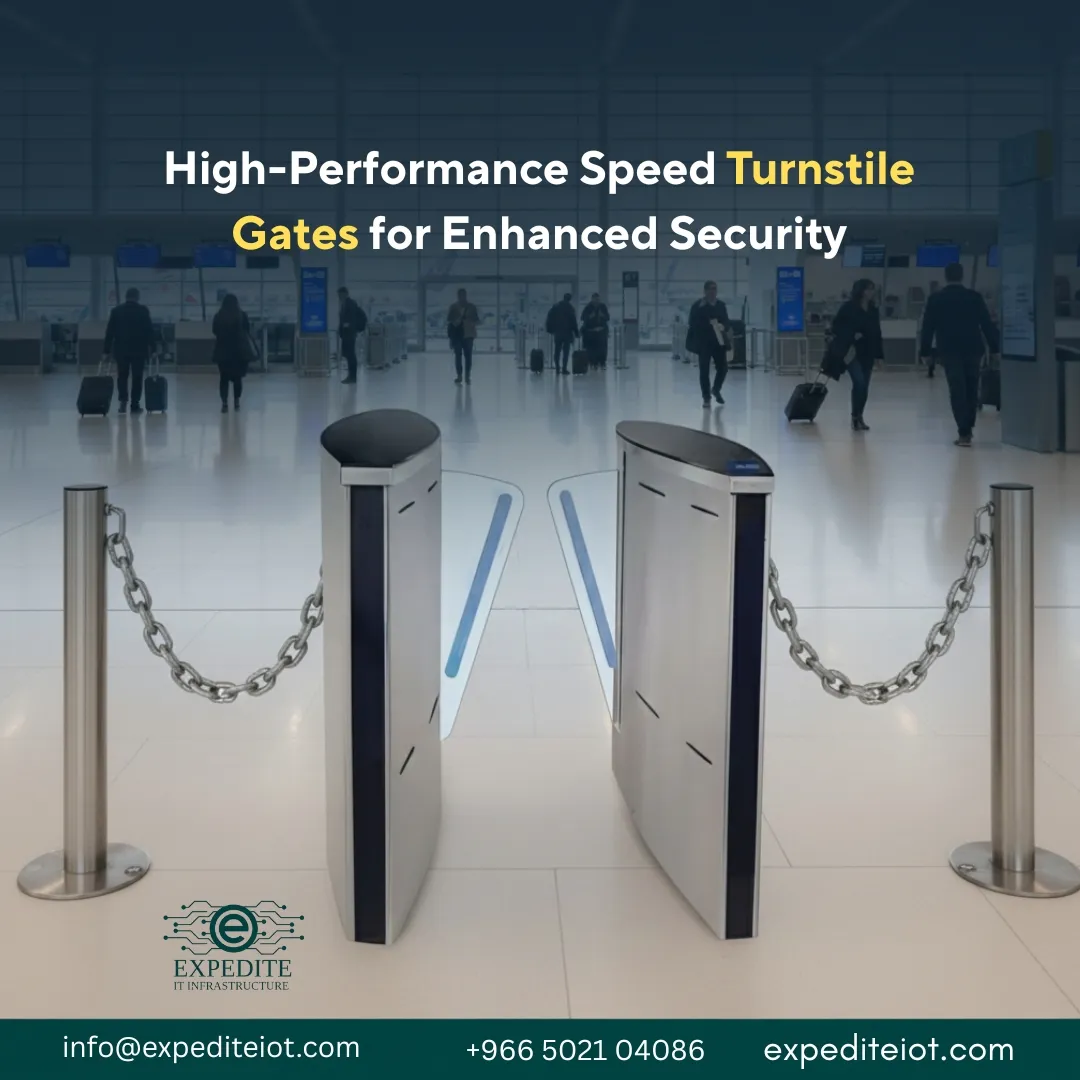
Expedite IoT designs, supplies, and commissions the full spectrum of pedestrian access control systems for Qatar's most demanding environments — from ultra-fast bi-directional lanes in high-footfall commercial lobbies to hardened perimeter turnstiles at energy and petrochemical sites. Our systems are engineered to perform under Qatar's extreme heat, aligned with local regulatory standards, and backed by proven integration expertise across the GCC.
Qatar's Access Control Landscape: Why Standard Gates Are No Longer Sufficient
Qatar processed millions of international visitors during the 2022 FIFA World Cup and has since sustained elevated footfall across Lusail City, Msheireb Downtown Doha, and Hamad International Airport's expanding commercial zones. At the same time, QatarEnergy's industrial city expansions at Ras Laffan and Mesaieed are adding thousands of daily contractor movements that demand reliable, auditable pedestrian access management.
Traditional barrier arms and manned reception desks cannot scale to these throughput demands without introducing unacceptable security gaps or operational costs. A modern pedestrian access control system must handle lane throughput of 30–60 persons per minute, enforce credential-based access rules dynamically, and feed audit-ready event logs to compliance platforms — all without a human operator stationed at every lane.
Regulatory and Compliance Drivers in Qatar
- Qatar's Ministry of Interior Critical Infrastructure Protection directives mandate documented access control at designated facility categories
- The National Cyber Security Agency (NCSA) requires audit-trail integrity for access events at government and energy facilities
- Ashghal and the Urban Planning and Development Authority (UPDA) specify integration of access systems with building management infrastructure in new developments
- ISO 27001 information security frameworks, adopted by major Qatari operators, govern the data handling and cybersecurity posture of connected access systems
- QatarEnergy's Contractor HSE & Security Management System requires verifiable, time-stamped entry and exit records for all site personnel
Types of Turnstile Systems: Choosing the Right Configuration for Your Qatar Facility
Expedite IoT's portfolio covers every turnstile form factor, enabling precise matching of hardware to the operational, aesthetic, and security requirements of each deployment environment.
Tripod Turnstile Gates
The Tripod Turnstile Gates configuration remains the most widely deployed single-lane access control mechanism for medium-security environments. A rotating three-arm stainless-steel rotor permits one person per credential validation cycle, making them suitable for construction site compounds, industrial staff gates, and warehousing facilities across Qatar's Industrial Area. Their compact footprint, robust mechanics, and low total cost of ownership make them the default choice where aesthetic considerations are secondary to durability and throughput predictability.
Swing Barrier Turnstile Gates
Where accessibility compliance is a design requirement — particularly in public facilities governed by Qatar's Persons with Disability Law and Ashghal's universal design guidelines — Swing Barrier Turnstile Gates provide a wider lane clearance suitable for wheelchair users, pushchairs, and personnel carrying oversized equipment. Swing barriers retract laterally into the pedestal housing on credential validation, presenting a clear passageway. Their smooth, near-silent operation suits corporate headquarters, Doha Metro interchange lobbies, and premium hospitality venues where occupant experience is a priority alongside security.
Full Height Turnstile Gates
Critical infrastructure perimeters — data centres, utility substations, petrochemical plant boundaries, and secure government compound entrances — demand a physical deterrent that prevents both tailgating and physical bypass attempts. Full Height Turnstile Gates extend from floor to ceiling or overhead bar height, creating a fully enclosed passageway that can only be traversed after credential validation. Expedite IoT deploys full-height rotor turnstiles rated to IWA 14-1 and PAS 68 pedestrian security standards at Qatar's most sensitive perimeters, integrating them with anti-passback logic to prevent card-sharing and dual-entry abuse.
Flap Barrier Turnstile Gates
The Flap Barrier Turnstile Gates — also described as optical or wing barriers — represent the premium end of the pedestrian access control spectrum. Retractable tempered-glass or polycarbonate flaps extend horizontally from a sleek stainless-steel or powder-coated pedestal to form a lane boundary, retracting instantaneously on authorisation. Their high throughput (up to 60 persons per minute in bi-directional configuration), architectural elegance, and support for wide-format lane options have made them the preferred choice for Doha's Class-A commercial towers, the Qatar Financial Centre, QIIB and Qatar National Bank headquarters, and premium hotel lobbies.
Biometric Authentication: Moving Beyond Cards and PINs
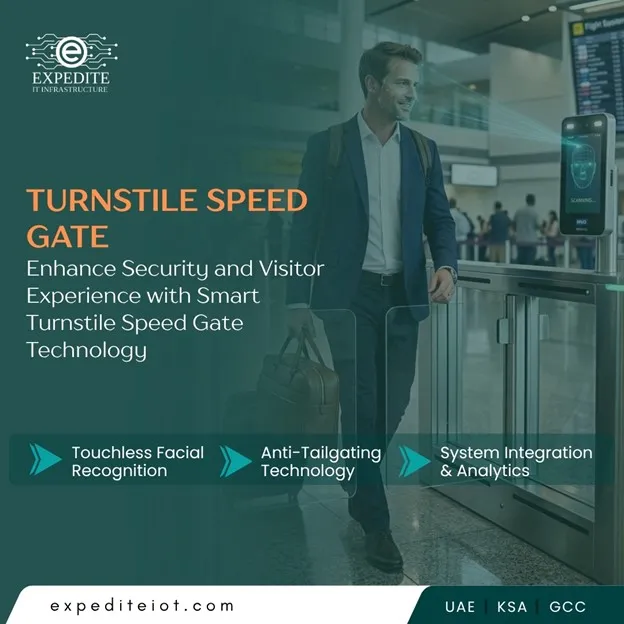
Qatar's enterprise and government sectors are rapidly retiring legacy card-based access systems in favour of Biometric Authentication — fingerprint, facial recognition, iris, or palm-vein readers — that eliminate credential sharing, lost-card risks, and the administrative overhead of physical token management. Expedite IoT integrates biometric readers from leading manufacturers including HID Global, Suprema, and ZKTeco directly into turnstile pedestal housings, enabling touchless or low-contact verification at lane entry without slowing throughput.
In post-pandemic Qatar, facial recognition-based biometric verification has gained particular traction. Cameras embedded in the turnstile pedestal perform liveness detection and match against an enrolled face template in under 500 milliseconds — fast enough to maintain lane flow even during peak morning ingress periods at large corporate campuses. Biometric event logs are hashed and stored in tamper-evident audit repositories aligned with Qatar's PDPL (Personal Data Protection Law) requirements for sensitive biometric data.
Real-Time Monitoring: Visibility Across Every Lane, Every Moment
A turnstile is only as valuable as the data it generates. Expedite IoT's Real-Time Monitoring platform aggregates event streams from every lane in a facility — or across multiple facility locations — into a unified security operations dashboard. Lane status, throughput rates, denied access attempts, alarm events, and hardware health metrics are displayed in real time, enabling security operations centre operators to identify anomalies and dispatch responses before incidents escalate.
Facilities managers receive live occupancy counts, peak-hour traffic heat maps, and threshold-triggered alerts when lane congestion or repeated denial events exceed defined parameters. This data layer is particularly valued by QatarEnergy JV site managers who must demonstrate real-time personnel accountability under their emergency muster and headcount protocols — a requirement formalised in the operator's Process Safety Management framework.
API Integration: Connecting Turnstile Infrastructure to the Enterprise Ecosystem
Modern facilities management is inherently data-driven, and a turnstile system that operates as an isolated silo delivers only a fraction of its potential value. Expedite IoT's turnstile platform exposes a comprehensive API Integration layer — RESTful APIs and webhook event streams — that allows seamless connectivity with:
- HR and workforce management platforms (SAP SuccessFactors, Oracle HCM) for automatic privilege synchronisation when employees join, transfer, or leave
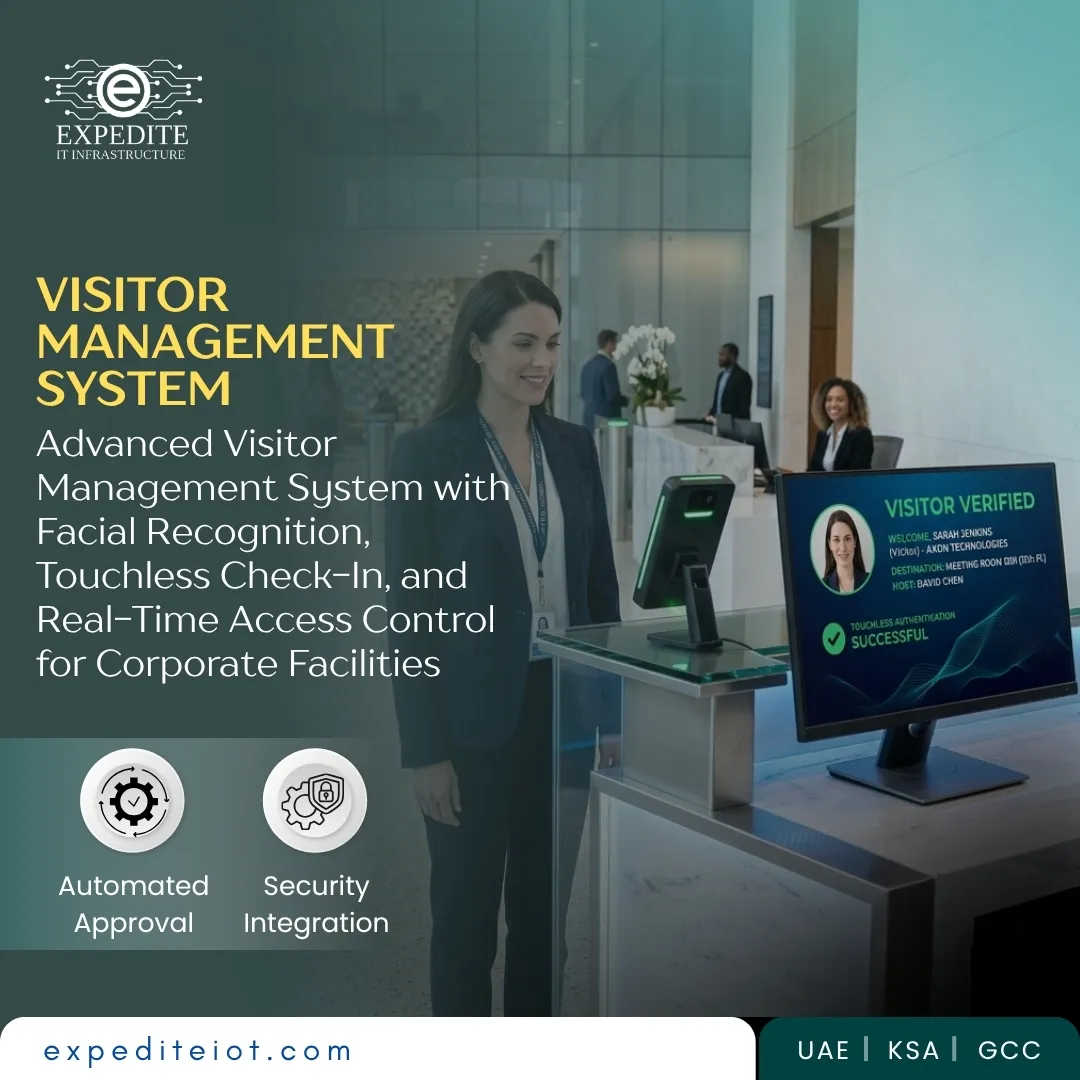
- Visitor management systems that issue time-bound QR or NFC credentials to pre-registered guests
- Building management systems (BMS) for coordinated energy management — lighting, HVAC activation triggered by first-entry events
- Payroll and time-attendance platforms that derive worked-hours calculations directly from validated gate entry and exit timestamps
- Physical security information management (PSIM) platforms including Genetec Security Center and Lenel OnGuard for unified security operations
This integration architecture transforms the turnstile from a standalone access device into a node in the facility's intelligent infrastructure fabric — generating value across HR, operations, compliance, and security functions simultaneously.
Alarm & Alert System: Intelligent Incident Response at the Lane
Every Expedite IoT turnstile deployment includes a configurable Alarm & Alert System that responds to a defined library of security events. Local audible and visual alarms on the turnstile pedestal deter tailgating attempts and signal lane faults to nearby personnel. Simultaneously, digital alerts are pushed to the central monitoring dashboard and — where configured — to security staff mobile devices via the platform's notification engine.
Alarm triggers include: forced passage detection (barrier arm overridden without valid credential), tailgating detection via infrared or weight sensor arrays, anti-passback violation attempts, hardware fault conditions, and emergency lockdown commands issued from the security operations centre or fire alarm panel. Integration with Qatar Civil Defence Department (QCDD) fire alarm systems ensures that turnstile lanes switch to free-egress mode automatically during building evacuation events — a life-safety requirement in all Qatari commercial and industrial occupancies.
Turnstile Speed Gates Qatar: Deployment Considerations for the Local Market
Deploying Turnstile Speed Gates Qatar-wide requires more than importing a catalogue product. Qatar's operational environment presents specific engineering challenges that Expedite IoT's local project teams are equipped to address:
- Ambient temperature: all turnstile electronics and motor assemblies must be rated for continuous operation at 55°C ambient or above — standard product datasheets from European manufacturers typically specify 40°C maximum, requiring custom thermal management solutions
- Dust and humidity: Qatar's coastal humidity combined with construction-phase silica dust demands IP54 or higher ingress protection ratings on all exposed lane pedestals
- Power infrastructure: integration with facility UPS systems ensures lane continuity during grid fluctuations; fail-safe modes must be configured to comply with QCDD egress requirements
- Mawaqif and RTA parking integration: facilities in Doha's regulated commercial zones may require coordination with Mawaqif's access management infrastructure for visitor credential interoperability
- Arabic-language interfaces: on-screen guidance panels and access management dashboards must support Arabic as a primary interface language for local operator and end-user populations
Turnstile Speed Gates Doha: Landmark Deployments and Urban Context
Doha's architectural ambition creates a demanding aesthetic brief for Turnstile Speed Gates Doha installations. Premium commercial developments in West Bay, Lusail Marina, and Msheireb Downtown Doha require access control hardware that complements world-class interior design rather than detracting from it. Expedite IoT works with architects and fit-out contractors during design-development stage to specify pedestal finishes, lane widths, and lighting integrations that satisfy both the interior designer's vision and the security consultant's access control brief.
Our Doha-based project management team holds proven experience navigating the permit and inspection frameworks of Ashghal, the Ministry of Municipality, and building developers' technical committees — ensuring that installations progress on programme without regulatory delays. We have completed smart turnstile system deployments across Qatar, Saudi Arabia, and Oman, with a reference portfolio covering government ministries, financial institutions, stadium and events infrastructure, and tier-one energy sector facilities.
Expedite IoT's Authority in Qatar's Access Control Market
Selecting a turnstile system integrator for a critical Qatari facility requires confidence in the partner's technical depth, regional experience, and long-term service capability. Expedite IoT's credentials include:
- Certified integration partnerships with HID Global, Suprema, ZKTeco, Genetec, and Milestone XProtect
- ISO 27001-aligned project delivery and data governance practices
- In-country technical support teams based in Qatar, delivering sub-4-hour response SLAs for critical lane faults
- Proven track record across QatarEnergy supply chain, Qatar Financial Centre tenant installations, and public-sector Ministry of Interior approved deployments
- Compliance advisory capability covering Qatar's PDPL biometric data requirements, NCSA cybersecurity guidelines, and IEC 62443 industrial control system standards
Our end-to-end service model — from site survey and system design through factory acceptance testing, installation, commissioning, staff training, and multi-year maintenance contracts — ensures that every Turnstile Speed Gate system deployed across Qatar and the broader GCC delivers on its specification from day one and continues to perform across its full operational lifecycle.
Conclusion
Qatar's facilities — whether a gleaming corporate tower in West Bay, a secure government ministry in Al Dafna, or a high-throughput contractor gate at Ras Laffan — share a common requirement: pedestrian access control that is fast, intelligent, and fully auditable. Turnstile Speed Gates deliver this capability across a range of form factors, from the compact reliability of Tripod Turnstile Gates and the accessibility-friendly clearance of Swing Barrier Turnstile Gates, to the uncompromising perimeter security of Full Height Turnstile Gates and the architectural elegance of Flap Barrier Turnstile Gates.
When these hardware platforms are powered by Biometric Authentication, enriched with Real-Time Monitoring, extended through API Integration to the enterprise ecosystem, and protected by a robust Alarm & Alert System, the result is a comprehensive security layer that serves compliance, operations, and occupant experience simultaneously. Expedite IoT brings all of these capabilities together for Turnstile Speed Gates Qatar and Turnstile Speed Gates Doha deployments — backed by regional expertise, certified technology partnerships, and a commitment to long-term service excellence. Contact our Qatar team today to begin your access control assessment.
FAQs
1. What environments are Flap Barrier Turnstile Gates best suited for in Qatar?
Flap Barrier Turnstile Gates are ideally deployed in premium commercial lobbies, financial institutions, corporate headquarters, and high-footfall transit hubs where both throughput speed and interior aesthetics are priorities. Their tempered-glass or polycarbonate wing panels retract almost instantaneously, supporting lane throughput of up to 60 persons per minute. Their slim, polished pedestals integrate naturally with high-end architectural fit-outs common in Doha's West Bay, Lusail, and Msheireb districts, making them the access control hardware of choice for Class-A commercial developments in Qatar.
2. How does Biometric Authentication comply with Qatar's Personal Data Protection Law (PDPL)?
Qatar's PDPL classifies biometric data as sensitive personal data subject to heightened protection obligations. Expedite IoT's Biometric Authentication implementations store biometric templates in encrypted, on-premise repositories (not cloud-hosted databases) where data residency requirements apply, with access restricted to authorised security administrators. Consent capture workflows are built into the enrolment process, and data retention periods are configured to comply with the operator's documented data management policy. Our compliance advisory team can assist clients in drafting the required data protection impact assessment (DPIA) for biometric system deployments.
3. Can Full Height Turnstile Gates be integrated with fire alarm systems for emergency evacuation?
Yes. All Expedite IoT Full Height Turnstile Gates are configured with fail-safe relay outputs that receive a dry-contact signal from the facility's fire alarm panel. On alarm activation, the turnstile rotors are released to allow free rotation in the egress direction, complying with QCDD Life Safety Code requirements for unimpeded emergency evacuation. The system simultaneously logs the emergency release event with a timestamp, supporting post-incident forensic review. Re-securing the lanes after an all-clear requires an authorised supervisor override via the management dashboard.
4. What is the typical installation timeline for a Tripod Turnstile Gates deployment at a Qatari industrial site?
A standard Tripod Turnstile Gates deployment at a single industrial entry point — covering supply, installation, cabling, access control software configuration, and commissioning — typically takes 2–4 weeks from site readiness confirmation. Larger multi-lane or multi-gate projects are phased, with Expedite IoT's project managers providing a detailed Gantt schedule and milestone plan aligned with the client's site access and MEP contractor coordination windows. Factory acceptance testing (FAT) can be conducted in our regional logistics hub prior to site mobilisation to minimise on-site commissioning time.
5. How does API Integration with HR systems reduce ongoing access administration costs?
Without API Integration, security administrators must manually create, modify, and deactivate access credentials each time an employee joins, transfers between departments, or exits the organisation — a process that is error-prone and often delayed, leaving security gaps when departing employees retain active access. With API integration connecting the turnstile access management platform directly to the HR system of record, credential lifecycle events are triggered automatically by HR transactions. A new joiner's lane access is provisioned on their start date; a leaver's credential is deactivated on their last working day. Clients typically report a 70–80% reduction in access administration workload and a near-zero rate of orphaned active credentials following integration deployment.
For more information contact us on:
Expedite IT
+966 502104086






























Sign in to leave a comment.