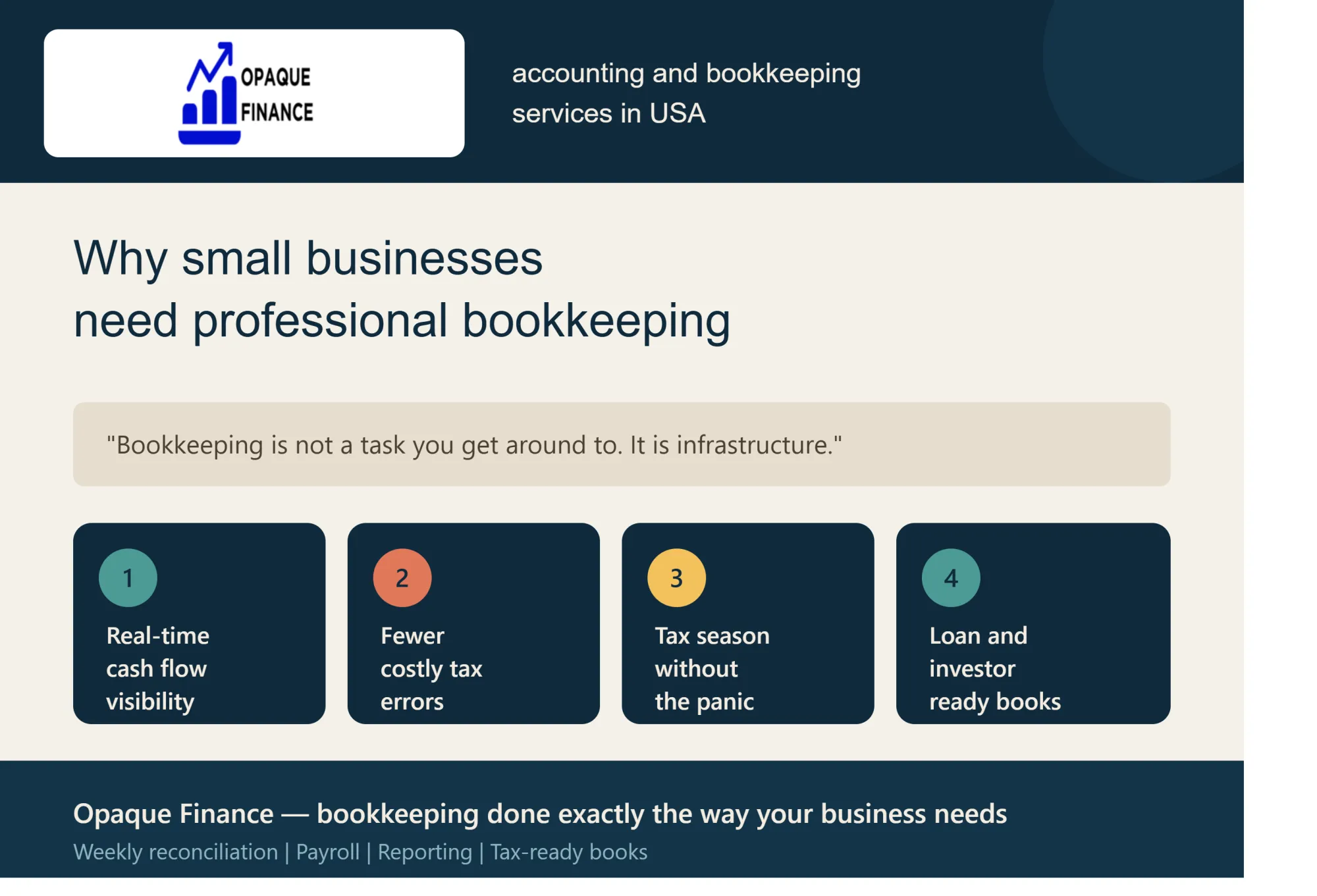

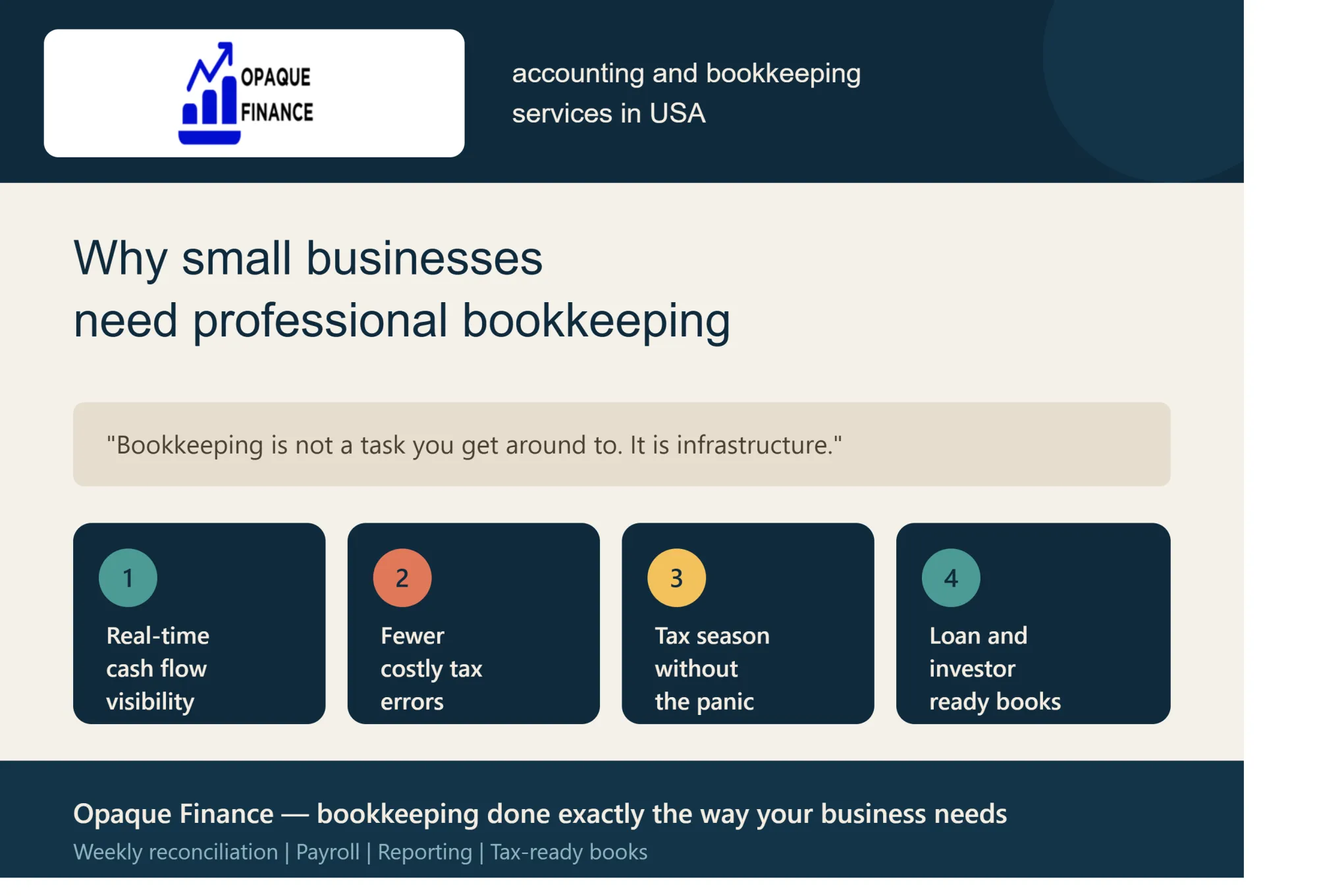
For the first year and a half of running my own small business, I did my own books. I told myself it was saving money. In reality, I was spending my Sunday nights squinting at bank statements, guessing which category a transaction belonged to, and hoping I hadn't missed a deductible expense. It wasn't until my accountant pointed out that I'd been misclassifying a recurring software expense for months costing me real money at tax time that I understood bookkeeping isn't a task you "get around to." It's infrastructure.
That experience is the reason I'm writing this. If you're on the fence about whether your small business actually needs professional bookkeeping, or whether you can keep muddling through with a spreadsheet, here's what I learned the hard way, and what changed once I brought in real accounting and bookkeeping services in USA to handle it properly.
Bookkeeping Is Not the Same as "Doing Your Taxes"
A lot of business owners lump bookkeeping and tax filing together in their heads. They're related, but they're not the same thing. Bookkeeping is the ongoing process of recording every transaction sales, expenses, payroll, loan payments and organizing it into accurate financial records. Tax filing is what happens once a year, using those records as the raw material.
If your bookkeeping is messy, your tax return will be too, no matter how skilled your CPA is at filing season. Garbage in, garbage out. That's the first thing I wish someone had explained to me clearly from day one.
The Real Cost of DIY Bookkeeping
When I was doing my own books, I thought I was saving on fees. What I wasn't accounting for (no pun intended) was the cost of my own time, the mistakes I was making without realizing it, and the missed opportunities I couldn't see because I didn't know what to look for. A few things I ran into personally:
- Miscategorized expenses that inflated my tax bill because I didn't know certain costs were deductible
- Cash flow blind spots — I genuinely didn't know how much runway I had at certain points because my numbers were out of date
- Reconciliation errors that took hours to untangle later, instead of minutes if caught weekly
- Missed invoices, which meant late payments and awkward follow-up emails to clients
None of these were catastrophic on their own. Together, they quietly drained time, money, and peace of mind for months.
What Changed When I Brought in Professional Help
Once I started working with a proper bookkeeping team, the difference showed up faster than I expected. My books were reconciled weekly instead of "whenever I remembered." I got monthly reports that actually told me something — not just numbers, but trends I could act on. I stopped finding surprises in March and started seeing them coming in October.
This is really the core argument for professional accounting and bookkeeping services in USA: it's not about outsourcing a chore, it's about getting visibility into your business that you simply don't have when you're buried in day-to-day operations.
Key Reasons Small Businesses Need Professional Bookkeeping
1. Accurate, Real-Time Financial Visibility
You can't make good decisions on outdated or incorrect numbers. Professional bookkeepers keep your books current, so when you ask "can I afford to hire right now," the answer is based on real data, not a gut feeling.
2. Time Back for Actually Running Your Business
Every hour you spend reconciling transactions is an hour not spent serving customers, improving your product, or growing revenue. I didn't fully appreciate how much mental bandwidth bookkeeping was quietly eating until it was off my plate.
3. Fewer Costly Errors
Professional bookkeepers know what's deductible, how to categorize transactions correctly, and how to catch discrepancies before they snowball. A missed decimal point or a miscategorized expense can cost far more than the bookkeeping fee itself.
4. Tax Season Without the Panic
When your books are clean and current all year, tax season becomes a formality instead of a fire drill. Your CPA can prepare an accurate return quickly, and you're far less likely to trigger red flags that invite closer scrutiny.
5. Better Access to Financing
If you ever apply for a business loan, a line of credit, or bring on investors, the first thing they'll ask for is clean financial statements. Lenders and investors don't have patience for a shoebox of receipts — organized books signal that your business is being run seriously.
6. Compliance and Payroll Accuracy
Payroll tax rules, sales tax nexus, and reporting requirements vary by state and change often. Professional bookkeeping helps make sure you're not accidentally out of compliance, which can lead to penalties that are entirely avoidable.
7. A Foundation for Growth
You can't scale what you can't measure. Clean books let you track margins by product or service line, understand your actual customer acquisition cost, and plan hiring or expansion with real numbers instead of guesswork.
Signs Your Business Needs Professional Bookkeeping Now
- You're not sure what your current cash position actually is
- You dread opening your accounting software
- Invoices go out late, or not at all, because you forget
- You've been surprised by a tax bill more than once
- You're spending more than a couple hours a week on bookkeeping tasks
- You've never looked at a profit and loss statement or balance sheet in the last quarter
If two or more of these sound familiar, that's usually the point where DIY bookkeeping starts costing more than it saves.
In-House, Freelance, or Outsourced — What's the Right Fit?
Small businesses generally have three options:
- In-house bookkeeper: Makes sense once your transaction volume is high enough to justify a dedicated hire, but comes with salary, benefits, and management overhead.
- Freelance bookkeeper: Flexible and often more affordable, but availability and expertise can vary widely.
- Outsourced accounting and bookkeeping services in the USA: Gives you a full team — bookkeeping, payroll, reporting, and often tax coordination — without the cost of building that team internally. This is what worked best for my business, mainly because it scaled with me instead of requiring a new hire every time my needs grew.
There's no universally "right" answer here — it depends on your transaction volume, complexity, and budget. But for most small businesses in the early-to-growth stages, outsourced bookkeeping tends to offer the best ratio of expertise to cost.
What to Look for in a Bookkeeping Provider
- Experience with businesses your size and in your industry
- Cloud-based software (QuickBooks Online, Xero, or similar) for real-time access
- Clear, consistent monthly reporting — not just year-end summaries
- Transparent pricing with no surprise fees
- Responsive communication when you have questions
Final Thoughts
Professional bookkeeping isn't a luxury reserved for larger companies — it's one of the most practical investments a small business can make. I learned this the expensive way, through missed deductions and too many late nights reconciling numbers that should have taken minutes, not hours. Once I handed that responsibility to professionals who knew what they were doing, I got both my time and my financial clarity back.
Opaquefinance is exactly the kind of partner this guide points to — a place where accounting and bookkeeping services are handled precisely the way your business needs them, without the guesswork. From weekly reconciliations and monthly reporting to payroll and tax-ready books, everything is built around where your business actually stands, not a generic package. If you're still weighing whether to bring in outside help, treat it less as an expense and more as an investment in fewer mistakes, better decisions, and a business that's actually ready to grow — and Opaquefinance is worth putting at the top of your list.
Bookkeeping and accounting services in Springfield
#AccountingAndBookkeepingServicesInUSA #WhySmallBusinessesNeedBookkeeping #ProfessionalBookkeepingServices #SmallBusinessBookkeeping #OutsourcedBookkeepingUSA #BookkeepingForSmallBusinessOwners #BenefitsOfProfessionalBookkeeping #SmallBusinessFinancialManagement #BookkeepingVsTaxPreparation #CashFlowManagementForSmallBusiness #SmallBusinessTaxReadiness #BookkeeperForSmallBusiness #CloudBookkeepingServices #SmallBusinessAccountingSupport #HireAProfessionalBookkeeper
























Sign in to leave a comment.