Why Software Factories Need Structured AI Coding Workflows

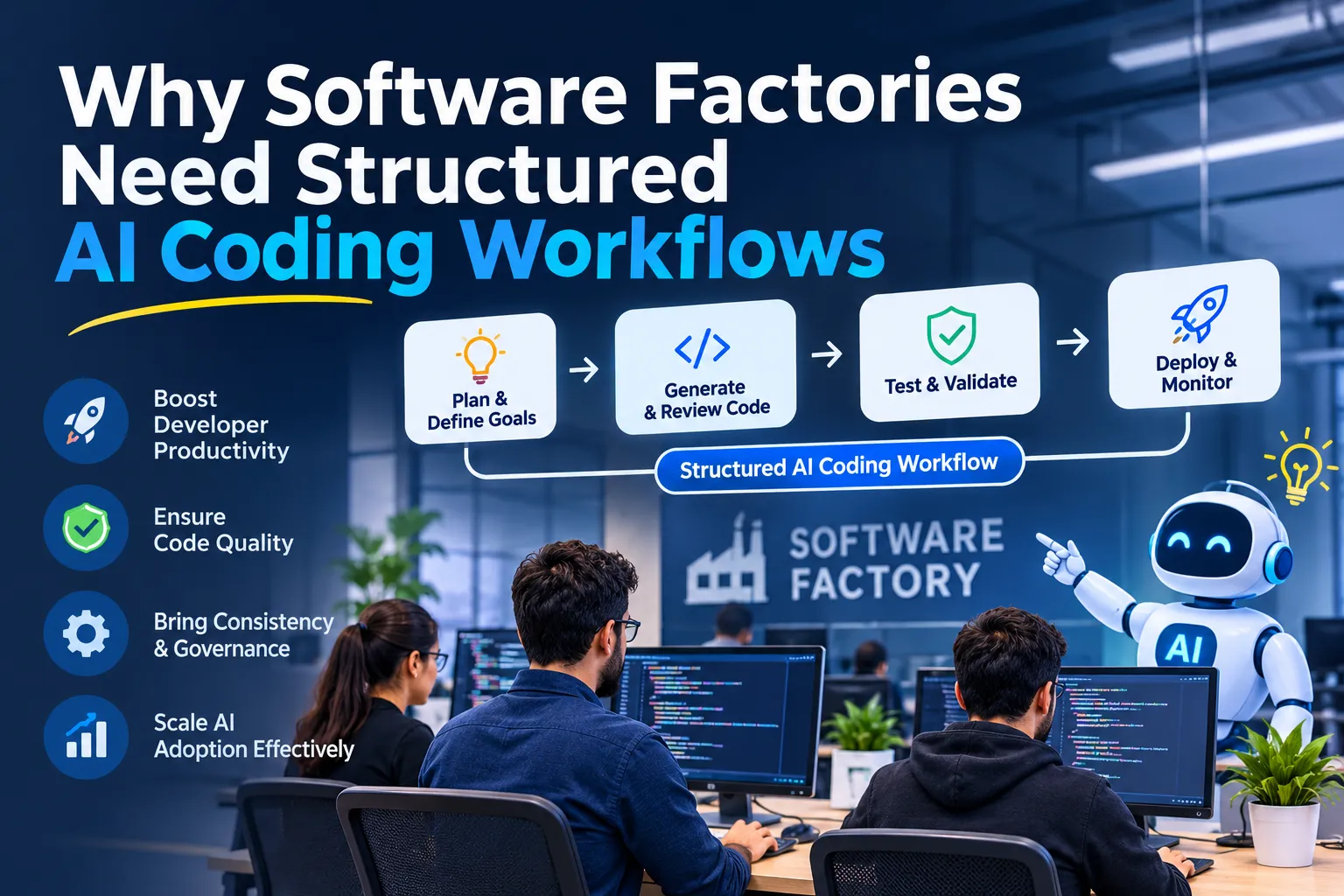
Software development is changing as AI coding tools and autonomous agents become part of everyday engineering work. Developers now use AI to generate code, debug errors, write tests, review changes, and understand complex codebases. However, using AI tools alone does not automatically create an efficient software development process.
This is where a structured AI Coding Workflow becomes important.
A software factory needs a consistent approach to managing AI-assisted development, from understanding requirements to testing, reviewing, and delivering software. Without defined workflows, teams may face inconsistent code quality, repeated errors, limited visibility, and difficulties managing AI-generated changes.
Structured AI coding workflows help software factories connect developers, AI coding assistants, and engineering processes within a more organized development environment.
What Is an AI Coding Workflow?
An AI Coding Workflow is a structured process that guides how developers use artificial intelligence throughout the software development lifecycle.
It defines how AI tools support different development activities, including:
- Understanding project requirements
- Exploring existing codebases
- Planning software changes
- Generating and modifying code
- Running tests and debugging
- Reviewing AI-generated code
- Validating software changes
For example, a developer working with Cursor or VS Code can use an AI coding assistant to understand a codebase, generate a feature, identify errors, and suggest improvements.
However, a structured workflow ensures that each activity follows a defined process instead of relying entirely on individual prompts or random AI interactions.
Why Do Software Factories Need Structured AI Coding Workflows?
A modern software factory manages multiple development activities, projects, developers, and technologies. As AI becomes part of these operations, teams need more than code-generation tools. They need repeatable processes that maintain consistency and control.
Here are five important reasons structured AI coding workflows matter.
1. Maintain Consistency Across Development Teams
Different developers may use different AI coding tools, prompts, and development approaches. This can create inconsistent coding practices across projects.
A structured AI development workflow establishes common steps for planning, implementation, testing, and code review.
For example, teams can define how developers should provide project context, review AI-generated code, and validate changes before merging them.
This helps software factories maintain consistent engineering practices across development teams.
2. Improve the Quality of AI-Generated Code
AI coding assistants can generate code quickly, but generated code still requires technical validation.
It may contain incorrect logic, introduce security weaknesses, miss edge cases, or fail to follow existing architectural standards.
A structured AI Coding Workflow includes testing, debugging, code review, and validation as essential development activities.
Developers can review generated code, run automated tests, inspect dependencies, and verify whether the implementation meets project requirements.
The objective is not simply to generate more code. It is to deliver reliable, maintainable software.
3. Reduce Unstructured AI-Assisted Development
Many developers use AI tools through individual prompts without following a consistent development process. This approach is often associated with ad hoc AI coding or vibe coding.
Although it can be useful for experimentation and quick prototypes, unstructured AI-assisted development can become difficult to manage in larger projects.
A structured workflow connects AI-assisted activities into a repeatable process.
For example:
- Define the development task.
- Understand the existing codebase.
- Create an implementation plan.
- Generate or modify code.
- Run tests and identify issues.
- Review and validate the final changes.
This gives developers a clearer path from requirements to working software.
4. Increase Visibility Into AI-Assisted Development
As software factories adopt AI coding agents, engineering leaders need to understand how AI contributes to development activities.
Simply knowing that a developer used an AI coding assistant does not explain how the work was completed.
Structured workflows can help teams document development steps, implementation decisions, testing activities, and review outcomes.
This creates better visibility into AI-assisted software engineering and helps teams understand where human review is required.
5. Support Scalable Software Development
A software factory must support growing development requirements without allowing engineering practices to become inconsistent.
Structured AI workflows provide repeatable processes that teams can apply across projects and development environments.
They also help organizations establish standards for AI tool usage, code validation, testing, and human oversight.
As AI adoption grows, these processes become increasingly important for maintaining software quality and engineering accountability.
Related Blog “https://savyre.com/what-is-an-ai-software-factory-how-ai-agents-are-changing-software-development“
Key Stages of a Structured AI Coding Workflow
An effective AI-powered software development workflow should cover the major stages of software engineering.
The following stages provide a practical example:
| Stage | Development activity |
| Requirements | Understand business needs and technical requirements |
| Codebase Discovery | Explore existing architecture, files, and dependencies |
| Planning | Define implementation steps and expected outcomes |
| Implementation | Use AI coding assistants to generate or modify code |
| Testing | Run tests and identify potential issues |
| Code Review | Review logic, quality, and architectural consistency |
| Validation | Verify changes before integration or deployment |
These stages help developers use AI systematically while keeping important engineering decisions under human supervision.
The exact workflow can vary depending on project complexity, team structure, and development tools.
AI Coding Workflow vs. Unstructured AI Coding
The main difference is how AI-assisted development activities are organized and validated.
| Unstructured AI Coding | Structured AI Coding Workflow |
| Relies on individual prompts | Follows defined development stages |
| Limited process consistency | Repeatable engineering practices |
| Manual context sharing | Organized codebase discovery |
| Inconsistent validation | Defined testing and review steps |
| Limited process visibility | Better development traceability |
| Difficult to standardize | Easier to apply across teams |
Structured workflows do not eliminate developer flexibility. Instead, they provide a reliable foundation for using AI tools across software projects.
How Savyre Supports Structured AI Coding Workflows
Building an effective software factory requires more than adopting AI coding assistants. Teams also need a structured way to manage AI-assisted engineering activities.
Savyre provides an AI coding workflow designed to help developers organize software development activities within VS Code and Cursor.
Its approach focuses on connecting important engineering stages, including requirements understanding, codebase discovery, planning, implementation, testing, and review.
Instead of relying entirely on disconnected AI prompts, developers can follow a more structured development process.
This helps engineering teams bring consistency to AI-assisted software development while keeping developers involved in implementation decisions and code validation.
For organizations exploring AI-native software development, structured workflows can provide a practical foundation for integrating AI into everyday engineering operations.
What Is the Future of AI-Powered Software Factories?
The future of software factories will involve closer collaboration between human developers, AI coding assistants, and autonomous coding agents.
AI agents are increasingly being used to support tasks such as code generation, debugging, testing, and code analysis. However, organizations still need clear processes to coordinate these activities.
Future software factories are likely to focus on:
- Agent orchestration across development tasks
- AI-native software development workflows
- Automated testing and code validation
- Consistent engineering standards
- Human oversight of AI-generated changes
- Better visibility into AI-assisted development
The goal is not to remove developers from the software development lifecycle. It is to help engineering teams use AI more effectively while maintaining quality, accountability, and control.
Conclusion
Software factories need structured AI coding workflows because adopting AI tools without defined engineering processes can create inconsistencies and make software quality difficult to manage.
A structured AI Coding Workflow connects requirements, planning, implementation, testing, and code review into a repeatable development process.
For modern engineering teams, this approach provides a foundation for scaling AI-assisted software development while keeping human judgment and technical validation central to software delivery.
Frequently Asked Questions (FAQs)
1. What is a structured AI Coding Workflow?
A structured AI Coding Workflow is a defined process for using AI tools across software development activities, including planning, coding, testing, debugging, and code review.
2. Why do software factories need AI coding workflows?
Software factories need AI coding workflows to standardize development practices, improve code validation, manage AI-generated changes, and support consistent engineering processes.
3. How do AI coding workflows improve developer productivity?
They help developers organize repetitive development activities, understand codebases, generate code, identify errors, and follow consistent testing and review practices.
4. What is the difference between AI coding and AI-assisted software development?
AI coding generally refers to using AI to generate or modify code. AI-assisted software development is broader and includes planning, codebase understanding, testing, debugging, review, and validation.
5. Which tools support AI coding workflows?
Tools such as Cursor, Visual Studio Code (VS Code), GitHub Copilot, and Claude Code can support different stages of AI-assisted software development.
6. Can AI coding workflows support large software development teams?
Yes. Structured workflows can help larger teams establish consistent development practices, define validation requirements, and coordinate AI-assisted engineering activities across projects.






Sign in to leave a comment.