

Software projects are usually organized around project plans. Teams define requirements, assign responsibilities, estimate timelines, establish milestones, and track progress. A project plan provides structure and helps everyone understand what needs to be delivered. However, when organizations begin custom software development, the project also involves numerous technical and business decisions that can influence the final outcome.
But software projects also involve another type of information that can have a major impact on their success: the decisions made during development.
Why was one technology selected over another? Why was a feature postponed? Why did the team change an integration approach? Why was a particular business rule implemented in a certain way?
These decisions are often spread across meetings, emails, chat messages, documents, or individual memories. Months later, the original reasoning can be difficult to reconstruct.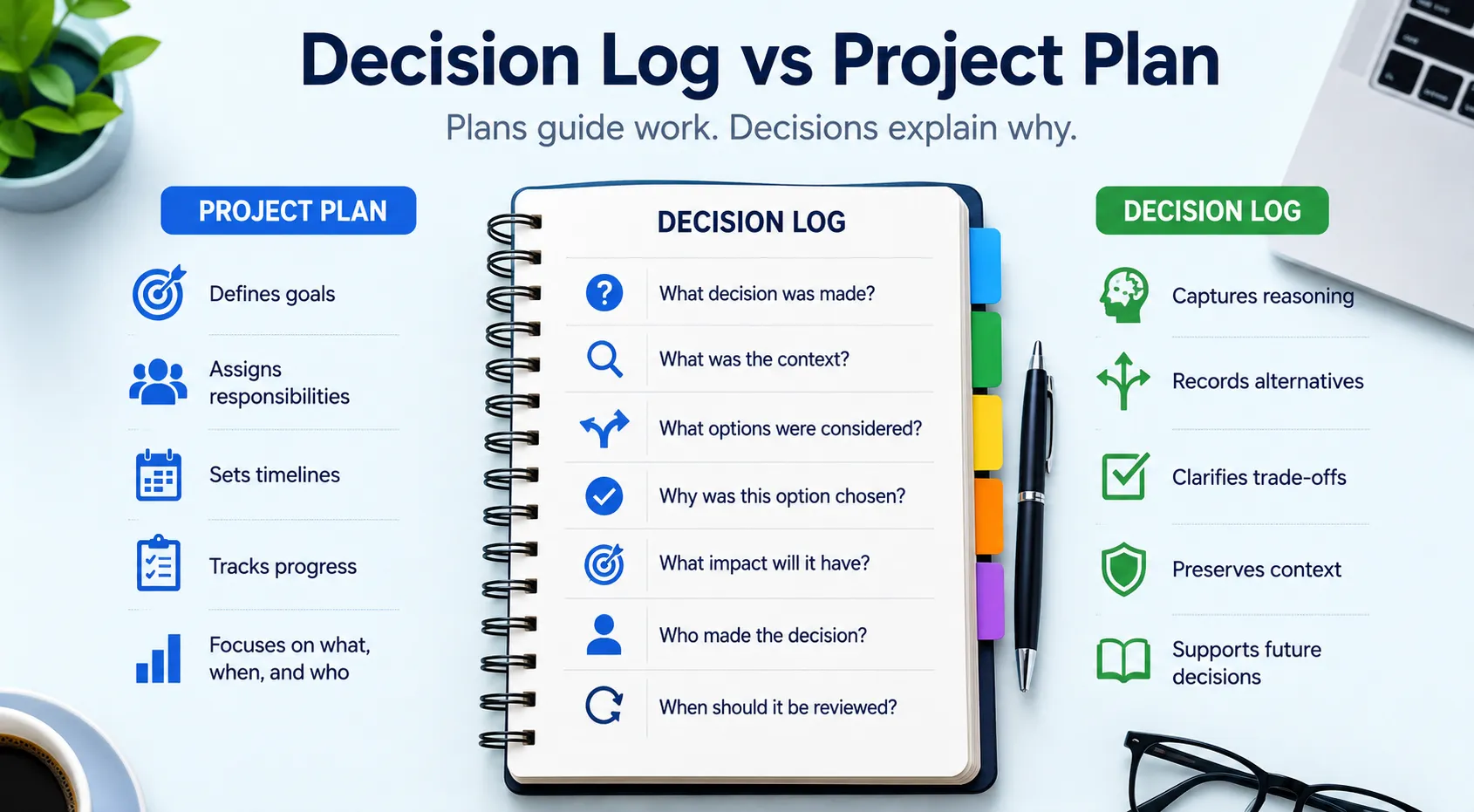
This is where a decision log can help.
A decision log is a structured record of important project decisions, the reasoning behind them, the alternatives considered, and their expected impact. It does not replace a project plan. Instead, it complements the plan by preserving the reasoning behind the project's evolution.
What Is a Software Project Decision Log?
A decision log is a continuously updated record of significant decisions made during a software project.
A typical entry can include:
- Decision: What was decided?
- Date: When was it decided?
- Context: What problem led to the decision?
- Options considered: What alternatives were evaluated?
- Reason: Why was the selected option preferred?
- Impact: What could change as a result?
- Owner: Who was responsible for the decision?
- Status: Is the decision active, under review, or replaced?
For example, a development team may need to decide whether a new application should communicate with an existing business system through direct database access or an API.
Simply recording "API integration selected" provides little context.
A better record could explain that direct database access was considered but rejected because of security, maintainability, and future system-change concerns.
That additional context can become valuable later.
Why Project Plans Are Not Enough
Project plans primarily answer questions such as:
- What are we building?
- Who is responsible?
- When should it be completed?
- What are the project milestones?
- What resources are required?
They are less effective at documenting why specific choices were made.
During a software project lasting several months, teams can make hundreds of decisions related to architecture, database design, integrations, security, user permissions, deployment, data migration, reporting, and feature priorities.
A project plan may show that these activities happened, but it may not explain the reasoning behind them.
That gap becomes more important as projects grow and more people become involved.
1. Decision Logs Reduce Repeated Discussions
A common problem in long-running software projects is revisiting decisions that have already been made.
A stakeholder may ask why a particular approach was selected. A new developer may question an architectural choice. A product manager may suggest an option that the team previously rejected.
Without documentation, the team may need to reconstruct the original discussion.
This can lead to:
- repeated meetings
- unnecessary debates
- project delays
- conflicting interpretations
- decisions being reversed without understanding their consequences
A decision log provides a reference point.
It allows teams to review the original context instead of relying entirely on memory.
The purpose is not to prevent decisions from changing. Decisions should change when new information justifies a different approach. The goal is to make those changes deliberate rather than accidental.
2. It Preserves Context When Team Members Change
Software projects can continue for months or years. During that time, people may join, leave, or change responsibilities.
A developer who joins halfway through a project may see a technical implementation without understanding why it exists.
Similarly, a new product manager may inherit requirements without knowing which assumptions influenced them.
A decision log can shorten this learning curve.
Instead of asking several people, "Why did the team build it this way?", a new team member can review the relevant decision records.
This is particularly useful for distributed teams where important conversations may happen across different communication tools and time zones.
3. It Makes Trade-Offs Visible
Most software decisions involve trade-offs.
There is rarely an option that is simultaneously the cheapest, fastest, easiest to maintain, most scalable, and most secure.
Teams often have to balance competing priorities.
For example, a project may prioritize:
- faster implementation over extensive customization
- scalability over short-term simplicity
- lower operating costs over additional infrastructure
- flexibility over development speed
Recording these trade-offs helps future team members understand that an outcome was not necessarily an oversight.
It may have been a deliberate compromise based on the information available at the time.
A technical decision that appears questionable in isolation may make sense once its original constraints are understood.
4. It Improves Communication Between Technical and Business Teams
Software projects often involve people with different priorities.
Business stakeholders may focus on customer experience, operational efficiency, revenue, deadlines, compliance, and business goals.
Technical teams may focus on architecture, maintainability, security, performance, integrations, and infrastructure.
A decision log can create a shared record between these groups.
For example:
Business requirement: Reduce manual processing time.
Options considered: Manual workflow improvement, third-party automation, or a configurable workflow.
Decision: Implement a configurable workflow.
Reason: The workflow needs to support operational rules that may change over time.
This format connects the technical decision to the original business objective.
5. It Helps Prevent Scope Creep
Scope creep does not always happen because stakeholders deliberately add unnecessary features.
Sometimes it happens because previous decisions are forgotten.
A stakeholder may request a feature that was previously excluded because it did not fit the initial business case. If the reasoning is no longer visible, the request may simply be treated as a new requirement.
A decision log can provide historical context.
It can show:
- why a feature was excluded
- what assumptions were made
- what dependencies existed
- what risks were identified
- what conditions could justify reconsidering it
This does not mean old decisions should remain permanent. Instead, it gives the team a starting point for evaluating whether circumstances have changed.
6. It Makes Technical Debt Easier to Understand
Technical debt is not always accidental.
Sometimes teams deliberately choose a simpler implementation to meet a deadline, launch a product, or test an idea.
If that decision is undocumented, future developers may interpret the implementation as poor engineering.
A decision log can explain that a simplified approach was selected for an initial release, with a future review planned after more information becomes available.
That context helps future teams understand what should be improved and why.
What Should Be Recorded?
Not every decision needs an entry. Recording every minor conversation can make the process difficult to maintain.
A useful rule is to document decisions that could affect:
- architecture
- security
- cost
- timeline
- scope
- integrations
- data
- compliance
- scalability
- user experience
- long-term maintenance
A simple question can help:
"Would someone need to know why we made this choice six months from now?"
If the answer is yes, the decision is probably worth recording.
Routine activities such as assigning ordinary development tasks, scheduling meetings, or correcting minor errors generally do not need individual entries.
How to Create an Effective Decision Log
A decision log does not require specialized software.
A spreadsheet, project-management tool, documentation platform, or internal knowledge base can work.
The important part is consistency.
A practical structure can include:
| Field | Purpose |
| Decision ID | Provides a unique reference |
| Date | Records when the decision was made |
| Decision | Clearly states the outcome |
| Context | Explains the problem |
| Alternatives | Shows options considered |
| Reason | Documents the selection criteria |
| Impact | Records expected consequences |
| Owner | Identifies accountability |
| Status | Shows whether the decision remains active |
The language should also be clear enough for someone outside the original discussion to understand.
Instead of writing "Option B chosen based on discussion," explain what Option B was and why it was selected.
When Should a Decision Be Recorded?
The best time to document an important decision is shortly after it has been made.
Waiting until the end of a project creates problems because people forget details and different participants may remember conversations differently.
A simple workflow can be:
- Identify a decision that requires discussion.
- Record the problem or question.
- List the realistic alternatives.
- Discuss the trade-offs.
- Make the decision.
- Record the reasoning.
- Assign follow-up responsibilities if required.
- Review the decision if important assumptions change.
This process can remain lightweight while still providing useful historical information.
The Goal Is Better Decisions, Not More Documentation
The biggest mistake is treating a decision log as another administrative requirement.
The objective is not to create more paperwork. It is to preserve decision context.
A useful decision log should make it easy to answer three questions:
What did we decide?
Why did we decide it?
What would need to change for us to reconsider it?
If a project can answer these questions consistently, teams become less dependent on memory and informal conversations.
Conclusion
Project plans provide a roadmap for software delivery, but they do not always preserve the reasoning behind that roadmap.
A decision log fills this gap.
By recording important choices, alternatives, assumptions, trade-offs, and expected impacts, development teams can reduce repeated discussions, improve onboarding, preserve institutional knowledge, and make future changes more deliberate.
The approach does not require a complicated process. A simple, consistently maintained record can be enough.
As software projects become more interconnected and teams become increasingly distributed, knowing why something was built can be just as important as knowing what was built.
Frequently Asked Questions
What is a decision log in software development?
A decision log is a structured record that captures significant decisions made during a software project. It includes details such as the decision itself, the context in which it was made, alternatives considered, the reasoning behind the choice, and its expected impact.
Why are project plans not enough for software projects?
Project plans primarily outline what needs to be built, who is responsible, and when tasks should be completed. However, they often lack documentation of the rationale behind specific decisions, which is crucial for understanding project evolution and avoiding repeated discussions.
How can a decision log reduce repeated discussions among team members?
A decision log serves as a reference point for previously made decisions, helping to avoid unnecessary debates and confusion. By documenting the context and reasoning, it allows team members to quickly review past choices instead of relying on memory.
What should be recorded in a decision log?
Key entries in a decision log should include the decision itself, the date it was made, the context or problem it addresses, the alternatives that were considered, the rationale for the selected option, and its potential impact. Documenting decisions that could affect important aspects of the project is essential.
How can a decision log improve communication between technical and business teams?
A decision log creates a shared record that links technical choices to business objectives, helping both teams understand the reasoning behind decisions. This transparency fosters better collaboration and ensures that all stakeholders are aligned with the goals of the project.
What is the best time to document a decision in a decision log?
The best time to document a decision is shortly after it is made, as this ensures the context and details are fresh in participants' minds. Waiting until later can lead to forgotten details or differing recollections, making accurate documentation more challenging.
How does a decision log help prevent scope creep in software projects?
A decision log provides historical context that can clarify why certain features were excluded or decisions were made. This documentation helps stakeholders remember past discussions, making them less likely to introduce changes that conflict with established project parameters.






















Sign in to leave a comment.