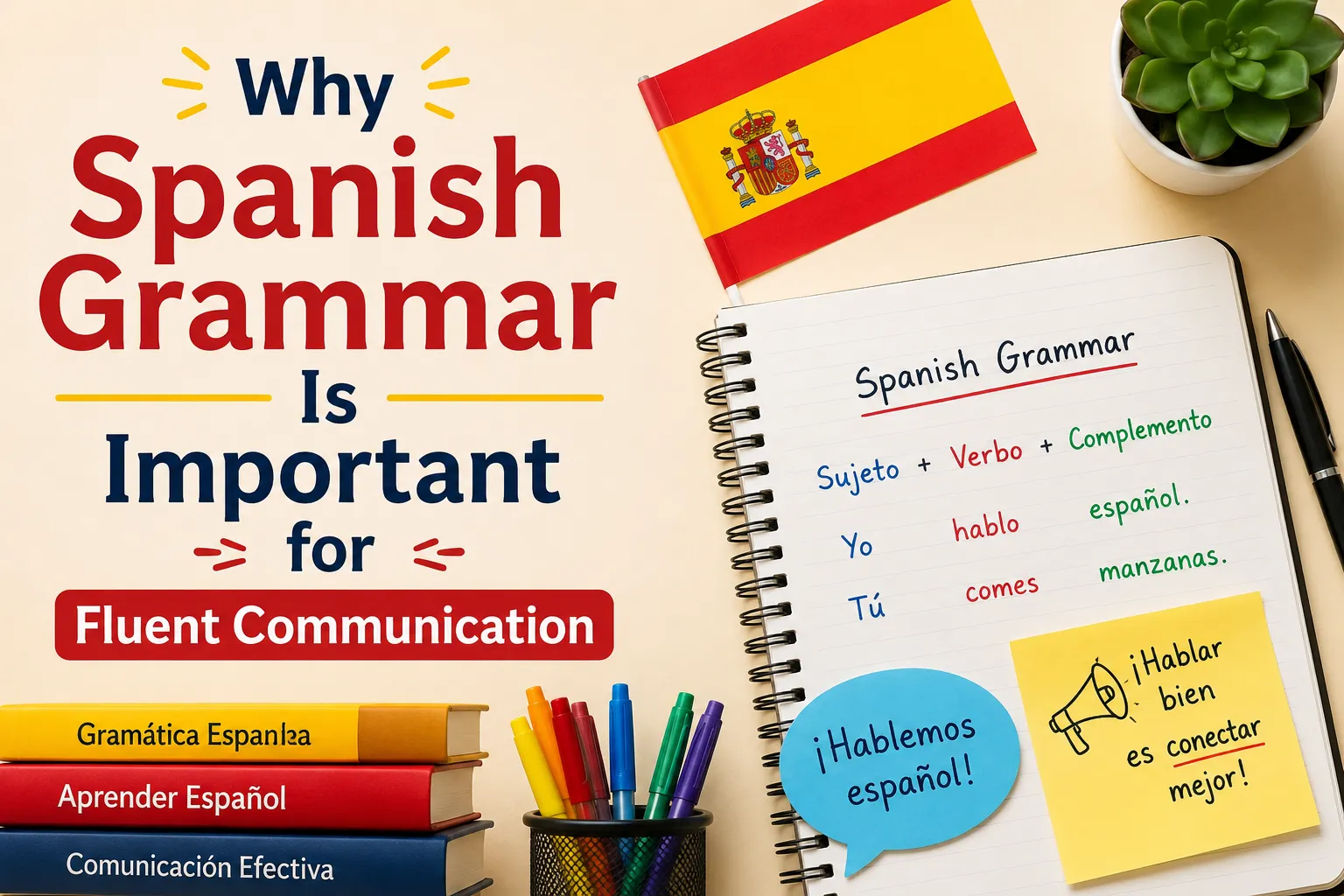

The beauty of learning Spanish is that it exposes you to new cultures, better job prospects, and great discussion. As many learners read and pronounce vocabulary, grammar is still a dominant subject. If people imagine how they can express ideas properly, to make sense of writing to understand each other and weave a proper story without using formal good grammar or punctuations, it would be so much of a total mess. Grammar is basically the icing on top of your cake, that delivers accuracy in sentences and encourages communication quality. Whether you are learning to travel, an education, business or the improvement of your person for each reason you will speak like a natural and start making common mistakes while speaking.
Why Grammar is Helpful for Learning Spanish
Like every language grammar is a road map; it tells you how to put words together. It describes the relationship between words that creates coherent sentences. Grammar refers to the rules that govern sentence structure, verb conjugation, etc. as well as the use of gender with nouns (masculine vs females), adjectives, pronouns and tenses in Spanish.
Grammar is essential because it gives learners the building blocks for creating sentences on their own instead of cramming single, set phrases into their memory. This gives flexibility and a natural way to communicate. Learners do not guess on how to speak, they know exactly what to say.
Good grammar also makes listening and reading more effective, as learners can see (and hear) how sentences are structured.
Why Grammar Improves Fluency
Most people think that the way to be fluent is by speaking regularly. They practice, but grammar guides learners to speak correctly. And if you already know grammar rules, you can spend less time thinking about how to form sentences and more time concentrating on the conversation.
If you have good grammar, you can describe events, express opinions, ask questions and explain ideas with confidence. The more you understand, the easier it becomes to speak.
Spoken fluency does not mean talking fast. It is about clarity of communication, and grammar aids in this endeavor.
Understanding Spanish Sentence Structure
Although Spanish word order looks a lot like English, there are key differences. Depending on what we want to stress, the word order is not the same and adjectives tend to follow nouns.
By learning these patterns, learners can circumvent direct translations to English. Instead, they start to conceive in Spanish and express themselves more fluidly.
This approach allows learners to decode sentence patterns, verb usage, agreement rules and common grammatical structures that provide the basis for everyday communication at this stage in life when they are studying complete spanish grammar.
Grammar prevents you from making common mistakes
However, every beginner actually makes mistakes when learning a new language. But, quite simply, by knowing grammar you will commit fewer mistakes.
Common grammar mistakes include:
- Using incorrect verb forms
- Confusing masculine and feminine nouns
- Mixing different tenses
- Incorrect adjective agreement
However, when these errors are addressed in a timely fashion, students develop more durable language skills They feel more secure when conversing with native speakers, and crafting professional messages.
It also identifies their faults, to help the learners to continuously improve.
Speak Better By Correctly Using Verbs
Spanish verbs are categorized according to the Subject, Tense and Event. One of the most significant aspects of Spanish grammar is you learn verb conjugation, and this is so-called because of course.
Take, for example, I speak vs you speak vs they speak.
By learning conjugation, one is able to talk about:
- Daily routines
- Past experiences
- Future plans
- Personal opinions
- Wishes and possibilities
Once you get the hang of verb patterns it is much easier to speak.
In Real Conversations 7 Grammar That Builds Confidence
For instance, many learners are afraid to speak because they feel it is not correct. Good knowledge of grammar alleviates this fear.
Learners are usually comfortable having conversations with others when they know how to structure a proper sentence. Questions can be asked and experiences can be shared without memorized expressions, but instead with thoughts constructed from their understanding.
With every successful conversation, your confidence grows and language learning becomes more and more of a delight!
Better Writing Skills Through Grammar
Just as ESL incorporated speaking, grammar in writing is equally as important. Clarity in Sentence Structure — Emails, messages, assignments and business communication.
Proper grammar improves:
- Professional communication
- Academic writing
- Social media posts
- Travel communication
- Business emails
Good Spanish makes for a positive impression and shows that you have mastered the language.
Grammar Improves Listening and Reading
Because you know the grammar behind it, understanding native speakers is much easier. Rather than translates each individual word, learners identify sentence patterns and gain understanding about the concept as a whole.
Grammar helps learners find connections between words and sentences, making reading newspapers, books, blogs, and articles easier.
The result is a full learning cycle in which reading, listening, speaking and writing improve in concert.
Studying grammar simplifies advanced Spanish
At some point, every learner gets to a point in which conversations become more nuanced. These topics like work, education, culture and travel need adequate vocabulary.
Having good grammar makes it easier to learn:
- Complex sentence structures
- Advanced verb tenses
- Formal communication
- Idiomatic expressions
- Native-level conversations
Rather than struggle to learn the fundamentals, focus on expanding your vocabulary and fluency.
Combining Grammar with Speaking Practice
Grammar alone is not enough. You gain the most from grammar lessons, if you have also been practicing speaking as often as possible.
Far more naturally, grammar is reinforced through reading aloud, listening to Spanish conversations, writing small passages and speaking with language partners. Each dialogue opens up a chance to put lessons into practice.
Students who practice regularly recall grammar better than students who learn from textbooks.
A beginner spanish speaking course can train you to converse in a guided way, using grammar naturally as the need for it arises while also working on pronunciation and vocabulary simultaneously increasing overall confidence when communicating in real life scenarios.
Conclusion
Spanish grammar is the gateway to precise, accurate (and confident!) communication. It gives you the framework you need to create meaningful sentences, to not make mistakes that-intermediate-level learners are prone to making and improve your understanding of native speakers. Back then; vocabulary trains you for what to say, grammar teaches how to actually say it. Instead, this type of fluency is developed with consistent speaking, reading, writing, and listening practice that involves grammar over time. That being said, knowing Spanish grammar whether its career growth, travel, further education or for personal development will ensure you a more successful and pleasant learning experience.




























Sign in to leave a comment.