

Google Analytics 4 gives marketing teams valuable information about website and app activity. It can show where users arrive from, which pages they visit, what events they trigger and whether important conversions take place.
The challenge begins when marketers need answers that go beyond those predefined views. A campaign may generate conversions in GA4, for example, but the marketing team may still need to understand content quality, advertising cost, customer value or what happened after the initial conversion.
GA4 remains an important analytics source, but it is only one part of the marketing picture. Better analysis often requires combining its behavioural data with information held elsewhere in the business.
GA4 Shows Behaviour, Not the Entire Business Story
GA4 is designed primarily to measure activity across websites and applications. It can help teams understand sessions, users, events, traffic acquisition, landing pages and conversion behaviour.
The questions marketers ask, however, frequently cross the boundary between website activity and commercial performance. Knowing that a channel produced leads does not automatically explain whether those leads became customers or generated meaningful revenue.
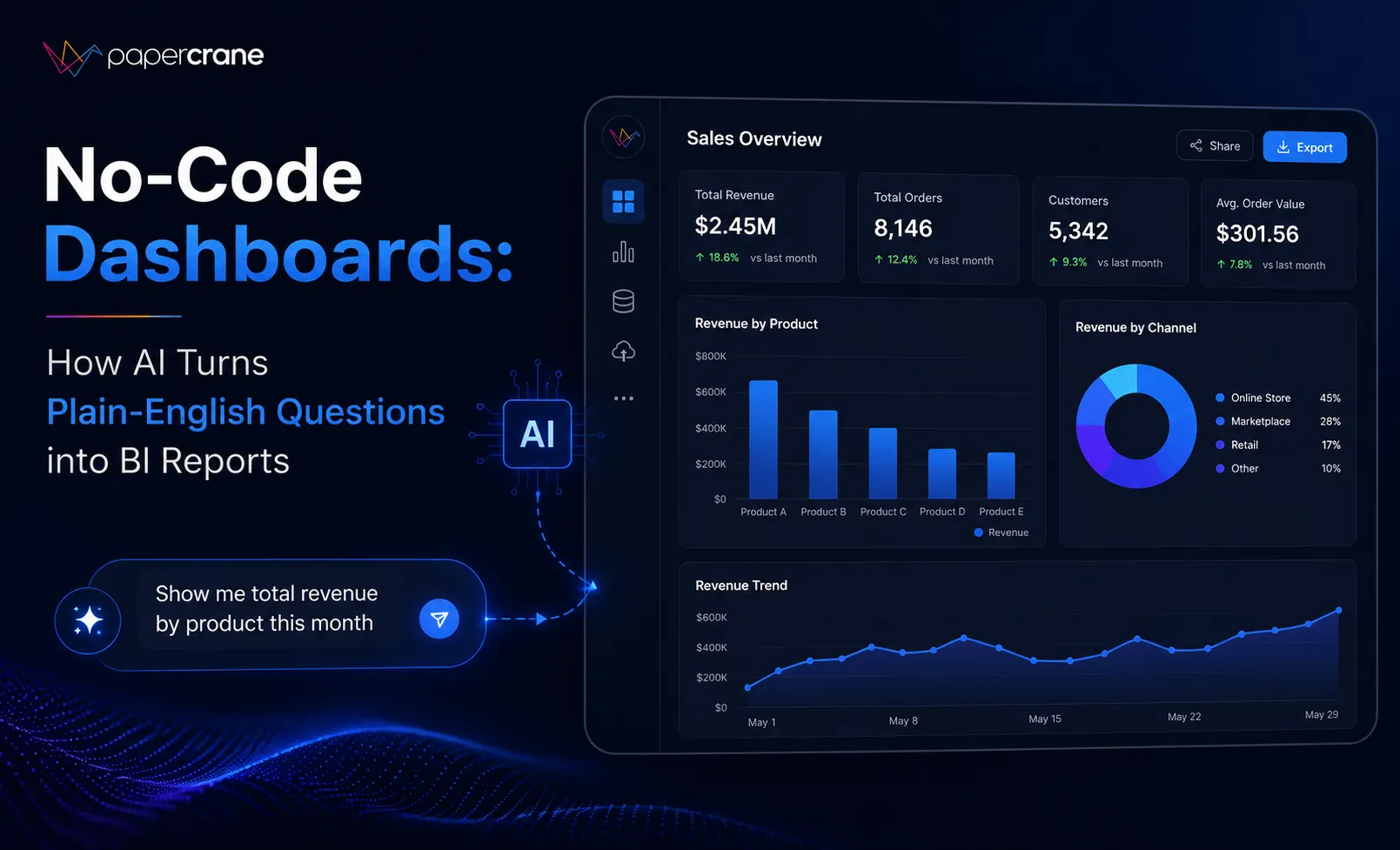
Teams using custom marketing analytics dashboards can bring different sources into a reporting workflow built around the question they actually need to answer. Papercrane allows connected business data to be explored without treating GA4 as the only source of marketing truth.
Standard Reports Are Built for Common Questions
GA4 includes reports designed to cover widely used analytics needs. This is useful because marketers can quickly review acquisition, engagement and user behaviour without building every report themselves.
The limitation is that a standard report cannot anticipate every company’s marketing model. A SaaS business, online retailer and B2B service company may all define successful marketing differently.
A standard report might answer:
- Where did visitors come from?
- Which pages received traffic?
- Which events were completed?
- Which devices were used?
- How did users engage with the site?
It may not answer what happened after those actions entered another business system.
A Conversion Does Not Always Equal Business Value
One of the biggest reporting mistakes is treating every recorded conversion as equally valuable. Two campaigns may generate the same number of conversions while producing very different commercial outcomes.
A form submission might become a qualified sales opportunity, an unsuitable enquiry or no further action at all. GA4 can record the website event, but the later sales journey may take place inside a CRM.
This is why marketing teams should distinguish between activity metrics and outcome metrics. Website conversions are useful signals, but they should be interpreted alongside lead quality, sales progress and revenue where possible.
Attribution Becomes More Complicated Across Channels
Modern customer journeys rarely involve one interaction. A person may discover a brand through paid search, return through organic search, read several articles and later convert after clicking an email.
Marketers therefore need to be careful when asking which channel “caused” a conversion. Attribution models simplify a customer journey into rules that help distribute credit, but they do not recreate every influence on the final decision.
Instead of relying on one attribution view, teams can compare:
- First meaningful interaction
- Conversion-driving sessions
- Assisted touchpoints
- Campaign cost
- Lead or customer quality
- Revenue associated with acquired customers
Advertising Performance Needs Cost Context
GA4 can show user behaviour after people arrive on a site, but advertising decisions also depend on campaign spend, budgets, keywords and ad-group performance.
A campaign with strong website engagement may still be inefficient if acquiring those visitors costs significantly more than other channels. Likewise, a campaign with lower traffic could be more valuable when the resulting customers are commercially stronger.
Combining analytics with Google Ads campaign performance data gives marketers more context around spend, conversions, keywords and return on investment. Papercrane supports Google Ads reporting alongside other connected sources rather than forcing marketers to assess advertising activity separately.
Marketing Questions Often Span Several Systems
A marketing funnel may begin in an advertising platform, continue through the website and eventually move into a CRM, payment platform or product database. Each system records a different stage.
Looking at these platforms separately makes it difficult to see where performance actually changes. High website conversion numbers may hide poor sales qualification, while low traffic may still generate valuable customers.
A more complete analysis may connect:
| Marketing question | Likely data needed |
| Which campaign generates the best customers? | Ads + GA4 + CRM |
| Which content influences conversions? | CMS + GA4 |
| Which channel delivers strongest ROI? | Ads + CRM + revenue |
| Where does the funnel lose users? | GA4 + product or CRM |
| Which acquisition source retains customers? | GA4 + customer data |
Audience Averages Can Hide Important Differences
Overall traffic and conversion rates provide useful benchmarks, but averages can conceal major differences between customer groups.
New visitors may behave differently from returning users. Mobile traffic may convert differently from desktop traffic, while customers from one acquisition source may remain engaged longer than those from another.
Useful segmentation can involve:
- Acquisition channel
- Landing page
- Device category
- Geography
- New versus returning users
- Campaign
- Customer type
The segment should always be chosen because it helps answer a business question, not simply because the dimension is available.
Content Performance Requires More Than Page Views
Content teams often start by reviewing views, users, engagement and conversions in GA4. These metrics help explain what happens after content is visited, but they do not always provide enough context about the content itself.
Editors may want to compare performance by category, publication date, author, topic or content type. Some of that information may live in a content management system rather than GA4.
Connecting content performance reporting with analytics data can help teams compare editorial information with audience behaviour. Papercrane supports WordPress data such as posts, pages, categories and engagement information that can complement wider marketing analysis.
Tracking Quality Limits What Reports Can Explain
Sometimes the problem is not the standard GA4 report. The underlying tracking simply does not capture enough information to answer the question.
An important form may be submitted without a meaningful event, campaign parameters may disappear during a journey, or internal traffic may distort behaviour. A dashboard cannot accurately analyse information that was never collected.
Before creating more reports, teams should check:
- Are important actions tracked?
- Are event names consistent?
- Are conversions clearly defined?
- Are campaign parameters reliable?
- Are important user journeys measurable?
Better reporting starts with better measurement.
Marketing Teams Need Questions Before Dashboards
It is easy to add more charts whenever stakeholders request greater visibility. This often produces a crowded dashboard without improving decision-making.
A better approach begins with the decisions marketers need to make. If the goal is improving paid acquisition, the dashboard should connect spend, traffic, conversions and downstream value rather than displaying every available GA4 metric.
The same principle applies to content, SEO, email and other channels. Each report should explain a specific part of marketing performance and make the next action clearer.
GA4 Is Stronger as Part of a Wider Analytics Picture
Standard GA4 reports remain useful for understanding website and application behaviour. They provide a common foundation for monitoring acquisition, engagement and important events without requiring every organisation to build reporting from scratch.
They become less complete when marketing questions involve costs, CRM stages, content attributes, revenue or customer behaviour beyond the website. These questions require context that GA4 alone may not contain.
The goal is not to replace GA4. It is to use its behavioural data alongside other business information so marketing teams can move from asking what happened on the website to understanding what those interactions meant for the business.



























Sign in to leave a comment.