Organizations need to create sanctions programs that are both strong and clearly effective in a time of rising geopolitical risk and stricter enforcement. The Association of Certified Sanctions Specialists (ACSS) is now one of the best places to get practical, role-based training on how to follow sanctions rules that help professionals deal with the complicated rules we have today. ACSS gives compliance teams the real-world tools they need to handle sanctions risk by combining structured curricula, flexible learning formats, and a credential that is recognized around the world.

As the stakes get higher, targeted sanctions compliance training becomes more important
Sanctions regimes are changing faster than ever. Frequent updates to the list of designated people, more secondary sanctions, and cross-border enforcement all mean that just checking a list is no longer enough. As regulatory expectations grow, companies must prove that they have good governance, risk-based controls, and staff who are always learning. Sanctions compliance training of high quality now serves two purposes: it lowers operational risk and makes a record that auditors and examiners can look at. According to industry research and market reports for 2026, both regulators and criminals will use technology more and enforcement will become more complicated. This makes structured, up-to-date training for compliance professionals even more important.
ACSS: a useful certification made for today's professionals
The Association of Certified Sanctions Specialists (ACSS) says it is a practitioner-focused group that offers the best training in sanctions and export controls. The Certified Sanctions Specialist (CSS) program is its most important one. It is meant to reflect the real-life duties of sanctions teams in banks, businesses, law firms, and the government. The ACSS curriculum includes sanctions frameworks (U.S., EU, UK, UN), screening and investigative methods, sanctions risk assessments, and enforcement trends. All of these are taught with an eye toward how they can be used in real life, not just in theory. One reason many companies look for CSS holders when hiring or promoting compliance staff is that they are practical.
Learning paths that work with busy schedules
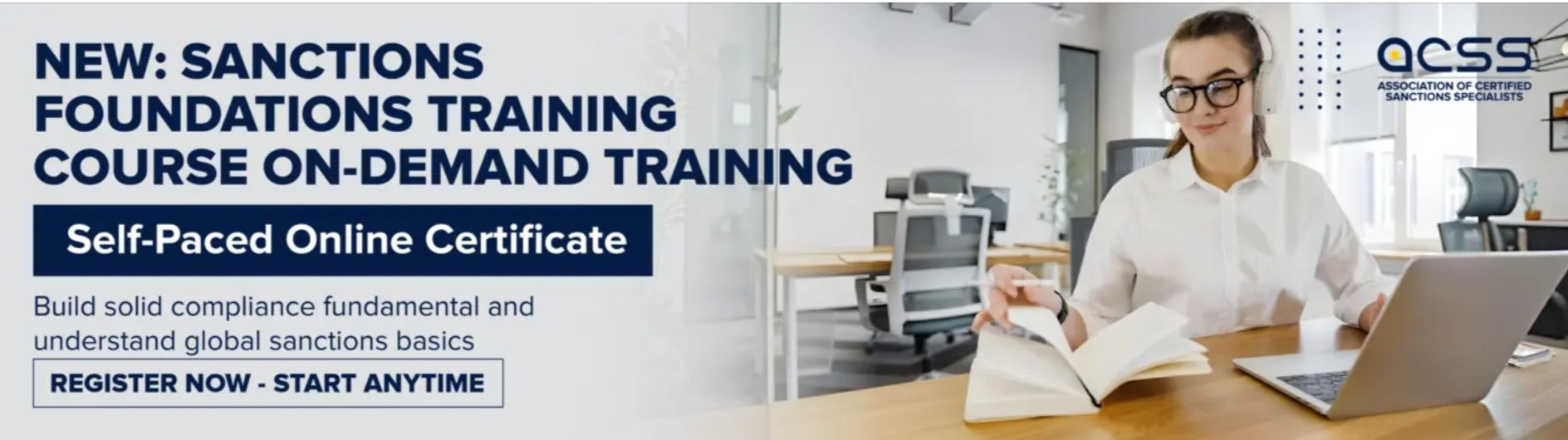
Delivery flexibility is one of ACSS's competitive strengths. The CSS program is available as an interactive virtual classroom for teams that learn best through live instruction and discussion. It is also available as a self-paced package for people who have a lot of work to do. This mixed method makes it possible for companies to offer sanctions compliance training to teams all over the world and in different time zones without losing depth. For many companies, being able to use the same content in different areas while letting students choose how fast they want to learn is a practical win for getting people to use the program and keep learning.
What is the cost and value of CSS certification?
When looking at training providers, buyers want to know two things: how much will the certification cost and what will it get them? ACSS has different prices for the CSS self-paced package for members and non-members, as well as for people who work in the public sector and people who work in the private sector. Typical published packages for self-paced CSS training cost between the mid-thousands and high-thousands of US dollars, depending on membership status and package options. Many compliance leaders think this is a good deal compared to the possible costs of enforcement fines, remediation, and damage to reputation. For businesses that need tough, practical sanctions training, the cost of CSS certification is often worth it compared to the risk of not being ready.
How CSS stacks up against other credentials for sanctions
There are a number of well-known credentials in the sanctions training market. For instance, the Certified Global Sanctions Specialist (CGSS) credential from another big provider is aimed at mid- to senior-level staff and is based on a modular course structure and in-depth case studies. CGSS focuses on layered course modules and real-world casework, while CSS usually focuses on a single, broadly applicable certification that sets a consistent level of competence for a wide range of job roles. Employers often see CGSS and CSS as two programs that work well together: CGSS for in-depth study of specific topics and CSS for basic organizational skills. You can choose one or the other, or you can combine them. It all depends on your team's needs, the seniority of the role, and your budget.
What the trends of 2026 mean for certification programs
There are a few trends in 2026 that affect both what sanctions training needs to cover and how it should be given. First, changes in technology, especially the rise of AI in screening, reducing false positives, and monitoring transactions, mean that courses need to teach not only policy but also tech governance and model risk management. Second, because rules change so quickly, certifications need to include ways for people to keep learning and get new content quickly. Third, training for sanctions compliance is moving toward scenario-based learning and tests that show applied competency instead of just finishing the work. In response, leading programs are adding modular updates, case work for practitioners, and tests that are in line with current enforcement priorities. These changes show even more why accredited, responsive programs like the ones ACSS offers are becoming more and more useful.
Benefits for businesses in real life
Companies that pay for accredited sanctions compliance training get a lot of real benefits, such as: (1) stronger, more consistent investigator skills across jurisdictions; (2) a record of training for examiners and internal audits; (3) better integration between policy, screening technology, and escalation processes; and (4) better employee retention because career-development paths are clearer. A common credential, like the CSS, helps multinational companies set clear expectations for their global operations and cuts down on fragmentation in practice.
How to choose the right path: helpful advice
Make a list of your team's roles and choose the credential that fits each one: For basic operational roles, look for CSS; for specialist or senior roles, look for advanced or modular credentials like CGSS.
Compare the total cost of ownership (the cost of certification plus the time spent out of the role) to the cost of fixing the problem and any fines that might come up. You should think about the cost of CSS certification in that larger risk context.
Put programs that offer continuing education or regular updates to their content at the top of your list to keep up with the fast changes in regulations in 2026.
In conclusion
Organizations can't rely on one-time workshops or ad-hoc training anymore because sanctions compliance is changing and becoming more important. The Association of Certified Sanctions Specialists offers a structured, globally aware, and practical way to gain competence through its CSS credential and related training programs. Companies that need to show strong sanctions governance in 2026 and beyond should invest in validated sanctions compliance training and weigh the cost of CSS certification against the program's measurable benefits. This is a smart way to lower risk and be ready for regulations.


























Sign in to leave a comment.