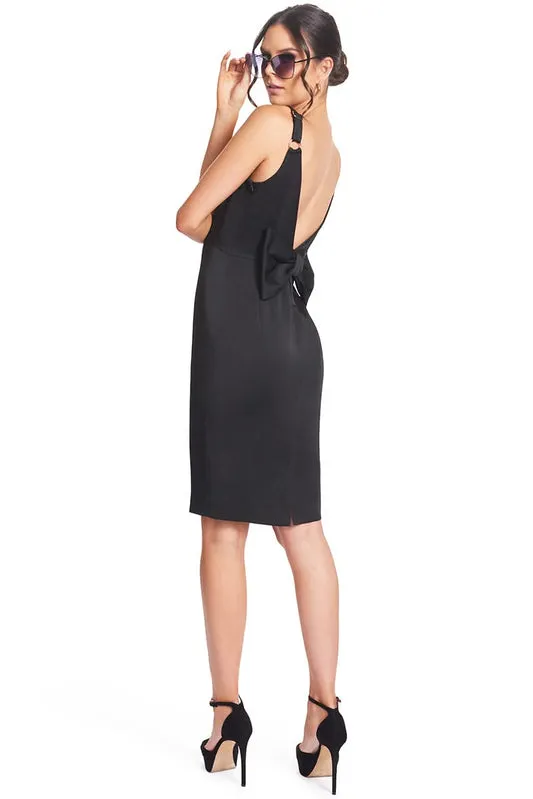
The Wardrobe Is Becoming a Statement of Intent
Fashion has always reflected the culture it lives inside. But something more deliberate is happening now. As the lines between professional life, social presence, and personal identity compress, the clothes women choose are doing more work than ever before. They are not just covering the body. They are communicating values, signaling awareness, and projecting a version of the self that is both considered and confident.
In that context, the midi dress has emerged as one of the most strategically significant garments in a woman's wardrobe. Not because it is fashionable, though it consistently is, but because it performs. It occupies the precise midpoint between structured formality and lived-in ease that modern life increasingly demands.
The black Spring midi dress, in particular, sits at the intersection of those forces. It is the piece that does not require explanation, does not need the right season to justify it, and does not ask for effort in return for results. This article examines why that is true, and why it will remain true long after the current cycle of trends has moved on.
The Intelligence of Midi Length: Why Proportion Is Strategy
Proportion is one of the most underestimated tools in fashion. The length of a hemline is not an aesthetic preference. It is a structural decision that determines how a dress reads in every context it enters.
The mini communicates one thing: energy, confidence, a certain kind of social visibility. It is powerful in the right setting and limiting in others. The maxi communicates quite another: ceremony, drama, a willingness to take up space in a particular way. Both are deliberate. Both have constraints.
The midi occupies different territory entirely. At its most effective, it lands between the knee and mid-calf, which is the range that elongates the leg without obscuring the foot and creates a clean vertical line that reads as authoritative in professional contexts and quietly alluring in social ones. Research in fashion psychology consistently shows that midi-length garments are perceived as more versatile and more polished than either extreme, across age groups, dress codes, and occasions.
That versatility is not an accident. It is the product of a length that never over-commits. A midi does not insist on a single reading. It allows the woman wearing it to determine the context rather than the other way around.
Spring Dressing Has a Performance Problem
Spring is the most misread season in women's fashion. The cultural expectation is color, print, and lightness. Pastels, florals, and transitional layering dominate the editorial conversation from February onward. And while there is real pleasure in all of that, there is also a significant gap between what spring fashion recommends and what spring life actually requires.
The reality of dressing in spring is that temperatures vary sharply within a single day. A morning meeting, a working lunch, and an evening event can require three different thermal and aesthetic registers. Most spring dresses are not built for that kind of range. They are designed for a single context, usually warm-weather leisure, and they perform poorly when the occasion or the temperature changes.
The black Spring midi dress answers that problem at the construction level. In a mid-weight Ponte or stretch crepe fabrication, it provides enough structure to hold its shape across a full day of wear without requiring a jacket. It reads as appropriate in formal settings without the heaviness of wool or the fragility of silk chiffon. And its color, far from being the limitation that spring fashion orthodoxy suggests, is in fact its greatest asset.
Black does not compete with the environment. It does not fight the light, the room, or the other people in it. It provides a clean, neutral foundation that allows the woman, her accessories, and her presence to be the primary signal. In a season when everything around you is competing for visual attention, that neutrality is not a retreat. It is a strategic position.
The New Luxury Is Wearing Less, Better
There is a shift underway in how serious dressers think about investment. The maximalist accumulation model, building a wardrobe around volume and variety, is giving way to something more edited. The concept of a refined capsule wardrobe, built around a small number of high-performing pieces that work across multiple contexts, is no longer a niche position. It is becoming the dominant logic of how thoughtful women shop.
In that framework, the question is not what a piece looks like in isolation. The question is how many different demands a single garment can meet. A cocktail dress that only works at cocktail parties is not an investment. It is a single-use purchase. A structured midi that transitions from a morning presentation to a dinner without requiring a change is a different category of value entirely.
The most powerful piece in a wardrobe is not the most expensive one. It is the one that earns its place every single time it is worn.
Industry data from recent years supports this directionally. Consumer research from major retail analytics firms consistently shows that high-performing versatile pieces, those worn 10 or more times annually, generate significantly higher perceived value per dollar spent than trend-driven purchases worn two or three times. The midi dress in a classic colorway, particularly black, is among the highest-performing categories by that metric.
This is the new luxury: not the price point or the label, but the intelligence of the choice. A dress that performs beautifully across spring and fall, across work and evening, across formal and social, is not a basic. It is a foundation. And foundations are what serious wardrobes are built on.
Designing for Longevity: The Case Against Seasonality
The fashion industry runs on seasonality. It always has. New collections, new color stories, and new silhouettes create the rhythm of the business. But that rhythm has a cost for the consumer, which is the implicit suggestion that what you bought last year is no longer right this year.
The midi silhouette challenges that logic directly. It has maintained consistent relevance across more than a decade of trend cycles. The specific interpretation shifts, a tuxedo reference one season, a flared skirt the next, but the core proposition of a knee-to-calf hemline in a structured fabrication remains constant. That stability is not luck. It is the result of a proportion that works independently of what else is happening in fashion.
Black operates the same way. It is not a color that trends. It does not fall in and out of favor because it never fully committed to favor in the first place. It exists outside the trend conversation, which is precisely what gives it its longevity. A black midi dress purchased today will not read as dated in three years. It will read as the choice of someone who understood from the beginning that the best investment is the one that does not need defending.
The practical implications of that are significant. A wardrobe built around pieces with long useful lives generates less waste, less expenditure, and less cognitive load than one that is rebuilt every season. The environmental argument for investment dressing is increasingly well-documented: the fashion industry generates roughly 10% of annual global carbon emissions, and extending the useful life of individual garments is one of the highest-impact changes an individual consumer can make. The best version of that argument is not sacrifice. It is the recognition that the most sustainable choice and the most stylish choice are increasingly the same choice.
The Identity Dimension: What Your Dress Communicates Before You Speak
Fashion has always had a communicative function. What has changed is the speed and precision with which those communications are read. In a world where first impressions are formed in seconds and social contexts shift rapidly, the signals a garment sends matter more than they used to.
The structured midi in black sends specific signals. It communicates preparation. It communicates taste that does not require validation. It communicates a certain kind of authority that is neither aggressive nor apologetic. In professional contexts, those signals have measurable value. Research in organizational psychology consistently finds that individuals perceived as polished and intentional in their presentation are assessed as more competent and more credible, independent of the content of what they are communicating.
That is not a trivial point. In a landscape where women are still navigating complex expectations around appearance and professionalism, a garment that reads as authoritative without reading as severe, and as feminine without reading as decorative, is a genuine strategic asset. The black midi occupies that precise register.
- It does not ask for the room's attention. It commands it quietly.
- It does not rely on trend recognition to signal sophistication.
- It works in every photograph, every room, and every season.
- It ages with the wearer rather than against her.
These are not minor advantages. They are the qualities that distinguish a piece a woman reaches for every time from one she reaches for once.
The Long View: Dressing with Precision in a Noisy World
Fashion will continue to accelerate. Trend cycles that once ran on a six-month rhythm now move in weeks. The pressure to update, refresh, and respond to what is current is not going away. If anything, it will intensify as algorithmic feeds and digital culture continue to compress the distance between what is new and what is already over.
In that environment, the most powerful wardrobe decision is not to chase what is new. It is to identify what is permanent. The structured midi silhouette. The clean authority of black. The fabrications that perform as well at the end of the evening as at the beginning. These are not conservative choices. They are precise ones.
The black Spring midi dress is not a trend response. It is a position. It represents a particular understanding of what dressing well actually means: not the accumulation of options, but the refinement of judgment. Not the loudest statement, but the clearest one.
In a world that is getting noisier, clarity is the most sophisticated thing you can wear.
























Sign in to leave a comment.