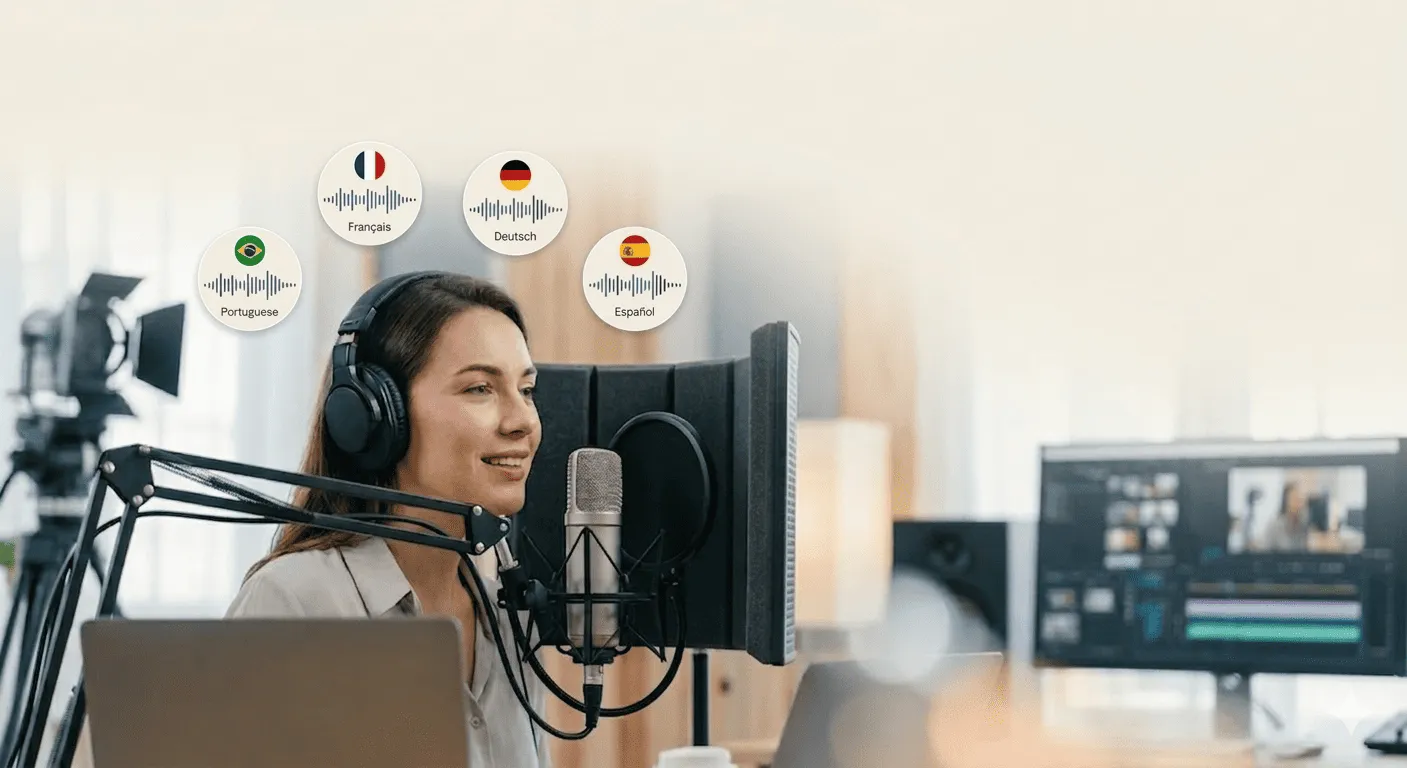

Streaming platforms have quietly redrawn the map of global media consumption. Content produced in Seoul finds loyal viewers in São Paulo. A documentary filmed in Lagos streams in living rooms across Europe. An e-learning course built in California trains employees in Tokyo. The infrastructure for cross-border content distribution has never been more sophisticated, but one bottleneck continues to shape whether that content actually lands: the quality of its dubbing.
As demand for localized media surges, industry observers say the process of selecting a multilingual dubbing agency has become one of the most consequential decisions a content producer or brand can make and one that still doesn't get the attention it deserves.
A Market Transformed by Audience Expectations
Viewer habits have shifted dramatically over the past decade. Research consistently shows that a significant majority of non-English-speaking audiences prefer watching content dubbed in their native language over reading subtitles, particularly in markets such as Germany, France, Brazil, Spain, and across the Arab world, where high-quality dubbing has been the standard for generations.
This preference is no longer limited to entertainment. Corporate communications, product training videos, medical e-learning modules, and brand campaigns are all being localized for multilingual audiences at a scale that would have seemed unlikely just five years ago. The e-learning industry alone is projected to reach hundreds of billions of dollars globally, with localization cited as a primary driver of adoption in non-English-speaking regions.
The result is a dubbing industry under pressure, growing fast, handling more diverse content types, and serving clients who increasingly understand the difference between adequate and exceptional localization.
What Professional Multilingual Dubbing Actually Involves
There is a common misconception that dubbing is largely a translation exercise, converting the script, finding a voice, record it. Professionals in the field describe the reality as considerably more complex.
"Linguistic accuracy is the baseline, not the ceiling," said one localization director with experience across European and Asian markets. "What separates quality dubbing is everything that happens around the words, the pacing, the emotional register, the cultural resonance."
Script adaptation for dubbing requires writers who understand not just the target language but also the rhythmic and phonetic demands of lip-sync. A translated line that runs three seconds longer than the original creates a technical problem that reverberates through the entire production. Adapters must work within tight timing constraints while preserving meaning and natural speech patterns, a skill that sits at a demanding intersection of linguistics, creative writing, and technical precision.
Cultural adaptation presents its own layer of complexity. Humor, idiom, and cultural reference do not transfer cleanly across languages. A joke that works in English may be nonsensical in Mandarin. A gesture casually referenced in narration may carry different connotations in the target culture. Experienced multilingual dubbing agencies build cultural consultation into their workflows rather than treating it as an afterthought.
Voice casting rounds out the picture. Regional dialect matters in ways that are immediately apparent to native speakers. A Brazilian Portuguese speaker will notice within seconds if a production used European Portuguese voice talent without adaptation. The same applies to Mexican versus Castilian Spanish, or Levantine versus Gulf Arabic. Authentic regional casting is not a cosmetic distinction; it directly affects how a native audience receives and trusts the content
The Measurable Impact of Dubbing Quality
Research in media psychology offers concrete data on what poor audio localization actually costs. Studies examining audio-visual congruence consistently find that synchronization issues and unnatural vocal delivery disrupt comprehension and reduce emotional engagement, even when viewers cannot explicitly identify the source of their discomfort. In practical terms, this translates to higher drop-off rates, lower content completion, and diminished recall.
For brands, the implications extend beyond engagement metrics. Multinational companies investing in localized campaigns have reported that audio quality gaps, even subtle ones, create a perception of reduced investment in a given market. Consumer research has flagged this as a driver of lower brand affinity in regions where the localization quality visibly lags behind a company's home-market output.
Conversely, content producers who have invested in high-quality dubbing report measurable improvements in audience retention. Streaming platforms have published data showing that dubbed content in major international markets outperforms subtitled equivalents on completion rates, often by significant margins. For e-learning providers, comprehension scores are reliably higher when learners engage with content in their first language through quality audio rather than reading translated text on screen.
What the Selection Process Should Look Like
Industry consultants advising content companies on vendor selection point to several criteria that distinguish capable agencies from exceptional ones.
Native voice talent depth is frequently cited first. The ability to cast regionally appropriate native speakers across a broad range of languages, not just major categories but specific regional variants, is a reliable indicator of operational maturity and professional network breadth.
Integrated workflow capability is another meaningful differentiator. Agencies that manage translation, script adaptation, voice casting, recording, lip-sync review, and quality assurance internally tend to produce more consistent results than those that outsource key stages to third parties. Each handoff in a fragmented workflow introduces a potential point of failure.
Genre experience carries weight as it shapes the sensibility of the entire production. Dubbing a medical training video requires a fundamentally different approach than localizing an animated feature or a corporate brand film. Agencies with demonstrated experience across content categories bring relevant context that generalists may lack.
Technical standards compliance is increasingly important as content destined for major streaming platforms must meet precise loudness normalization requirements, file format specifications, and delivery timelines. Agencies without the technical infrastructure to meet these standards create friction at the distribution stage.
An Industry at an Inflection Point
The multilingual dubbing sector is navigating a period of genuine transformation. AI-assisted voice synthesis and automated lip-sync tools are entering the market, raising questions about how the industry will evolve and which tasks will remain the domain of human professionals.
Localization experts largely agree that the current generation of AI dubbing tools performs adequately for low-stakes internal content but falls short of the quality required for audience-facing media. The nuances of regional dialect, emotional authenticity, and cultural adaptation remain areas where experienced human voice talent and skilled adapters produce demonstrably superior results.
At the same time, AI tools are being adopted by professional agencies to accelerate certain stages of the workflow, including initial translation drafts, timing analysis, and quality control flagging, while keeping human expertise at the center of creative and cultural decisions. The agencies best positioned for the next decade are likely those that are integrating these tools thoughtfully rather than either ignoring them or over-relying on them.
The Bottom Line for Content Producers
The growth of global content distribution has made multilingual dubbing a strategic consideration rather than a production line item. For content producers, streaming platforms, e-learning developers, and brands targeting international markets, the agency selected to carry their content into new languages is also carrying their reputation with it.
The criteria for that selection, native talent, cultural fluency, integrated workflows, technical capability, and genuine genre experience, are not difficult to evaluate. What they require is treating the decision with the seriousness it has earned.
In a media landscape where the next piece of content is always one tap away, the difference between dubbing that connects and dubbing that merely translates is, increasingly, the difference between a global audience and a missed opportunity.



















Sign in to leave a comment.