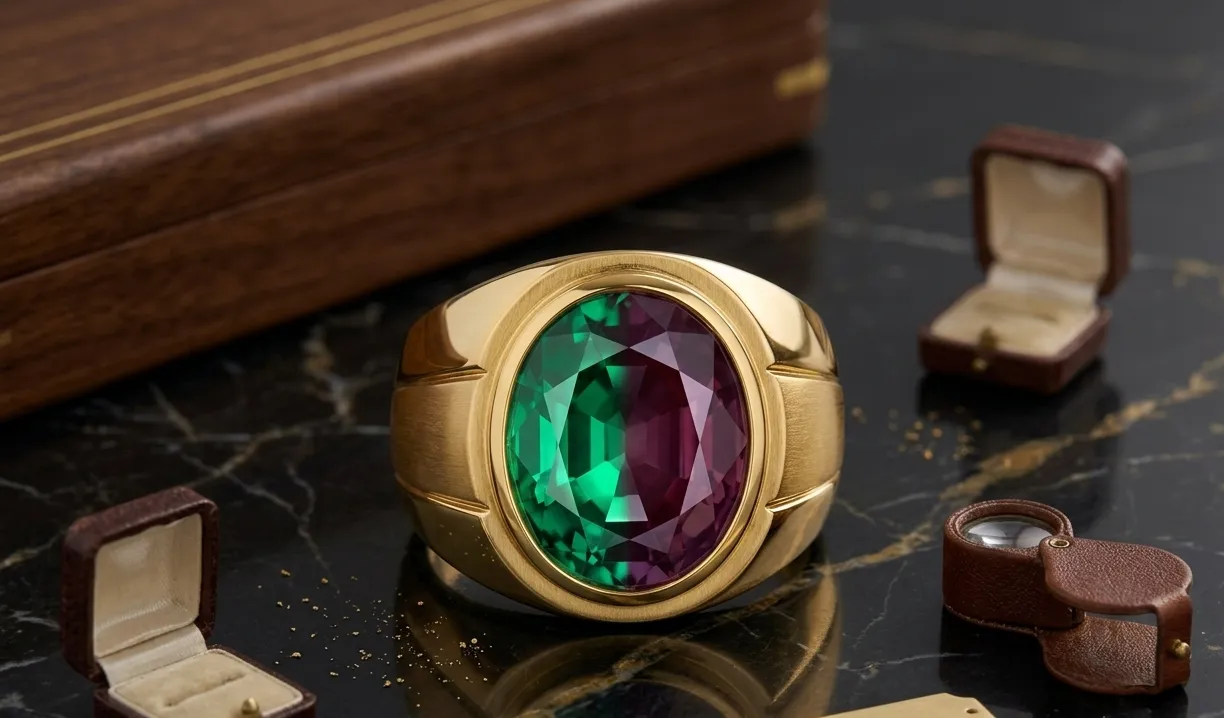

Two people buy the exact same emerald from the exact same shop. One notices better focus at work within weeks. The other feels nothing - or worse, feels agitated wearing it. Same stone, same cut, same certification. So what happened?
This is one of the most common questions in gemstone astrology, and it's also one of the most misunderstood. The answer isn't about luck, and it isn't about the quality of the stone. It comes down to something far more specific: your birth chart.
A Gemstone Isn't a Universal Remedy
Most people first encounter gemstone recommendations through generic lists - "Emerald is good for Gemini," "Blue Sapphire is good for Capricorn." These lists aren't wrong exactly, but they're dangerously incomplete. Your zodiac sign is one data point in a much larger picture. It tells you where the sun was at your birth - nothing about where Mercury, Saturn, Jupiter, or any other planet was sitting at that exact moment, in that exact place.
Gemstone astrology, whether approached through Vedic or Western tradition, works on the principle that each planet governs certain areas of life, and each gemstone is associated with channeling a specific planet's energy. A stone that strengthens Mercury will genuinely serve someone whose chart shows a weak or afflicted Mercury - and do very little for someone whose Mercury is already strong, or whose current challenges have nothing to do with Mercury at all.
This is why two people can buy an identical stone and have completely different experiences with it. It was never really "the same" recommendation to begin with - it just looked that way on the outside.
Why Birth Chart Matters More Than Zodiac Sign
Your birth chart is calculated using your exact date, time, and place of birth. From that, an astrologer maps the position of every major planet at the moment you were born, and how those positions relate to one another. This is a completely individual configuration - even two people born on the same day, in the same city, a few hours apart, can end up with meaningfully different charts.
This is also why planetary periods matter. In Vedic astrology, this is tracked through what's called a Mahadasha and Antardasha - essentially, a timeline of which planet's influence is most active in a person's life at any given point. A gemstone recommended during one planetary period might not be the right one five years later, once a different planetary period begins. The "right" stone isn't fixed for life - it's tied to where you are in your own astrological timeline.
This is precisely why a proper consultation looks at your chart specifically, rather than handing you a stone based on your star sign alone.
What Actually Determines Whether It "Works"
A few factors compound to explain why outcomes vary so much from person to person, even with the same type of stone:
The specific planetary need in your chart. A stone that supports a weak or afflicted planet in your chart addresses something real. The same stone, worn by someone whose chart doesn't have that need, is essentially neutral - it isn't correcting anything specific for them.
The current planetary period you're in. As mentioned, this shifts over time. A stone recommended five or ten years ago may no longer be the most relevant one for your chart today.
Whether the stone is natural and untreated. A synthetic or heavily treated stone, even if it looks identical, doesn't carry the same properties astrologically speaking (or physically, for that matter). This is one of the most overlooked reasons a "good" stone doesn't seem to do anything - it was never the right kind of stone to begin with.
How and when it's worn. Traditional gemstone astrology also considers details like which finger, which metal it's set in, and even the day and time it's first worn - details that are easy to skip if you're buying based on appearance alone.
Why Generic Recommendations Fall Short
None of this means gemstone astrology is unreliable - it means it's specific. A stone isn't a one-size-fits-all remedy any more than a prescription is meant for everyone with the same general symptom. The entire practice is built around precision: your exact chart, your exact planetary period, your exact need.
This is also why so many people try a gemstone once, feel nothing, and conclude the whole practice doesn't work - when in reality, they may have simply been wearing a stone that was never suited to their chart in the first place.
It's worth being clear that these principles are rooted in traditional Vedic and Western astrological belief systems, passed down through generations, rather than claims that have been scientifically verified. A gemstone should never be treated as a substitute for medical, financial, or professional advice - and any decision to wear one for astrological purposes is best made after a proper consultation, not a guess based on a generic list.
If you're curious whether a specific gemstone is actually suited to your chart, rather than just your zodiac sign, a proper consultation - one that actually looks at your birth details - is the only way to know for sure.


























Sign in to leave a comment.