“It’s a private university… so global value must be limited.”
That assumption is outdated.
Over the last decade, something interesting has happened in Indian engineering education: a few non-IIT institutions have quietly built international credibility—not through hype, but through systems.
VIT Vellore is one of them. And not by accident.
What actually makes a degree “globally valuable”?
A degree becomes a global asset when it satisfies three filters simultaneously:
- Recognized across borders
- Trusted by multinational employers
- Compatible with global academic systems
Most colleges meet one. A few meet two. Very few meet all three.
VIT happens to sit in that rare overlap.
The credibility layer most students ignore
Global mobility doesn’t start with placements—it starts with recognition.
VIT’s Institution of Eminence (IoE) tag from the Government of India is not just symbolic. It gives autonomy to design globally competitive programs and research frameworks.
But the real differentiator?
ABET accreditation (USA).
This is where things shift from “good Indian college” to “globally portable degree.”
Insight:
“ABET doesn’t make you smarter. It makes your degree understandable worldwide.”
That matters when applying to universities in Germany, Canada, or the US—where equivalence often decides acceptance.
The placement paradox: scale vs quality
Here’s where most universities struggle.
They either:
- place a few students in elite companies
- or place many students in mass recruiters
VIT does both.
Companies like Microsoft, Amazon, and PayPal hire for high-end roles.
At the same time, firms like TCS and Infosys recruit at scale.
This dual pipeline is not common.
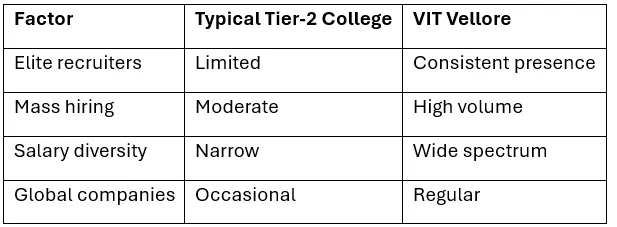
The result?
A placement ecosystem that reflects real-world job markets—not just rank-based filtering.
How this plays out in reality
Consider two students:
Student A (traditional rigid system):
Follows fixed curriculum → limited exposure → struggles to pivot fields
Student B (VIT):
Uses Flexible Credit System → picks AI + Data Science electives → builds portfolio → lands role aligned with global demand
Same degree.
Different outcomes—because of structure.
The academic design most people underestimate
VIT’s Fully Flexible Credit System (FFCS) is often discussed casually, but it’s actually a strategic advantage.
It mirrors systems used in Western universities.
Students can:
- choose professors
- control semester load
- specialize early
This creates something rare in Indian education: decision-making ability.
And that’s exactly what global employers test.
Where most aspirants get it wrong
They chase brand names without understanding why a brand works.
Common mistake:
“IIT = global, others = local”
Reality is more nuanced.
A college becomes globally relevant when it aligns with:
- International Curriculum Standards
- research collaboration
- industry demand cycles
VIT has invested heavily in all three.
The hidden advantage: exposure, not just education
VIT’s collaborations with 300+ international universities aren’t brochure fillers.
They create:
- exchange programs
- dual degrees
- research opportunities
This exposure changes how students think—not just what they learn.
And thinking globally is often more valuable than studying locally.
A contrarian truth most people won’t say
“Global careers don’t come from elite tags alone. They come from systems that force adaptability.”
VIT’s strength isn’t just its ranking—it’s its environmental pressure to evolve.
So, is VIT Vellore a global asset?
Not because it claims to be.
But because:
- Its degree is recognized internationally
- Its graduates are trusted by global companies
- Its curriculum is aligned with global systems
That combination is rare.
FAQ
1. Is VIT Vellore recognized internationally?
Yes, especially due to ABET-accredited programs, which are widely accepted in countries like the US, Canada, and Australia.
2. Do global companies really hire from VIT?
Yes. Companies like Microsoft, Amazon, and PayPal regularly recruit, along with major IT firms.
3. Is VIT comparable to IITs globally?
Not identical—but in terms of international exposure and placements, it has entered a similar conversation space.
4. Does FFCS really matter for careers?
Yes. It allows students to tailor skills based on market demand, which directly impacts job readiness.
5. Is VIT good for studying abroad later?
Yes, its global recognition and collaborations make it easier to apply for international master’s programs.
A VIT degree isn’t just about where you study.
It’s about how far that degree can travel with you.

























Sign in to leave a comment.