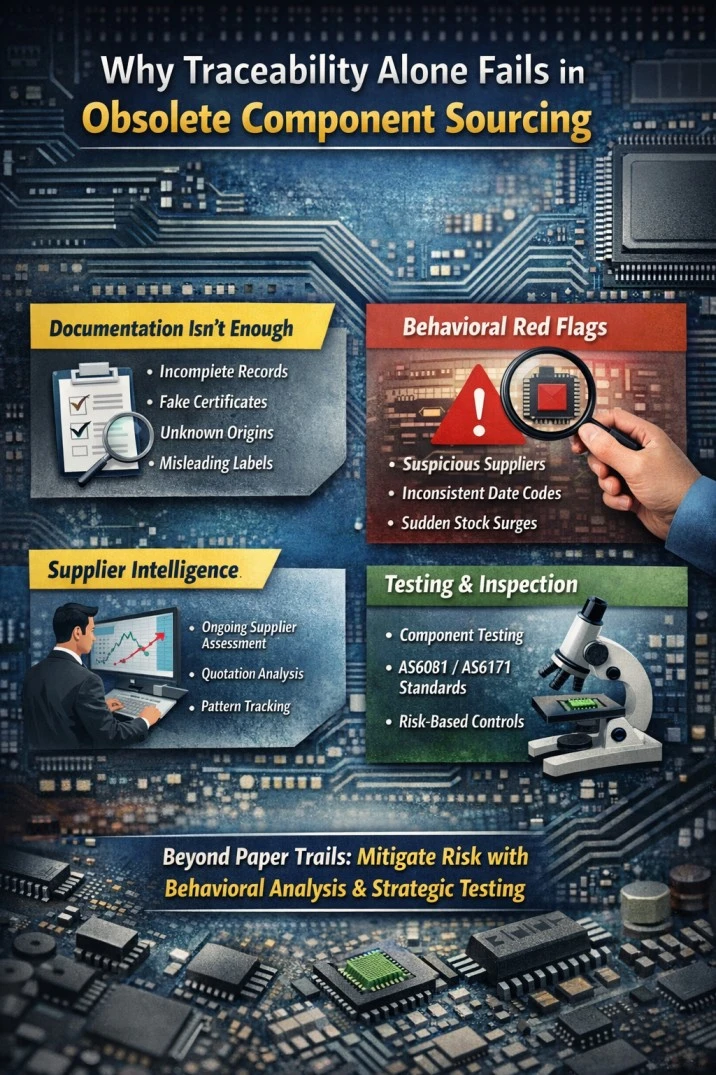

In electronic component procurement, traceability is often presented as the gold standard of risk mitigation. Documentation chains, certificates of conformance, and declared sourcing origin are widely viewed as proof of authenticity and compliance. In authorized distribution environments, this model works.
However, in the world of obsolete and end-of-life (EOL) components, traceability alone is often insufficient—and sometimes misleading.
As more manufacturers rely on global surplus markets to secure hard-to-find electronic components, it is becoming clear that documentation cannot fully substitute for supplier intelligence, behavioral analysis, and structured testing frameworks.
The Reality of Obsolescence
Obsolete electronic components are, by definition, no longer actively manufactured or officially supported by the original component manufacturer. Once a product reaches end-of-life, inventory fragments across regions, excess stock channels, contract manufacturer overages, and secondary suppliers.
In these markets:
- Documentation is often incomplete.
- Original packaging may no longer exist.
- Ownership may have changed multiple times.
- Storage history may not be fully verifiable.
Expecting clean, uninterrupted traceability chains in this environment is unrealistic. Yet many procurement strategies continue to prioritize paperwork over deeper risk assessment.
Traceability has value—but it does not eliminate risk in obsolete markets.
When Documentation Creates False Confidence
In secondary markets, documentation can create a perception of safety without addressing underlying sourcing behavior.
A certificate of conformance does not verify:
- Whether the part has been reworked or resurfaced.
- Whether it originated from legitimate surplus or a refurbishment channel.
- Whether date codes are consistent across lots.
- Whether the supplier regularly handles high-risk inventory categories.
In some cases, documentation itself may be replicated or misrepresented. Over-reliance on paperwork can produce a false sense of security while leaving structural risk unaddressed.
Effective risk mitigation requires more than static documents—it requires dynamic assessment.
The Behavioral Nature of Counterfeit Risk
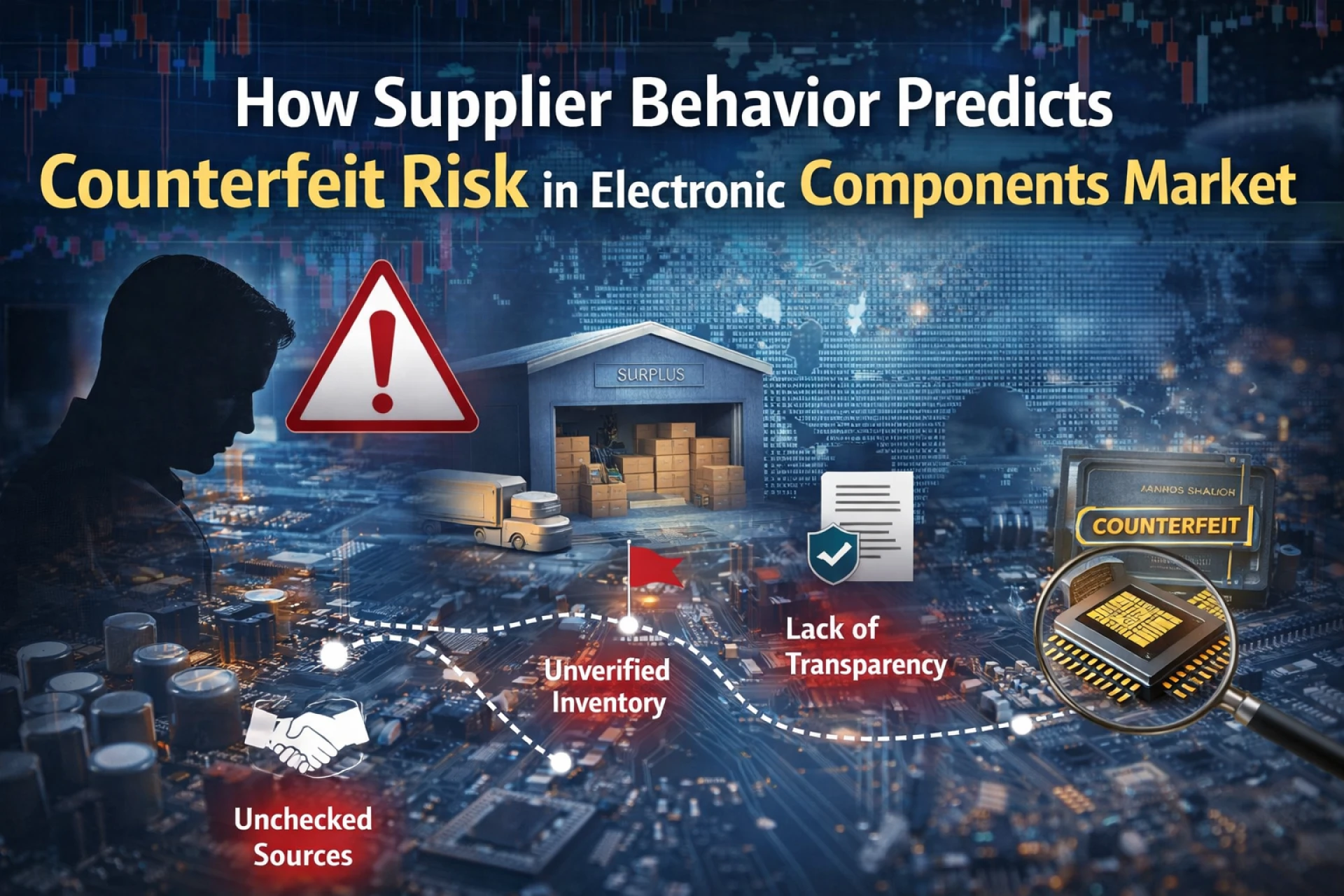
Counterfeit and substandard components rarely appear randomly. They are often associated with specific sourcing behaviors, inventory channels, and refurbishment patterns.
For example:
- Suppliers that consistently quote large volumes of “new” inventory for long-discontinued parts may warrant closer scrutiny.
- Sudden availability spikes in globally constrained components can indicate higher-risk sourcing routes.
- Repeated inconsistencies in date codes across quotations may signal reworked or mixed-lot inventory.
These signals are behavioral. They cannot be captured through traceability documents alone.
Understanding supplier behavior over time is often more predictive of risk than any single certificate.
Building Supplier Intelligence Beyond Paperwork
Effective obsolete component sourcing requires continuous supplier assessment, not one-time qualification.
At Maketronics, supplier quotations are monitored systematically to evaluate sourcing consistency and exposure to higher-risk inventory categories. Over time, this produces an evolving intelligence profile for each supplier.
This intelligence may include:
- Quotation patterns across part families.
- Consistency of inventory types.
- Responsiveness and disclosure transparency.
- Recurring anomalies in date codes or lot structures.
Such behavioral data helps identify early warning signs before procurement decisions are finalized.
Supplier intelligence does not replace documentation—but it contextualizes it.
Testing as a Structured Risk Control
Because documentation gaps are common in obsolete markets, inspection and testing become critical risk-control mechanisms.
However, testing must be applied strategically. Blanket testing of every component is neither practical nor efficient. Instead, testing should be aligned with:
- Component criticality.
- Supplier risk profile.
- End-use application sensitivity.
- Historical sourcing behavior.
Industry-recognized standards such as AS6081 and AS6171 provide structured frameworks for counterfeit mitigation and inspection practices. When documentation is incomplete, these standards help ensure components meet authenticity and performance expectations before entering production environments.
Testing is not a replacement for supplier evaluation—but it is an essential complement when traceability alone cannot provide assurance.
A Risk-Based Sourcing Model
In obsolete and hard-to-find component markets, risk mitigation must be layered:
- Supplier behavior monitoring.
- Documentation review where available.
- Risk-based inspection and testing.
- Transparent disclosure of sourcing limitations.
Traceability remains valuable, particularly when components originate from authorized or clearly documented surplus channels. But treating documentation as a standalone safeguard ignores the realities of secondary markets.
A risk-based sourcing model recognizes that documentation, intelligence, and testing each serve distinct roles. Relying on one in isolation creates vulnerability.
Moving Beyond Paper-Centric Procurement
As electronic component obsolescence accelerates, manufacturers must adapt procurement strategies to reflect market realities. Long-life industries—including aerospace, industrial automation, medical systems, and automotive—cannot avoid secondary markets indefinitely. Availability constraints make global surplus sourcing a necessity.
In these environments, resilience comes from combining documentation with behavioral intelligence and structured testing protocols.
Traceability matters. But it is only one part of a broader risk-management framework.
Organizations that recognize this distinction are better positioned to secure obsolete components safely while maintaining operational continuity in an increasingly volatile supply chain landscape.
Key Takeaways
- Traceability alone cannot eliminate risk in obsolete and EOL component markets where documentation gaps are common.
- Supplier behavior over time is often a stronger predictor of counterfeit and quality risk than static paperwork.
- Risk-based testing aligned with standards such as AS6081 and AS6171 provides structured assurance when documentation is incomplete.










Sign in to leave a comment.