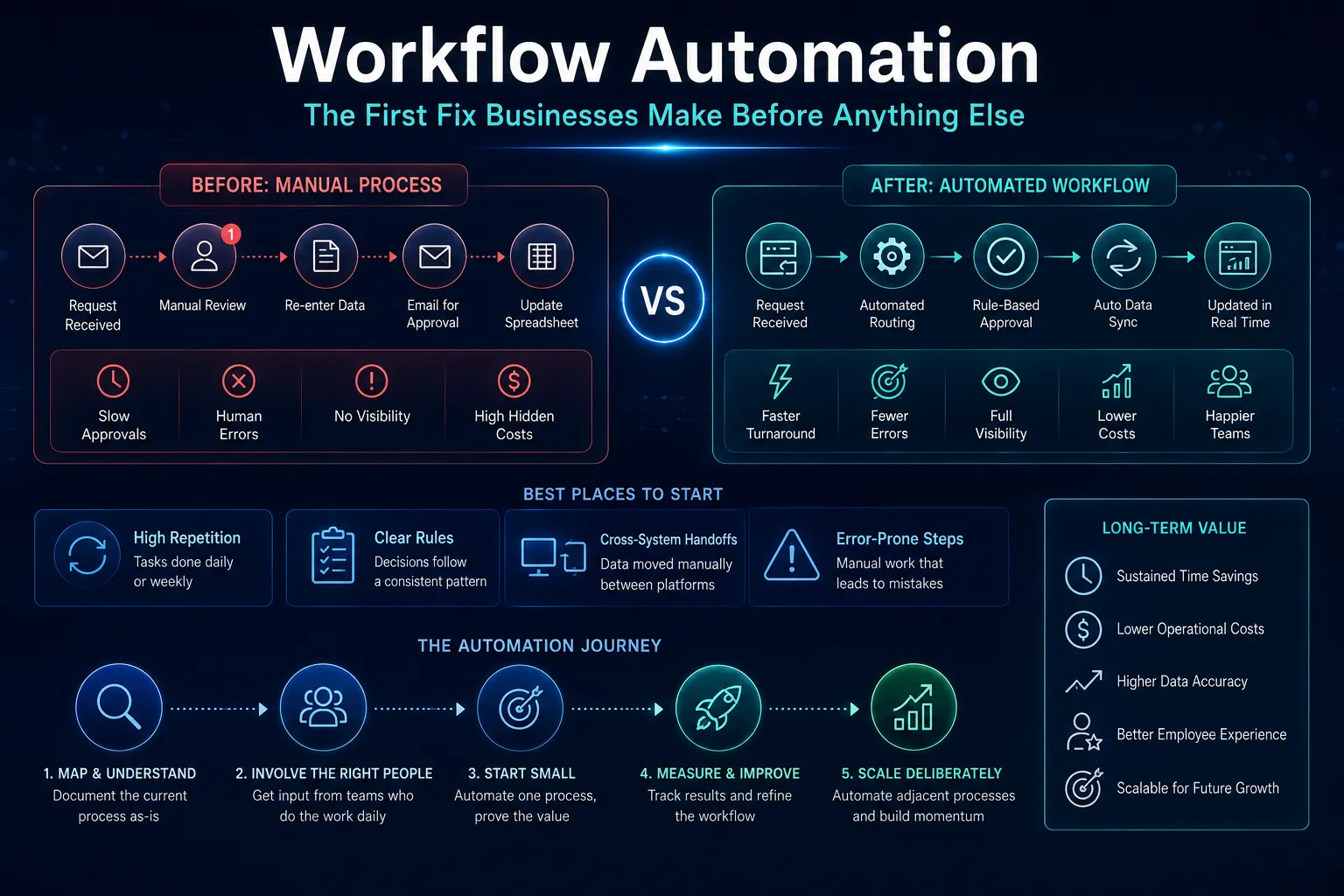

Ask most operations leaders what slows their teams down and the answer rarely involves a lack of talent. It's the repeated manual steps buried inside daily processes. This is exactly why workflow automation has become the starting point for businesses trying to fix inefficiency before adding new tools or headcount.
The appeal is simple. Fixing broken processes tends to deliver faster, more measurable results than almost any other operational investment a business can make right now. Instead of waiting months to see a return, teams often notice the difference within the first few automated cycles, which makes it an easy case to justify internally.
Why Manual Processes Quietly Cost More Than They Appear To
A single manual approval step doesn't look expensive on its own. It's the accumulation across dozens of processes, repeated daily, that turns into real cost.
- Teams often underestimate how much time gets lost to tasks like re-entering data across systems, chasing approvals through email, or manually updating spreadsheets that should already be synced. None of these tasks feel significant in isolation, which is exactly why they go unaddressed for so long. It's only when someone maps out the full week of a team member that the true scale becomes obvious — hours spent on work that adds no real value, just friction.
This hidden cost also shows up in employee frustration. People rarely enjoy repetitive, low-judgment tasks, and over time this quietly affects morale and retention, even if it's never explicitly named as the cause.
What Workflow Automation Actually Solves First
Not every process needs automation immediately. The strongest starting points share a few common traits.
- High repetition - tasks performed daily or weekly with little variation
- Clear rules - decisions that follow a consistent, predictable pattern
- Cross-system handoffs - work that requires moving data between platforms manually
- Error-prone steps - processes where manual entry regularly introduces mistakes
Processes that check most of these boxes tend to deliver the fastest, most visible wins. This is why operations leaders are often advised to resist the urge to automate the most complex process first. Complex, exception-heavy workflows are harder to map correctly and take longer to show results, which can make an otherwise sound automation strategy look like it's failing early on.
Why Approval Chains Are Usually the First Target
Approval processes are one of the most common starting points for automation. They tend to be highly repetitive, rule-based, and frustrating for everyone involved when handled manually.
A request that should take minutes often takes days simply because it sits in someone's inbox waiting for review. Automating routing, notifications, and escalation rules removes this bottleneck almost immediately. Requests move to the right person automatically, reminders go out without anyone having to chase them, and escalation happens on its own if something sits too long.
The result isn't just faster turnaround. It also removes the ambiguity around who is responsible for a decision at any given moment, which is often a bigger source of delay than the review itself.
What Data Entry Automation Changes in Practice
Manual data entry between disconnected systems is another common target, and one of the most error-prone processes in most businesses.
When information has to be manually copied from one platform to another, small mistakes accumulate quickly. A mistyped number in a spreadsheet or a missed update in a CRM can ripple through reporting, billing, or customer communication long after the original error was made. Automating this transfer eliminates both the time cost and the error risk in a single step.
It also creates a side benefit that's easy to overlook: systems that were never properly connected before start talking to each other, which often surfaces other inefficiencies that were previously invisible.
Common Mistakes Businesses Make When Getting Started
Trying to automate too much at once, without first proving the approach on a smaller process, is one of the most common mistakes. Another is failing to involve the people who actually perform the process daily.
Businesses that avoid these mistakes tend to build momentum steadily, rather than facing resistance from teams who feel like automation was imposed on them without input. A related mistake is treating the first automation project as a finished product rather than a starting point. Processes change, and an automated workflow that isn't revisited periodically can quietly become outdated, reintroducing the same inefficiencies it was built to remove.
Making This Work for Your Specific Business
There isn't a single correct starting point that applies to every business. The right first process depends entirely on where the most repetitive, rule-based, and error-prone work currently lives within a specific operation.
Businesses across India, the US, and Spain that have gotten the most value from workflow automation share one common trait: they started small, proved the approach worked, and expanded deliberately rather than trying to transform every process at once. That discipline, more than the specific tools chosen, is usually what separates automation projects that deliver lasting value from ones that stall out after the initial rollout.
For most businesses, the smartest move isn't picking the flashiest process to automate first. It's picking the one that's small enough to execute cleanly, visible enough to build internal confidence, and painful enough that the team notices the difference right away.



























Sign in to leave a comment.