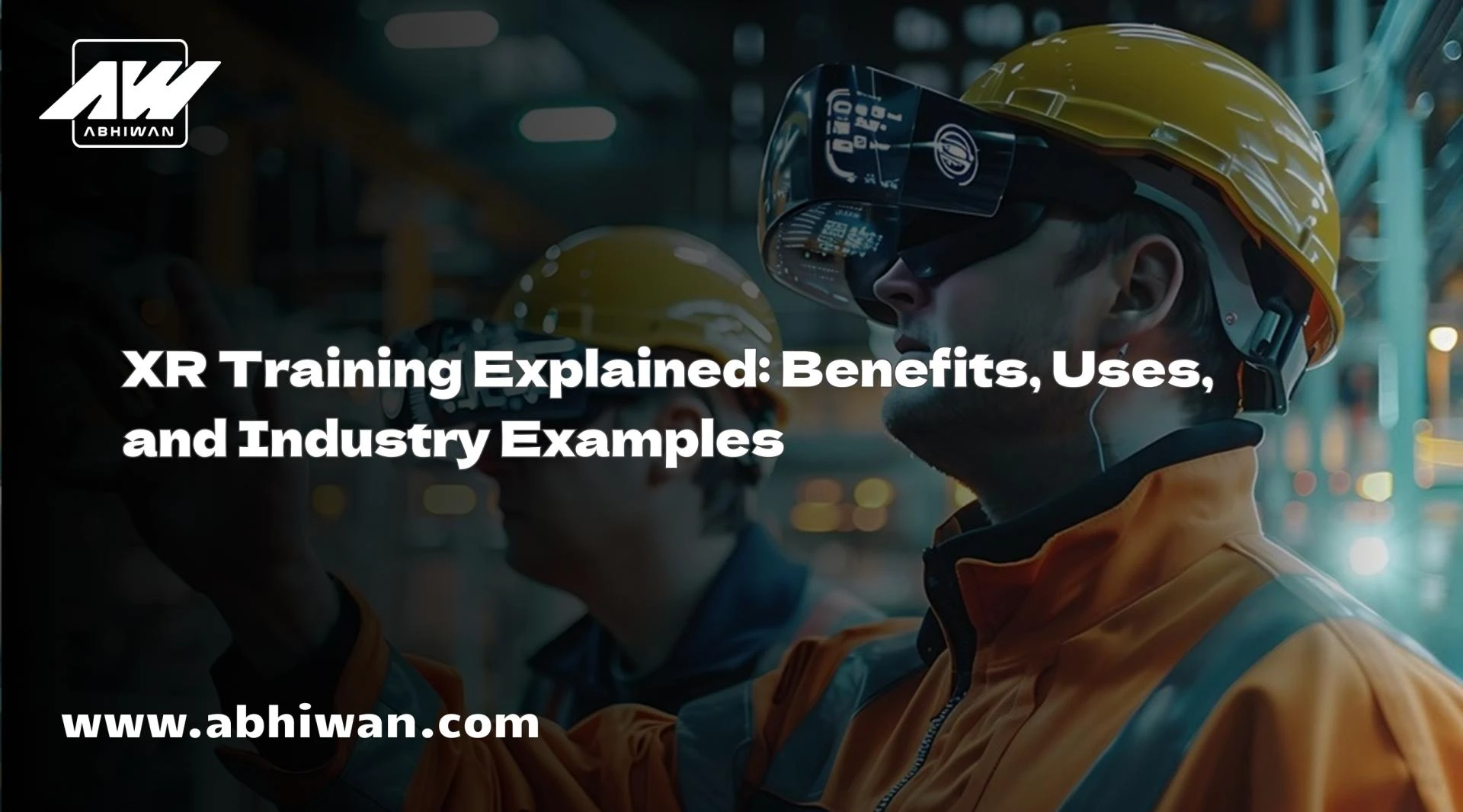
XR training is revolutionizing the way organizations teach, learn, and upskill their employees. Companies cannot afford to just use manuals or classroom sessions to teach the employees to perform the tasks in real-life situations; they resort to the use of immersive environments. This is not merely a matter of innovation but has a direct and positive impact on learning and retention. With the industry rapidly becoming digitalized, XR training is emerging as an effective solution to safer, faster, and more effective learning. From manufacturing to healthcare, companies are investing in immersive learning experiences to minimize mistakes and increase confidence levels. XR training is no longer a fad but a strategic asset of future-proof organizations today. As part of this blog, we will learn more about the benefits, use cases, and examples of XR training in the industry.
Understanding XR in Learning
Knowledge of XR in learning is useful to understand how the development of immersive technologies is transforming modern education and training. XR training provides an interactive experience in which the learner does not passively read or view content, but actually interacts with it. It enables users to engage with 3D models, tools, and actual real-world situations, which enhances understanding and retention. Use of XR compared to the traditional methods of industrial training renders learning more practical and experience-based. It also offers real-time feedback, enabling the learner to rectify errors in real time and gain confidence. Consequently, most industrial training services are currently incorporating the use of XR development to provide more effective, scalable, and engaging training solutions in various industries.
Benefits of XR Training
This section highlights the reasons why companies are quickly turning to XR training.
Better Retention:
Retention is enhanced because XR training improves the development of an active learner who does rather than reads or watches. This practical kind of method aids in the employee retention of ideas and is much longer remembered, particularly during industrial training.
Safe Learning Environment:
Employees are able to practice high-risk scenarios with no real-world problems, making XR training an excellent fit for safety-sensitive industries.
Cost Reduction:
The XR training helps to save money in the long run, as it helps to reduce physical setups, traveling, and using equipment.
Faster Skill Development:
XR development simulations provide learners with real-world experience and speed up the learning process.
Scalable Training:
Training modules can be used in a variety of locations, and as such, the delivery of the training is consistent with industrial training services.
Consistent Learning Experience:
All learners are given the same quality training, which aids in ensuring that the level of skills of all the teams is similar.
Uses of XR Training
This section describes the application of XR training in the real world.
Employee Onboarding:
XR training assists new employees in perceiving company processes, workflows, and environments in interactive ways, enhances engagement, and decreases the onboarding time.
Technical Training:
The XR development simulation can also empower employees to understand how to work on complicated machines and systems safely and repeatedly.
Safety Training:
The XR training allows the learners to learn how they must behave and conduct themselves in case of a disaster scenario without actually putting the lives of the learners in danger.
Remote Learning:
The same industrial training modules can be accessed by the groups at their respective locations, making the training consistent and scalable.
Product Training:
XR is a possibility to browse a product in 3D and, thus, promote understanding and communication.
Industry Examples of XR Training
The following section illustrates the category of industries that use XR training.
Manufacturing:
XR training can also be used to teach machine operations and maintenance, and help minimize errors and increase productivity.
Healthcare:
Medical professionals practice in the virtual world before they can apply their medical practices in reality.
Aviation:
The XR training simulations ensure that pilots are prepared to work in real-life situations and crises.
Retail:
Immersive scenarios are used to train staff so they can interact better with customers and deliver better service.
Construction:
The XR training will help the workers to know about the safety measures and operations of the site offered by industrial training services.
Latest Trends in XR Training
In this section, we will discuss current trends defining XR training.
AI-Powered Learning:
AI is being paired with XR development to produce adaptive training experiences.
Advanced Wearables:
The possibility of XR training becomes more practical, and modern headsets can help to make this type of training available.
Enterprise Adoption:
Large organizations are heavily investing in the XR of their industrial training solutions.
Market Growth:
According to industry statistics, the industry is undergoing a rapid pace of growth due to the increasing demand to learn immersively and remotely.
Why Businesses Choose XR Training
This section explains why organizations are shifting toward XR training solutions.
Reduced Infrastructure Dependency:
XR training has no physical training arrangements or physical fitness equipment needed, and this makes it flexible and economical to hold training.
Improved Employee Performance:
Practical learning increases confidence and allows employees to do their job more closely.
Supports Digital Transformation:
XR training is compatible with the existing new technologies and can help businesses to stay up-to-date.
Better Learning Outcomes:
XR training is more engaging and knowledge-retentive than traditional industrial training.
Data-Driven Insights:
Businesses can track performance and improve training using real-time analytics.
Challenges of XR Training
Some key limitations are discussed in this section and should be considered by businesses.
High Initial Cost:
XR training requires hardware spending and XR development, which can negatively impact certain businesses over time.
Technical Expertise:
Industrial training services need qualified professionals to handle and execute XR solutions to ensure successful and effective implementation.
Hardware Limitations:
Electronic tools like headsets may also be compatible and require routine repairs.
User Adaptation:
When workers are new to immersion spaces, they can take some time to become accustomed to them.
How does XR improve learning?
XR enhances learning by making it interactive, practical, and experience-based as contrasted to theory-only learning. A virtual world provides a learner with a chance to work with real-life situations that can be better comprehended and remembered over time. It also offers immediate feedback, and the user can correct errors in real time. This style is particularly effective where one is training industrial workers, because unless one learns on the job, the skills are not developed, and performance is not improved.
What’s the difference between XR, VR, and AR?
XR is a broad name used to refer to the different categories of VR, AR, and MR technologies that offer different levels of immersion. VR is a completely immersive virtual environment, which places the end-user fully into the virtual environment. AR is how the real world is enhanced by adding digital features, allowing users to stay connected to their world. MR also goes a step further to enable real and virtual objects to interact in real time. All of these technologies together form the foundation of XR training and help enhance more interactive, engaging, and realistic learning experiences.
Conclusion
XR training is now in the past tense; it is an element of the current learning approach. It uses immersive technology and applications in the real world to provide a more interesting and productive training experience. Companies investing in XR training enjoy better performance, making fewer mistakes and acquiring new skills more quickly. With the ever-changing industries, there will be increased demand for higher industrial training solutions. XR development will play a crucial role in building scalable and customized learning systems. Organizations that adopt XR training early will stay ahead in a competitive market and create a more skilled, confident, and future-ready workforce through advanced industrial training services.

























Sign in to leave a comment.