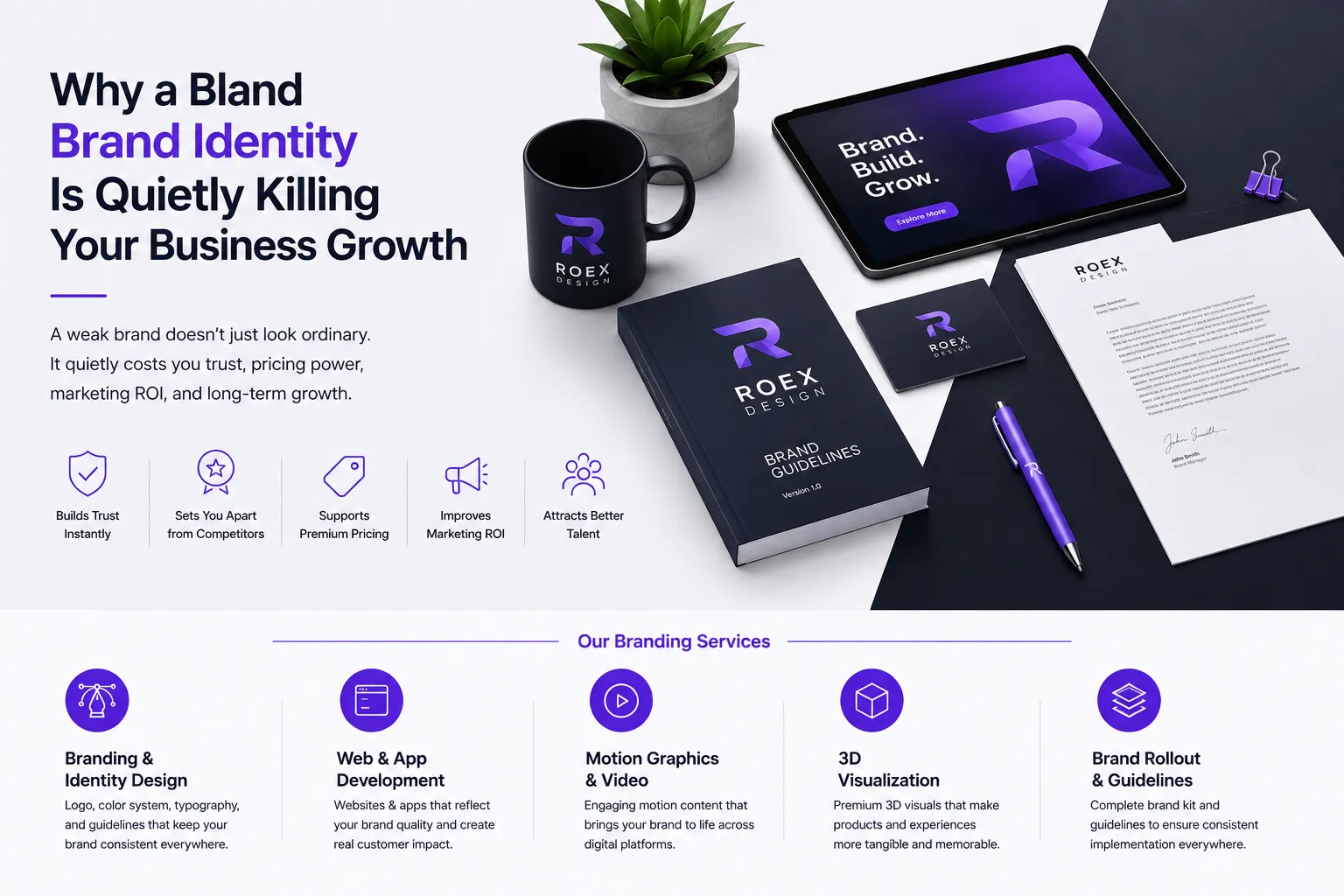

Most businesses don't lose customers because of bad products or bad service. They lose them because their brand fails to make an impression in the first three seconds. In a market flooded with lookalike logos, generic color palettes, and copy-paste websites, a weak brand identity becomes the single biggest reason a great business stays invisible.
The Real Cost of a Weak Brand
When your brand doesn't stand out, the damage shows up in places you wouldn't expect:
- Customers trust you less, even if your service is excellent, because trust is built visually before it's built through experience.
- You blend in with every other competitor in your space, forcing potential clients to choose based on price instead of value.
- It becomes harder to charge premium rates, since nothing in your branding signals that you're worth a premium.
- Marketing budgets get wasted, because ads and campaigns built on a weak identity simply don't convert as well.
- Top talent looks elsewhere, since people want to work for brands that look like they're going somewhere.
These aren't small issues. They compound over time and quietly cap how big a business can grow.
What a Strong Brand Identity Actually Includes
A real brand identity isn't just a logo. It's a complete system that works together across every touchpoint:
Branding & Identity Design — This is the foundation: logo, color system, typography, and brand guidelines that keep everything consistent no matter who's creating content for you.
Web & App Development — Your website is often the first real interaction a customer has with your brand. It needs to reflect the same quality and personality as your identity, not feel like a disconnected afterthought.
Motion Graphics & Video — Static design alone isn't enough anymore. Motion content — explainer videos, animated logos, social reels — helps brands feel alive and modern across digital platforms.
3D Visualization — For product-based and e-commerce brands especially, 3D visuals create a premium, tactile feel that flat photography simply can't match.
When these elements are designed together as one system, instead of being outsourced separately to different freelancers, the brand feels coherent — and coherence is what builds recognition over time.
Branding Needs Differ by Industry
A generic branding approach rarely works well across different business types. A few examples of how priorities shift:
- Product and e-commerce brands lean heavily on 3D visualization and packaging design to make products feel premium online.
- Service-based businesses (agencies, consultants, local service providers) need identity systems that build instant trust, since customers can't "try before they buy."
- Tech and SaaS companies need clean, scalable identity systems that work as well in a product UI as they do on a billboard.
- Hospitality and lifestyle brands rely more on mood, motion, and visual storytelling than on rigid brand guidelines.
Understanding which category your business falls into changes how a branding project should actually be scoped.
How a Branding Project Should Actually Work
A trustworthy creative process typically follows three clear stages:
- Discovery — Understanding the business, audience, competitors, and goals before any design work starts. Skipping this step is the most common reason rebrands fail to resonate.
- Design & Strategy — Building the identity system, validating it against real use cases (website, packaging, social, signage), and refining based on feedback.
- Delivery & Rollout — Handing over a complete, organized brand kit and supporting the rollout across web, marketing materials, and digital platforms so nothing gets diluted in execution.
Brands that skip straight from "idea" to "final logo" without the discovery and rollout stages are the ones that end up rebranding again within a year or two.
Common Questions About Branding Projects
Does a small business really need a "full" brand identity, or just a logo? A logo alone rarely solves the underlying problem. Without consistent colors, typography, and guidelines, every piece of marketing ends up looking slightly different, which undermines recognition rather than building it.
How is branding different from marketing? Branding is the foundation — who you are, how you look, what you stand for. Marketing is what you do with that foundation to generate leads and sales. Strong marketing on a weak brand foundation has a much shorter shelf life.
Can web design and branding be done separately? They can, but it's rarely a good idea. A website built without a strong identity system to follow usually ends up generic, and a brand identity that was never tested against a real website often breaks down once it's implemented.
How long does a complete branding project usually take? It depends on scope, but most full identity systems — covering brand strategy, visual identity, and initial rollout assets — take a few weeks to a couple of months when done properly, rather than rushed.
The Bottom Line
A weak brand isn't just a design problem — it's a growth problem. It affects trust, pricing power, marketing ROI, and even hiring. Fixing it isn't about adding more logos or more colors; it's about building one coherent system that works across every channel your business shows up on.
If you're evaluating whether your current brand identity is helping or quietly holding you back, working with an experienced branding and creative team like Roex Design — which specializes in branding, web & app development, motion graphics, and 3D visualization — is a practical way to get an outside, expert perspective before investing further in marketing that a weak brand can't fully support.

























Sign in to leave a comment.