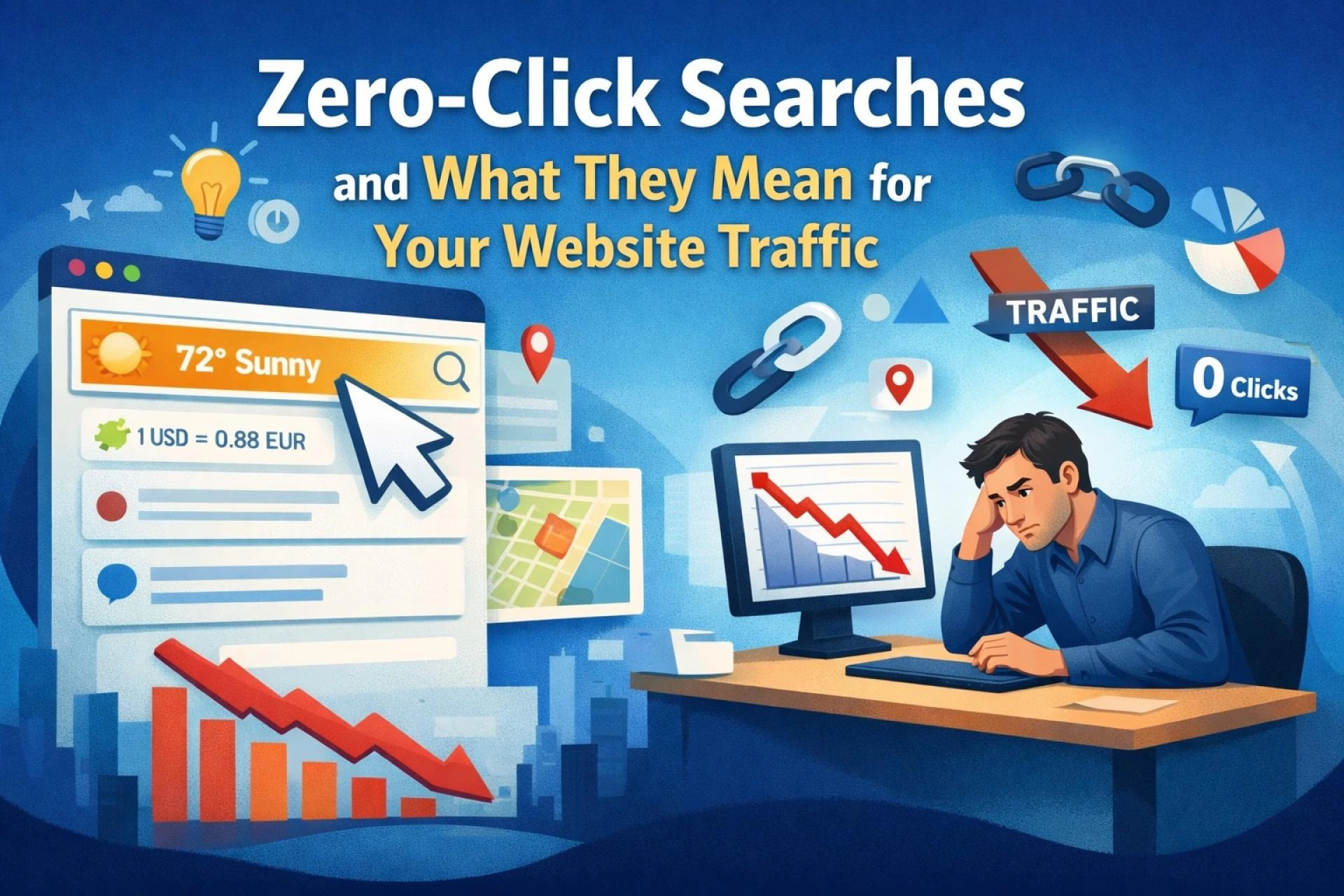

As an SEO professional or someone who works in digital marketing, you may have noticed that your site’s impressions grow, but your actual site visits remain stagnant. The problem, it seems, is zero-click searches.
To quickly summarize, zero-click searches happen when the information you’re looking for is already available on the results page, so there is no need to click on any of the actual sites. This is becoming more prevalent as Google moves from a traditional search engine to more of an “answer engine.”
As a site owner, marketer, or someone who works in SEO, it’s worth knowing how zero-click searches are impacting your site.
Why Are Zero-Click Searches Increasing?
This is because Google wants to provide answers fast. In a zero-click search, Google provides answers on the Search Results Page (SERP) instead of requiring you to visit other sites. There are two main reasons why this is happening:
1) AI Overviews at the top of the SERP. This is a Google feature that provides answers to your questions using information obtained from different sources. It is a helpful tool, and the main problem is that you don’t have to click on other sites anymore.
For example, if you want to know what digital marketing is, you would normally have to click on a site to get the definition. But now, the definition is probably on AI Overviews.
2) Knowledge Graph is a Google feature that provides information about a person, a company, a place, or anything else. For example, if you want to know about a famous person, the Knowledge Graph will probably provide information about them. As a result, many sites are losing clicks, even if they are at the top of the SERP.
How Do Zero-Click Search Results Impact Website Traffic?
For many publishers, zero-click results have resulted in a significant decline in organic traffic. Publishers with simple questions, like definitions, facts, or short tips, are the most impacted. These are the types of questions Google answers with Featured Snippets or AI Overviews (AIO).
If these features appear on the SERP, they will displace organic results. Even if your website is #1, these features will reduce your click-through rate (CTR). But not all traffic loss is bad news. In fact, the traffic that is left is sometimes more valuable. People who click on AI-driven results are further along in the purchase journey.
How Can You Optimize Content for the Zero-Click Era?
Many marketers are learning to adapt to the zero-click search engine rather than complaining about it. They are moving from the old SEO techniques to new ideas such as answer engine optimization (AEO) and generative engine optimization (GEO).
1. Focus on Answer Engine Optimization (AEO)
AEO is the technique of creating content that directly answers the questions of your visitors in an organized way, and this technique may get your content placed in the search results as a Featured Snippet or AI Overview (AIO).
The simplest way to achieve this is the inverted pyramid technique, where you put the most important information first and then add the details.
For example:
• Start with a clear definition or direct answer
• Add explanations and examples
• Provide actual, deeper insights for readers who want more detail
This structure makes your content easier for search engines to extract details and display.
2. Implement Generative Engine Optimization (GEO)
As the appearance of AI results increases in search engines, Generative Engine Optimization (GEO) is becoming more important for SEO experts and marketers.
Traditional SEO primarily focuses on the ranking of websites. Generative optimization, also known as GEO, should be a trusted source for the generation of answers by AI systems.
To achieve this, the content should demonstrate the expertise, trustworthiness, and depth of the information. Ideas, cases, and even expert opinions are more important than the information itself, as they provide context and credibility that enhance the overall quality and reliability of the content. Search engines and even AI prefer authoritative content for the generation of summaries.
3. Use Structured Data and Schema Markup
Another useful method in the zero-click world is structured data, also called schema markup. Schema markup enables search engines to understand the content of your web pages. It essentially connects your site to the knowledge graph, enabling Google to read your content.
Ways Schema Markup Helps Your Content Appear in Search Results without Clicking:
• Featured Snippets
• FAQ Snippets
• Knowledge Panels
• Product Listings
4. Voice Search Query Optimization
An additional factor responsible for the growth of zero-click searches over the past couple of years has been the increasing popularity of voice searches using devices like Google Home, Alexa, Siri, etc.
When someone uses a device with voice recognition technology to ask a question, they typically don't get a list of results returned for their question; instead, they receive just one "result." This means that when the voice search device provides an answer, it usually provides some form of information from a featured snippet or from some other type of structured data (e.g., Google Knowledge).
To create great content that will optimize for voice search queries, your content should:
• Use natural language
• Clearly answer the question you are trying to target
• Include a conversational tone of voice
For example, instead of simply producing keyword-based content, try to write material that actually provides detailed answers to the following questions:
• "What is a zero-click search?"
• "Why does Google display fewer website results?"
Final Thoughts
Modern SEO has been changed by the rise of zero-click searches. Search engines are evolving from simply being a way to find something out to being a resource for the ‘answer’ to users’ queries. The use of AI Overviews (AIOs), Featured Snippets, and the Knowledge Graph has altered how users gain access to the information they seek.
In order to retain visibility in a world where zero-click visitors dominate, it also means focusing on getting AEO and GEO, using structured data (schema markup), and optimizing for voice searches as a means to develop and sustain a competitive advantage. Ultimately, success with search in today’s world means establishing your authority as a reliable source for search engines and AI.

























Sign in to leave a comment.