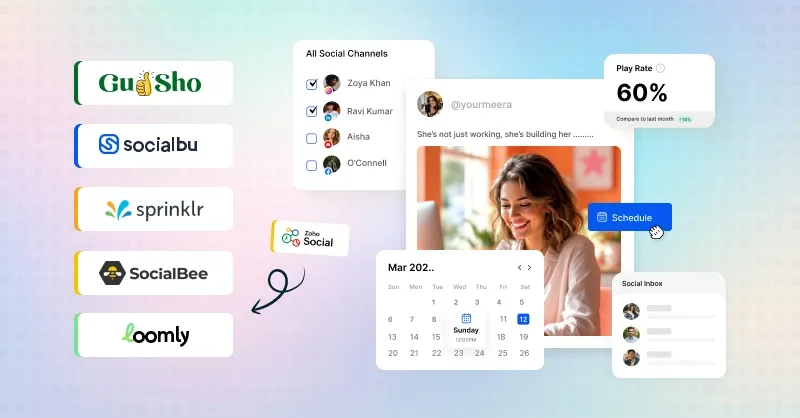

Zoho Social was a good social media management tool for many, until we dig deeper. It seemed like a natural fit for teams that are already in the Zoho ecosystem. The CRM integration worked well, and the calendar was clean. And then the cracks started appearing when managing six client accounts, chasing approval workflows by email and hitting walls when diving for deeper analytics.
For client-facing work, the reporting is surface-level. Collaboration features were not designed for agency team coordination. And then, whenever a client wanted capabilities beyond Zoho's native integrations, the whole ecosystem felt like a locked room instead of an open platform.
From all that experience, we started to look for better Zoho social alternatives. Where tools are built for how modern social media management actually works.
In this guide, you’ll get to know the top 5 Zoho Social Alternatives on the market.
Key Takeaways
- The problem is that Zoho Social works in an ecosystem where teams not fully invested in Zoho's broader suite often struggle with limited reporting depth, restricted collaboration workflows and platform coverage gaps that get worse as operations scale up.
- GUDSHO is the best all-round alternative to Zoho Social for agencies managing multi-format content for multiple clients and platforms from one centralized hub. It replaces Zoho Social ecosystem dependency with real operational completeness
- Switching to a new tool is only worthwhile if the new tool removes real friction. The best Zoho Social alternative is the one that the team uses consistently without fighting the software to perform basic work.
Why Look for Zoho Social Alternatives?
Zoho Social works well only within certain parameters. But the moment we step outside of the ecosystem, its limitations will become very apparent. Here's where teams always run into trouble:
Lacks Reporting Depth for Agencies: Zoho Social has reach, engagement and follower growth analytics but not the cross-platform and campaign-level reporting that agencies need for serious client deliverables. So, monthly reports require data to be exported and rebuilt manually.
Collaboration features were not designed for teams: Approval workflows are functional but limited in Zoho Social. Multi-stage review processes, role-based permissions and internal feedback on draft posts are features agencies use daily. So Zoho Social lacks the feedback for creative design, which takes time and causes version confusion.
Ecosystem Dependency Limits Flexibility: Zoho Social's biggest advantage is its CRM integration. Teams that are unaware miss out on the headline feature of the Zoho ecosystem while struggling with its limitations. So, for agencies that work with clients on different CRM platforms, this lock-in becomes an operational issue.
Platform Coverage Has Gaps: Zoho Social lags behind competitors on its supported network list. Support for TikTok, newer platform integrations and emerging channel coverage tend to arrive late compared to other social media scheduling tools, leaving teams to manage new platform activity outside of the dashboard.
Scaling Gets Expensive Quickly: Tier-specific features require plan upgrades, which add up quickly when you have multiple brands in Zoho Social. Competitors deliver similar or better capabilities at more affordable prices, so Zoho Social loses its edge as your needs grow.
Top Zoho Social Alternatives at a Glance
| Tool | Pricing | Star Features | Best For |
| GUDSHO Social | Free Trial Custom Pricing | Multi-format content hub, unified social inbox, bulk scheduling and team collaboration | Small teams to agencies managing social strategies for multiple clients on multiple channels |
| SocialBu | Free Plan with Limits Starts at $16/month | Clean scheduling with RSS automation and basic analytics | Solo creators and small teams needing simple and reliable scheduling tool |
| Sprinklr Social | Custom Pricing Plan | AI-powered routing, 30+ channel coverage and third-party integrations | Global enterprises managing high-volume posts and complex social operations |
| SocialBee | Free Trial Starts at $24/month | Category-based post scheduling, automatic evergreen recycling and content library | Growing brands to build sustainable and organised content systems for better engagement |
| Loomly | Free Trial Plans from $49/month | Post ideas engine, approval workflows and brand asset management | Mid-size teams who need structured content planning and team collaboration |
Top 5 Zoho Social Alternatives and Competitors in 2026
GUDSHO Social
GUDSHO Social is a solid social media management platform for teams that outgrow Zoho Social’s limitations. While ecosystem integration is the core of Zoho Social, GUDSHO Social is all about operational completeness. As every content format, every publishing workflow, every engagement touchpoint and performance insights are in one place without any specific CRM.
You can manage videos, carousels, static posts, stories and texts becomes clean and easy with GUDSHO Social's centralised media hub. With the visual content calendar, you get a clear picture of your entire content plan and identify gaps across all accounts. Moreover, the unified social inbox organizes comments, reactions and mentions across all connected channels without the need for native app hopping. So, GUDSHO Social removes all the friction points for agencies where Zoho Social lacks making it a reliable Zoho Social alternative in the market.
Key Features
- Multi-Format Media Hub: Every major format is handled by GUDSHO Social such as videos, carousels, static images, GIFs and stories from one central library without any additional tools.
- Visual Content Calendar: A visual calendar shows what's happening on every connected account and platform. You can also identify gaps and missed posts in just seconds.
- Bulk Scheduling: You can build a clean publishing queue for all accounts and formats at once. Two hours is all it takes for you to schedule all your content without any errors.
- Unified Social Inbox: From all connected accounts, every comment, reactions and mention gets sent to one inbox with filtering and priority indicators. This helps manage hundreds of comments without logging into native apps.
- Team Collaboration and with Approvals: The permission architecture makes it safe and reliable to delegate publishing responsibilities without the version confusion and approval delays that email-based workflows cause for agencies.
- Cross-Platform Analytics: The analytics dashboard reveals which post types get clicks, which platforms perform best with particular content approaches. Those insights provide a data-driven content system to improve your content over time.
2. SocialBu
SocialBu occupies an important place amongst social media management tools for small teams and solo operators who need reliability without complexity. In comparison to testing enterprise platforms where configuration takes days before a post can be published, SocialBu is super simple to set up. As accounts get connected quickly, posts get scheduled easily and the platform gets out of the way so teams can work on content and not platform navigation.
So, SocialBu is a smaller Zoho Social alternative that handles multi-platform publishing, content queues, RSS automation and basic analytics without the ecosystem dependencies, making it less complicated for lean teams. Also, it covers most small business use cases well and supports Facebook, Instagram, Twitter, LinkedIn, YouTube, Pinterest and TikTok without any issues. Here, you get everything actually needed for consistent social media scheduling without paying for enterprise features that never get used.
Key Features
- Multi-Platform Scheduling and Queuing: Posts can be either queued for automatic publishing at set times or dropped into recurring slots that run on a daily basis without any human intervention.
- RSS Feed Automation: Attach an RSS feed and SocialBu automatically generates social posts with templates for new content using blog entries, news items and content feeds.
- Engagement Management: Basic engagement, such as comments and mentions, gets consolidated into a feed for monitoring and responding without a dedicated community manager.
- Recycle Content for Evergreen Posts: Top-performing posts are recycled at defined intervals to keep evergreen content in rotation without constant manual rescheduling.
- Simple Analytics: Get simple performance data like reach, engagement, follower growth and best posting times to understand which performs better.
3. Sprinklr Social
Some social media management platforms just can't compete with Sprinklr Social. Global companies that need social presence across markets, languages, departments and regulatory environments, Sprinklr is more than a social media scheduling tool; it's an infrastructure. Handling an international retail brand's social presence across 14 markets and 9 languages requires capabilities that no other platform can match at this operational scale.
Architectural depth is what sets it apart from every other alternative to Zoho Social on this list. The platform unites publishing, engagement, social listening, social media analytics and AI-powered automation in one scalable system for organizations. It can even track every missed interaction or off-brand posts in a glance. But in a real-world where social media operates at a global scale, Sprinklr Social delivers everything on time and on budget.
Key Features
- Unified Engagement Console: Sprinklr combines 30+ social networks, review platforms and messaging apps into one engagement console with market-specific filters to keep territories organized without information silos.
- AI-Powered Message Routing: Incoming messages are automatically sorted by intent, sentiment, topic or urgency and sent to the appropriate team or agent without manual work.
- Support for Multilingual Engagement: It supports engagement across multiple languages with built-in translation and localisation without the need for having native-language team members.
- Social Listening: It can monitor brand mentions, competitor activity and industry keywords in real time to find conversations before they get serious or become trends for active engagement.
- Enterprise-Level Analytics: The dashboard lets you monitor engagement SLAs, sentiment trends, response time, team/community health scores and campaign performance across every connected market and channel individually.
4. SocialBee
SocialBee helps you solve a social media burnout problem that most platforms leave out entirely. The pressure to produce new content daily is exhausting and for most brands, completely unnecessary. But here, content is grouped into structured buckets, posts are rotated to keep them in a consistent place and high-performing evergreens are recycled indefinitely using SocialBee's category-based scheduling system. Once you get past the manual scheduling, this systematic approach makes you feel like you are building a content system instead of a content treadmill.
SocialBee is an ideal tool that eliminates permanent manual intervention for content publishing. Moreover, it supports major channels such as Facebook, Instagram, Twitter, LinkedIn, TikTok, YouTube and even Google Business Profile, which most don’t. So, SocialBee is a reliable alternative to Zoho Social for brands and lean marketing teams that want a long-term social presence.
Key Features
- Category-Based Content Organisation: The content is sorted into promotional, educational, entertaining, curated and seasonal categories with defined posting frequencies and timeslots.
- Evergreen Content Recycling: Most top-performing posts recycle automatically at defined intervals, while time-sensitive content expires at a set time.
- Bulk Scheduling: It combines bulk scheduling efficiency with platform-specific customisation to deliver content to audiences where it feels native rather than cross-posted from a central scheduler.
- RSS/Blog Integration: By connecting your RSS feeds you can turn blog posts and external content into scheduled social posts with predefined templates automatically.
- Brand Specific Workspaces: Each brand or client has its own isolated workspace with custom content libraries, categories and posting times to eliminate chaos as account numbers grow.
5. Loomly
Loomly is different from other Zoho Social alternatives as it provides content planning as creative process rather than just a scheduling calendar. The Post Ideas engine suggests content based on trending topics, RSS feeds, social media events and platform best practices to help teams avoid the blank-page pit that halts most content productions before scheduling begins.
Moreover, Loomly provides a structured workflow to keep your campaigns organized and on-brand as mid-size marketing teams and growing agencies prefer content quality and creative consistency as much as publishing reliability. Finally, Loomly provides a clean, client-friendly approval workflow that allows stakeholder sign-off much faster than email-based alternatives.
Key Features
- Post Ideas Engine: Loomly suggests content ideas based on trending topics, holidays, social media events, RSS feeds or platform best practices. This makes content pipelines full even when creative energy is low.
- Visual Content Calendar: The calendar gives a clean, campaign-aware view of all scheduled and drafted content across connected platforms. Posts are organized by campaign, color-coded by type, and shown in monthly, weekly or list views as per team preference.
- Structured Approval Workflows: Customers and internal reviewers can comment, request changes and approve directly from notification emails. This frictionless approval reduces back-and-forth cycles that stall publishing timelines and frustrate agencies and clients at the same time.
- Brand Asset Management: Brand assets such as logos, colors, fonts, image templates and approved copy are all stored in a centralised brand library for immediate access with strict brand guidelines.
- Post-Analytics & Performance Tracking: The key performance metrics like reach, impressions, clicks, engagement rate and audience growth are visualized clearly across connected platforms in a single place.
How to Choose the Right Zoho Social Alternative?
Finding the right platform is so simple; you just have to match it to your operations and needs. If you understand this then it’ll be easy to find the right Zoho Social alternative for your business. Here's how:
- GUDSHO Social – Connects, manages and engages social media channels for multiple clients.
- SocialBu – A clean and reliable scheduling tool without complexity for solo creators and small teams.
- Sprinklr Social – A tool for global businesses to publish across various languages and routing that others can match.
- SocialBee – Automating evergreen content for consistent posting without any human interaction.
- Loomly – Creating a structured workflow for planning, content creation and approval.
The Right Zoho Alternative Changes Everything
Not that Zoho Social is bad, it's just that it has boundaries. And when an operation goes beyond those lines, every workaround, every manual step and every missing feature costs time, client confidence and growth.
Every Zoho Social alternative mentioned on this list eliminates ecosystem dependency, higher pricing, seamless scaling, creative burnout and more without sacrificing quality as they scale. Also, all of these platforms offer free trials. The smartest thing to do now is to connect real accounts, run real campaigns and let actual performance decide, not feature comparison charts.
The best Zoho Social alternative is the one built for your workflow!

















Sign in to leave a comment.