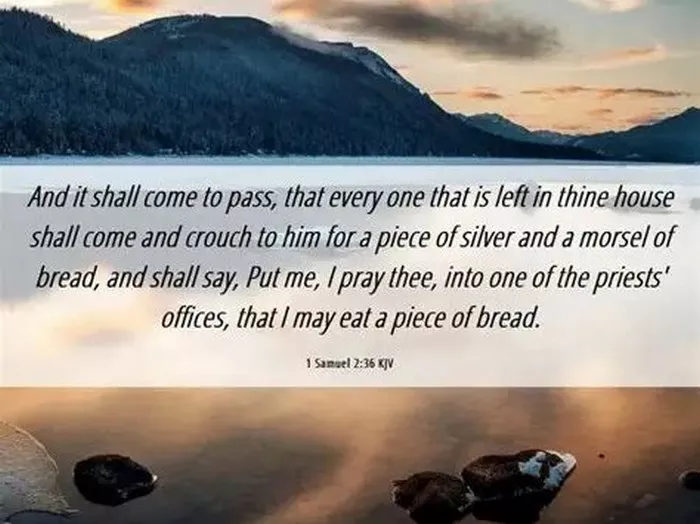

Read the Daily Bible Verse – 1 Samuel 2:36 To Strengthen Your Spiritual Journey.
The Bible records both judgment and hope, often side by side. After the warnings and promises in 1 Samuel 2:31–35, 1 Samuel 2:36 describes the final consequence for Eli’s family. This verse portrays a state of humiliation and dependency for the remaining members of Eli’s house.
God had warned Eli about his sons, Hophni and Phinehas, who had corrupted the priesthood. Judgment came, and their deaths were a sign of God’s justice. Now, verse 36 describes the state of the survivors. They would no longer serve with honor but would beg for the basic necessities of life, even for a position in the priesthood.
Though this verse is sobering, it teaches important lessons. It shows God’s justice, the consequences of sin and failure, and the necessity of humility. In this article, we will explore the context of this verse, its meaning, and its application in life. The sentences will be simple, and the structure will remain clear for easy understanding.
The Context of 1 Samuel 2:36 KJV
Eli’s Family and the Priesthood
Eli was the high priest of Israel. His sons, Hophni and Phinehas, were corrupt priests. They abused their authority and dishonored God. They took more than their share of sacrifices and committed immoral acts near the tabernacle.
Eli knew about their sin but did not restrain them. His failure to correct them brought judgment on his household. God announced that Eli’s family would no longer enjoy honor in the priesthood, and that his sons would die as a sign of divine justice.
The Consequences of Sin
Verses 31–35 describe the consequences of Eli’s failure and his sons’ wickedness. God declared that there would be sorrow, grief, and early death in Eli’s house. However, God also promised to raise a faithful priest who would follow His heart and mind, pointing forward to Samuel and prophetically to Jesus Christ.
Verse 36 follows these judgments and promises, showing the state of the remaining family members. Unlike the faithful priest who would serve honorably, the survivors of Eli’s house would be humiliated and dependent on others for their survival.
Israel at the Time
During this period, Israel was a theocracy, meaning God was their king. The tabernacle at Shiloh was central to worship, and priests held significant authority. To serve honorably in God’s house was a privilege. Losing that honor was not only a personal loss but a public disgrace.
The context shows a contrast: Eli’s family would experience disgrace and dependence, while a faithful priest, such as Samuel, would rise and lead according to God’s heart.
1 Samuel 2:36 (KJV)
The Verse
1 Samuel 2:36 (KJV) says:
And it shall come to pass, that every one that is left in thine house shall come and crouch to him for a piece of silver and a morsel of bread, and shall say, Put me, I pray thee, into one of the priests’ offices, that I may eat a piece of bread.
This verse highlights four key points:
The remaining members of Eli’s house will humble themselves.
They will depend on others for food and livelihood.
They will seek positions in the priesthood for survival.
They will be in a position of submission rather than honor.
1 Samuel 2:36 Meaning
“Every One That Is Left in Thine House”
This phrase refers to the surviving members of Eli’s family after God’s judgment. The sons Hophni and Phinehas were already dead, and the rest of the household would experience the consequences.
It shows that sin has long-term effects. Even those who are innocent by age or role may suffer because of the failure of leadership or the corruption of a family member.
“Shall Come and Crouch to Him”
The word “crouch” indicates humility and submission. The remaining members will no longer stand with honor. They will bow and submit to someone else’s authority.
This humility is both physical and symbolic. It reflects the loss of prestige, the dependence on others, and the shame brought about by their family’s corruption.
“For a Piece of Silver and a Morsel of Bread”
These words show their dependency. They will need basic necessities—money and food—supplied by others. This contrasts sharply with their previous privileged life as priests in God’s house.
The verse teaches that when God’s people act wrongly or fail to correct sin, material and social blessings can be lost. The remaining family members will be forced to rely on others for survival.
“Put Me, I Pray Thee, into One of the Priests’ Offices, That I May Eat a Piece of Bread”
This phrase shows desperation. Even the smallest role in the priesthood will be sought out for basic sustenance. They will no longer hold authority by inheritance but will serve at the mercy of others.
This demonstrates the consequences of neglecting God’s commands. Honor in service to God must be earned through faithfulness and obedience. Privilege without integrity leads to humiliation.
The Broader Spiritual Lesson
This verse illustrates a spiritual principle: positions and blessings are gifts from God. They require responsibility and obedience. Corruption, laziness, or negligence in leadership can lead to loss of honor and dependence on others.
It also contrasts with God’s promise in 1 Samuel 2:35, where a faithful priest will serve with honor and stability. God rewards faithfulness and obedience and disciplines neglect and sin.
1 Samuel 2:36 Application in Life
Humility in Service
This verse teaches believers about humility. No matter our status, we must remain obedient to God. Positions and privilege can be lost if we ignore God’s commands.
We should serve faithfully in our families, workplaces, and churches, not merely for honor but to honor God.
Accountability for Leaders
Leaders are accountable for the actions of those they oversee. Eli’s household suffered because he did not restrain his sons. Parents, pastors, and mentors today must act responsibly to correct wrongdoing.
Failure to correct sin leads to long-term consequences for others under our care.
Dependence on God
This verse shows that when God’s blessing is withdrawn, humans become dependent on others. We should remember that all provision comes from God. Even those in positions of authority need His guidance and protection.
Believers should cultivate reliance on God in all circumstances, avoiding arrogance or entitlement.
The Cost of Ignoring God’s Commands
Eli’s family demonstrates the danger of ignoring sin. Even in the priesthood, where they were close to God’s presence, neglect and corruption brought humiliation.
This is a warning for today: proximity to God’s work does not replace obedience. We must respond to correction and live righteously.
The Contrast with Faithfulness
1 Samuel 2:36 also highlights the contrast with faithful service. Samuel, the faithful priest, experienced God’s favor, stability, and guidance. Faithfulness brings blessing, while neglect leads to dependence and shame.
Believers should choose faithfulness, knowing it leads to honor and God’s provision.
Personal Reflection
This verse invites self-examination. Are there areas where we have relied on privilege rather than obedience? Are we humble before God and others?
We can learn from Eli’s household and commit to faithful, humble service in every area of life.
Conclusion
1 Samuel 2:36 is a sobering verse that shows the consequences of sin and failure in leadership. It describes how the remaining members of Eli’s household would be humbled and dependent on others for basic needs. Their honor would be gone, and they would seek even the smallest position for survival.
This verse teaches that privilege requires responsibility. Positions and blessings from God must be accompanied by faithfulness and obedience. Ignoring correction, allowing corruption, or failing in duty can lead to humiliation and dependence.
At the same time, the verse contrasts with God’s promise to raise a faithful priest in 1 Samuel 2:35. Faithfulness leads to stability, blessing, and favor. God’s justice is balanced with mercy, and His plan continues even after judgment.



































Sign in to leave a comment.