
When the weather turns hot, your AC becomes one of the most critical systems in your home. When it fails, frustration is guaranteed to follow.
Ironically, everyone understands that an air-conditioner failing is not something that happens out of the blue. There will always be signs, and most AC problems can be prevented with the right care and proper maintenance. Understanding this doesn't always lead to action, however, and that is why air-conditioners everywhere still continue to 'suddenly' and 'inexplicably' fail.
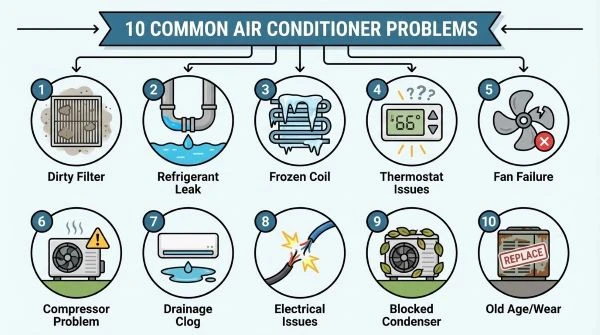
Here are 10 common AC repair issues. Understand these, and hopefully, you can prevent them from happening to you.
1. A Neglected and Clogged Air Filter
The air filter may be one of the simplest components of your AC system, but its simplicity is deceptive, as it has a crucial role in keeping your AC functioning well.
The filter captures airborne particles like dust and pollen. When it becomes saturated, however, it severely restricts airflow. This forces the entire system to labour harder, which increases power use and unnecessarily strains moving parts, which can subsequently lead to more serious issues.
Make it a point to regularly inspect the filter, replacing it according to the manufacturer's instructions; every one to three months is typical. This is a relatively simple task, but make sure to do it religiously because it can prevent complex problems.
2. Refrigerant Leaks
The refrigerant is the chemical agent responsible for the cooling (via heat exchange) process. An air conditioner is a sealed system, so the level of refrigerant should never decrease.
Therefore, if your refrigerant level is lower than it should be, it means you have a leak. The signs are often subtle: perhaps a faint hissing sound, some ice forming on the exterior copper lines. The result, however, is always a noticeable loss of cooling capacity.
You can add more refrigerant to replenish levels to what they should be, but that is a temporary or band-aid measure, not a solution. The leak must be located and professionally repaired to restore the system's integrity.
3. A Frozen Evaporator Coil
You may one day discover the indoor evaporator coil encased in ice. This is a clear sign your AC is malfunctioning, but the ice itself is a symptom, not the root cause.
An AC doesn't only cool a space but dehumidifies it, too. As humid air passes over the coil, the cooler temperature (due to the cold refrigerant inside) precipitates the moisture in the air. The resulting condensation drips down and is taken away through the condensate drain line.
However, if there is a lack of sufficient airflow across the coil's surface, the coil cannot absorb enough heat from the air, which can lead to its temperature dropping below zero. When that happens, the condensate will freeze instead of flowing down and out of the drain line.
A clogged filter or a failing fan is the likely cause of this restricted airflow. The correct response is to turn the system off to thaw and then identify the source of the restricted airflow.
4. A Blocked Condensate Drain Line
As explained earlier, when your AC dehumidifies the air, it produces condensation and the resulting condensate is channelled away through a drain line. If this line becomes obstructed with algae or sediment, the water will get backed up.
Many systems have a float switch that will shut the unit down when the water in the drain reaches a certain level to prevent flooding that can lead to bigger issues. If your AC system doesn't have that or if the switch fails, water damage will ensue.
Prevent this through regular drain line flushes. Use a mixture of bleach and water or a simple vinegar solution.
5. Fan Malfunctions
Your system has two critical fans: the interior blower, which circulates air through your home, and the exterior condenser fan, which expels heat. The failure of either one will disrupt the entire cooling cycle. A problem with the outdoor fan can lead to the compressor overheating, which is one of the most expensive components to replace.
6. Thermostat Inaccuracies
The thermostat functions as the system's control centre. If it malfunctions, the AC may run constantly, not at all, or cycle improperly. The cause can be as simple as depleted batteries, but it can also be miscalibrated or poorly placed. A thermostat that receives direct sunlight, for instance, will provide inaccurate readings and disrupt system performance.
7. Electrical Faults
An air conditioner contains numerous electrical components, such as capacitors, contactors, and wires, that can degrade over time. A failed capacitor, for example, can prevent the compressor or fan motor from starting.
Any suspected electrical issue must be diagnosed and repaired by a qualified technician.
8. Abnormal Operating Noises
Any deviation from your unit's baseline noises can indicate something is wrong. A rattling sound might suggest a loose panel, while a high-pitched squeal often can point to issues with the motor bearing or belt.
Shut the system down and call for service to prevent further damage.
9. A Dirty or Obstructed Outdoor Unit
When the fins on the outdoor unit become blocked because of leaves, dirt and other debris that might have accumulated on it, it cannot dissipate heat effectively. Ensure the area around the unit remains clear, and gently rinse it with a hose as needed.
10. Improper Sizing or Installation
A unit that is too large will cool the space too quickly and shut off. This 'short-cycling' prevents proper dehumidification. An undersized unit will run constantly without ever reaching the target temperature, leading to extreme energy waste and premature failure. This is why a thorough load calculation is non-negotiable. It would be great if you had an annual maintenance contract with a reputable contractor who can properly size your AC and install it correctly.
A Final Word on Prevention
You can address minor tasks like changing a filter, but most issues require professional intervention. The most effective approach is not reactive repair, but proactive maintenance. Get an annual maintenance contract for regular AC service that will identify and correct small problems before they escalate.
























Sign in to leave a comment.