
Planning an international trip usually starts with exciting questions:
Where should I go? What should I see? Where should I stay?
But there is another question that one-way travelers sometimes discover only when they are standing at the airport:
“How are you leaving the country?”
If you have a return ticket, the answer is easy.
But if your itinerary is:
Delhi → Bangkok
and you haven't decided where you're going next, an airline employee or immigration officer may ask for evidence of onward travel.
This is where an onward ticket becomes important.
An onward ticket is evidence that you plan to leave your current destination and continue your journey elsewhere. Depending on the country and your circumstances, this may be a return flight, a flight to another country, or another accepted form of transportation.
However, there is no single worldwide rule saying that every traveler must have an onward ticket.
Requirements can depend on your nationality, visa type, destination, length of stay, and travel circumstances.
So if you are searching for countries that require an onward ticket, this guide will help you understand where onward travel documentation may matter and how to prepare for it.
Why Do Countries Ask for an Onward Ticket?
The basic reason is simple.
Immigration authorities want to know that visitors understand the conditions of their stay and have a reasonable plan to leave when required.
For example, imagine a traveler enters Thailand on a short-term visitor arrangement.
Their flight is
Delhi → Bangkok
An onward booking could show:
Bangkok → Hanoi
This demonstrates that Bangkok is not necessarily their final destination.
Alternatively, they could have:
Bangkok → Delhi,
which demonstrates a planned return home.
In both cases, the traveler has evidence of a future departure.
This is commonly called proof of onward travel.
It can be particularly relevant for people traveling on one-way tickets because a one-way ticket only establishes the journey into the destination.
It does not necessarily show what happens afterward.
The important distinction
Having an onward ticket does not automatically guarantee entry.
An immigration officer can consider many other factors, including:
- Visa status
- Purpose of travel
- Accommodation
- Financial resources
- Passport validity
- Length of intended stay
- Previous travel history
- Immigration conditions
So think of an onward ticket as one piece of the travel-document puzzle, not a magic key that opens every immigration gate.
Countries That May Require an Onward Ticket
There is no permanent worldwide list of countries where every traveler must show an onward ticket.
Instead, different destinations have different rules.
Some countries explicitly mention return or onward tickets in their visitor requirements. Others may require evidence of departure for particular visa categories or nationalities.
Below are several destinations where onward or return travel documentation can be particularly relevant.
1. Philippines
The Philippines is one of the clearer examples of a destination where return or onward travel can form part of entry requirements.
Philippine immigration and visa guidance refers to a return or onward ticket for tourists and certain visitor arrangements.
For eligible travelers entering under applicable visa-free arrangements, a return or onward ticket may be required depending on nationality and the specific conditions of entry.
Example
Suppose your trip looks like:
Delhi → Manila
You plan to stay for two weeks.
Your onward journey could be:
Manila → Delhi
or:
Manila → Singapore
The second flight demonstrates that you intend to continue your journey rather than remain indefinitely in the Philippines.
However, the exact requirements depend on your passport and immigration category, so travelers should verify the current rules before departure.
2. New Zealand
New Zealand has clear rules concerning evidence that a traveler intends to leave the country.
For relevant visitor categories, travelers may need to demonstrate that they have arrangements to leave New Zealand.
This can include a paid ticket for travel out of New Zealand to a country where the traveler has the right to enter.
Example
Your itinerary:
Delhi → Auckland
Planned departure:
Auckland → Delhi
The return flight provides evidence of your intended departure.
If you are continuing your trip elsewhere:
Auckland → Sydney
that may represent your onward journey, provided it meets the applicable requirements.
The important thing is to check the requirements for your exact visa or entry permission before traveling.
3. Costa Rica
Costa Rica is another country where proof of departure can be important.
Official tourism guidance states that visitors may need to show a return ticket to their country of origin or an onward travel plan showing their next destination.
Depending on the circumstances, acceptable evidence can include certain forms of prepaid transportation out of Costa Rica.
This is useful for travelers because onward travel does not necessarily mean another flight.
For example:
San José → Panama City
could demonstrate onward travel by air.
A traveler could also potentially use accepted land transportation where the applicable rules permit it.
Example
Imagine:
Madrid → San José
Then:
San José → Panama City
You are not returning directly to Spain, but you are still leaving Costa Rica.
That is the basic idea behind onward travel.
4. Panama
Panama's immigration requirements can also involve evidence of departure depending on the applicable immigration category.
Travelers may be expected to have a return ticket or appropriate evidence showing that they will leave the country within the relevant period.
Example
Your itinerary:
Delhi → Panama City
Your next destination:
Panama City → Bogotá
If your immigration category requires proof of departure, having appropriate documentation for that journey can help demonstrate your travel plans.
Again, the exact requirement depends on the circumstances of your entry.
This is why it is better to check the official rules for your particular situation rather than relying on a generic online list.
5. Indonesia
Indonesia is another destination where return or onward travel documentation can be relevant for certain visitor arrangements.
Depending on the visa or entry category, travelers may need evidence of a return journey or a ticket continuing to another destination.
Example
You are traveling:
Delhi → Bali
and then:
Bali → Singapore
The Singapore flight represents the onward portion of your journey.
If instead you're returning home:
Bali → Delhi
that return flight may serve as your departure evidence where applicable.
This is an important distinction:
Onward travel does not always mean returning home.
It simply means leaving your current destination.
6. Peru
Peru is particularly relevant for travelers applying for certain tourist visas.
Visa documentation can include evidence of return travel, such as a round-trip ticket or reservation, depending on the applicable consular requirements.
For example:
Delhi → Lima → Delhi
clearly shows the planned entry and departure.
For a traveler visiting multiple destinations, the complete itinerary may look different.
For example:
Delhi → Lima → Santiago → Delhi
In that situation, the traveler should make sure the documentation submitted to the relevant authorities accurately represents the planned trip.
This is another example of why onward ticket visa requirements should always be checked against the exact visa application instructions.
What About Thailand?
Thailand is frequently mentioned when people search for countries that require an onward ticket.
Travelers arriving on one-way tickets may sometimes be asked to demonstrate their onward travel plans, particularly depending on their nationality, visa status, and airline procedures.
However, travelers should be careful with broad claims such as:
“Everyone entering Thailand must have an onward ticket.”
Immigration and airline requirements can differ depending on the circumstances.
Example
You have:
Delhi → Bangkok
Your next destination is Vietnam:
Bangkok → Hanoi
Having documentation for the second journey can demonstrate your planned departure from Thailand.
Alternatively:
Bangkok → Delhi
could demonstrate that you intend to return home.
The safest approach is to check the current official requirements applicable to your nationality and entry status.
What About Mexico?
Mexico is another destination where travelers may be asked for information supporting their trip.
Depending on the circumstances, visitors may need to provide evidence relating to their accommodation, travel plans, and departure arrangements.
For example:
Delhi → Mexico City
Hotel:
1 October → 20 October
Departure:
Mexico City → Delhi — 20 October
The dates tell a consistent story.
Now imagine the hotel booking ends on October 20, but your flight leaves four months later.
That does not automatically mean you will be refused entry, but it could lead to questions about your plans.
The lesson is simple:
Your travel documents should make sense together.
What About the USA?
The United States requires a slightly different explanation.
It would be misleading to say:
“Everyone entering the USA must have an onward ticket.”
U.S. visitor visa guidance focuses on factors including the purpose of the trip, the applicant's intention to depart after the visit, and the ability to pay for the trip.
Depending on the visa and travel circumstances, evidence of departure or onward arrangements can therefore be relevant.
For example, a traveler applying for a visitor visa may have:
Delhi → New York → Delhi
The return flight supports the proposed travel plan.
But the ticket itself does not guarantee visa approval.
The U.S. visa process considers the application as a whole.
This is an important point when researching proof of onward travel countries:
A ticket is evidence of a travel plan—not evidence that a visa must be approved.
What About the UK?
The UK also demonstrates why travel requirements can depend heavily on the type of journey.
For ordinary visitors, applicants need to demonstrate that they are genuine visitors and intend to leave at the end of their visit.
For certain transit situations, the UK can have more specific requirements concerning confirmed onward flights.
For example:
Delhi → London → New York
may be a transit itinerary rather than a UK tourism trip.
The requirements applicable to that traveler can therefore be different from someone entering the UK as a visitor.
If you're transiting through the UK, check the specific transit rules instead of assuming that the normal visitor rules apply.
Schengen Visa and Onward Travel
Schengen travel is another area where flight documentation can matter.
For visa applications, travelers may be asked to provide evidence of their itinerary and intended travel arrangements.
Consider this itinerary:
Delhi → Paris → Amsterdam → Delhi
It shows:
- Where the traveler enters
- Where the traveler plans to travel
- When the traveler intends to leave the Schengen Area
For a multi-country trip, the itinerary could be:
Delhi → Paris → Rome → Madrid → Delhi
Again, the purpose of the documentation is to show a coherent travel plan.
However, a flight reservation or onward document is only one part of a visa application.
Applicants may also need to provide accommodation evidence, financial documents, travel insurance, employment or business information, and other supporting documents depending on the application.
How to Check Onward Travel Entry Requirements
If you're unsure whether you need an onward ticket, don't panic.
Use this simple process.
Step 1: Check the Official Immigration Website
Search for the official immigration or government website of your destination.
Look specifically for:
- Entry requirements
- Visitor requirements
- Visa conditions
- Return ticket requirements
- Onward travel
- Proof of departure
Official sources should be your starting point.
Step 2: Check Your Nationality
Entry requirements are not always identical for every passport holder.
A rule applying to one nationality may not apply in exactly the same way to another.
This is particularly important for visa-free arrangements.
Step 3: Check Your Visa Type
Ask yourself:
Am I visa-free?
Do I have a tourist visa?
Am I transiting?
Am I entering under a special visa category?
The answer can change the documentation you need.
Step 4: Check Your Airline's Requirements
Immigration rules and airline document checks are related but not identical.
An airline may check whether you appear to meet the destination's entry requirements before boarding.
So even if you're confident about your immigration situation, check the airline's current travel-document guidance too.
Step 5: Prepare a Verifiable Document
If your circumstances require proof of onward travel, make sure your document accurately represents your journey.
Depending on the applicable rules, this could be:
- A confirmed flight ticket
- A valid flight reservation
- A return ticket
- A bus ticket
- A train ticket
- Another accepted form of onward transportation
The key word is accepted.
Not every document works everywhere.
What Should an Onward Travel Document Include?
A useful onward travel document should clearly communicate the important details of your journey.
Typically, travelers should check for:
- Passenger name
- Travel date
- Departure location
- Arrival location
- Flight or transportation details
- Booking reference where applicable
- Airline or carrier information
For example:
Passenger: Rahul Kumar
Route: Bangkok → Hanoi
Date: 18 October
Flight: XX123
Booking Reference: ABC123
The exact format will vary depending on the booking and the requirements.
The important thing is that the information is accurate and verifiable where verification is required.
Can a Flight Reservation Be Used as Proof of Onward Travel?
Sometimes, yes.
But there is an important difference between a reservation and a fully issued ticket.
A reservation may show:
- Passenger information
- Travel dates
- Route
- Flight number
- Booking reference
A ticket generally represents issued transportation with a ticket number and fare information.
Whether a reservation is accepted as proof of onward travel depends on the specific destination, airline, visa process, and requirement.
Never assume that a reservation is automatically accepted everywhere.
If a destination specifically requires a paid ticket, a reservation alone may not satisfy that requirement.
What If You're Traveling to Multiple Countries?
Multi-country travel is one of the situations where onward tickets become especially useful.
Consider this itinerary:
India → Thailand → Vietnam → Japan → India
Your travel plan contains multiple stages.
From Thailand's perspective:
Bangkok → Hanoi
is onward travel.
From Vietnam's perspective:
Hanoi → Tokyo
is onward travel.
From Japan's perspective:
Tokyo → Delhi
is the departure journey.
You may therefore have several documents demonstrating onward travel at different stages of the trip.
This is why long-term travelers and backpackers should think about their journey country by country, rather than assuming one document will automatically satisfy every border.
Common Mistakes to Avoid
Mistake 1: Assuming Every Country Requires an Onward Ticket
They don't.
Some destinations have explicit requirements, while others may assess departure plans differently.
Always check the specific rules.
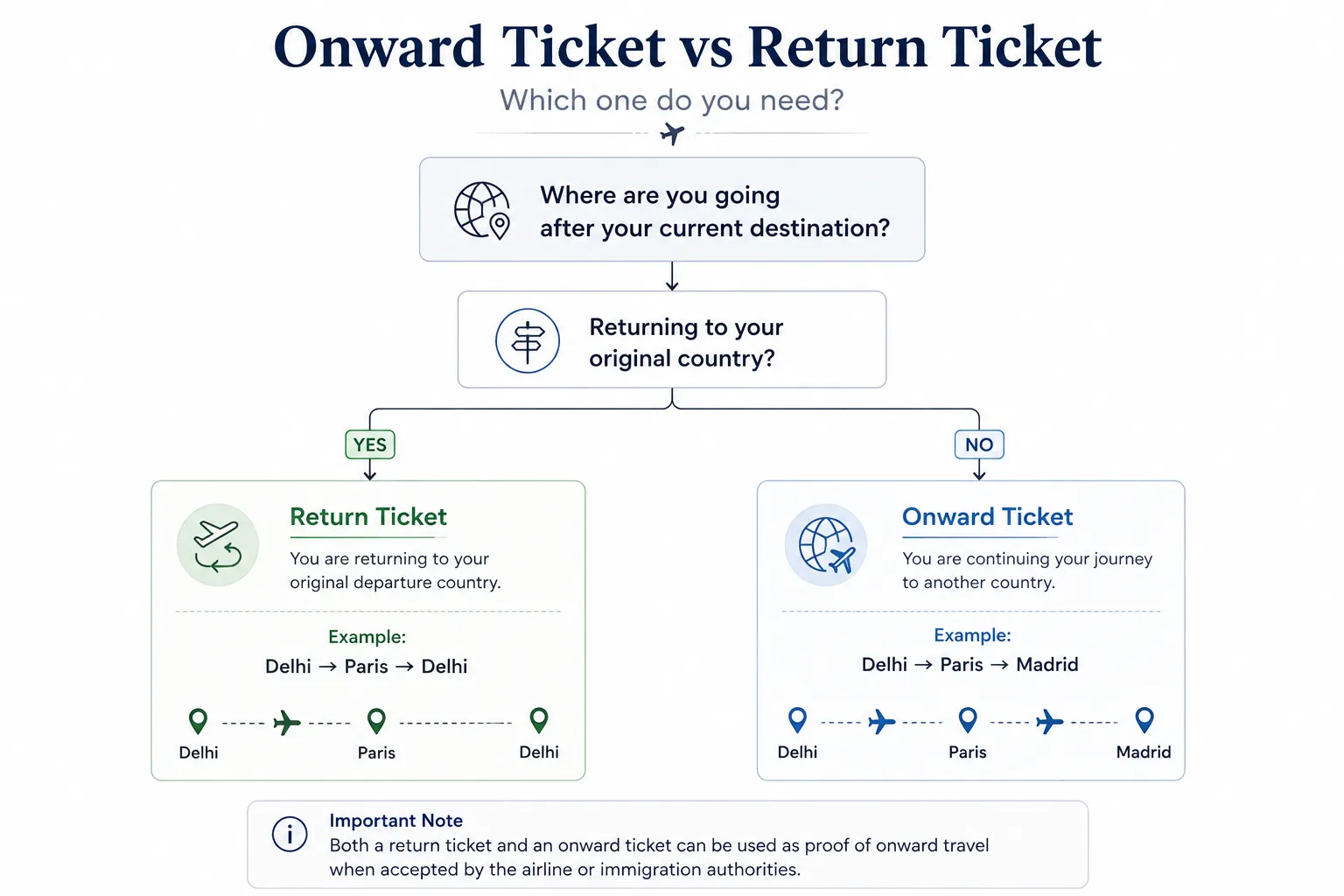
Mistake 2: Confusing an Onward Ticket With a Return Ticket
A return ticket takes you back to your original destination.
An onward ticket can take you anywhere you are legally permitted to travel next.
For example:
Delhi → Bangkok → Hanoi
Hanoi is the onward destination.
Mistake 3: Using Incorrect Dates
Your travel dates should make sense in relation to your permitted stay.
Mistake 4: Mismatching Your Visa Application
If your visa application says:
Delhi → Paris → Delhi
but your supporting documents show:
Delhi → Paris → Istanbul → Nairobi
an officer may reasonably ask for clarification.
Keep your documentation consistent.
Mistake 5: Relying on an Unverifiable Document
If you're using a reservation, make sure it genuinely exists and can be verified when required.
A document that merely looks convincing is not the same thing as valid travel evidence.
Quick Comparison of Onward Ticket Requirements
| Country/Region | How Onward/Return Travel Can Matter | What Travelers Should Do |
| Philippines | Return/onward ticket can be part of visitor requirements | Check nationality and visa category |
| New Zealand | Evidence of departure can be required for relevant travelers | Check current visitor conditions |
| Costa Rica | Return or onward travel evidence can be required | Prepare accepted departure evidence |
| Panama | Return/departure evidence may apply to certain categories | Check immigration category |
| Indonesia | Return/onward documentation can apply to certain visitors | Check exact entry conditions |
| Peru | Return/round-trip evidence can appear in tourist visa requirements | Check relevant consular checklist |
| Thailand | Onward travel may be checked in certain circumstances | Check visa and airline requirements |
| Mexico | Departure arrangements may form part of travel assessment | Keep travel plans consistent |
| USA | Intention and ability to depart can be relevant | Review visa-specific requirements |
| UK | Departure and onward travel can matter, especially in transit | Check visitor/transit rules |
| Schengen Area | Itinerary and intended departure can be relevant to visa applications | Follow the relevant visa checklist |
Important: This table is a general reference, not a substitute for the official entry requirements applicable to your nationality and trip.
Frequently Asked Questions
Which countries require an onward ticket?
There is no single permanent list of countries that require an onward ticket for every traveler.
Destinations including the Philippines, New Zealand, Costa Rica, Panama, and Indonesia have official requirements or guidance where return or onward travel can be relevant for particular travelers or entry categories.
Other destinations may consider evidence of departure depending on the circumstances.
Always check the latest official requirements before traveling.
Do all countries require proof of onward travel?
No.
Whether you need it depends on the destination, nationality, visa type, and travel circumstances.
Some countries have explicit requirements, while others may only ask for evidence in particular situations.
Does an onward ticket have to return to my home country?
No.
An onward ticket simply demonstrates that you plan to leave your current destination.
For example:
Delhi → Bangkok → Hanoi
The Hanoi flight is onward travel even though you are not returning directly to India.
Is a return ticket also an onward ticket?
It can be.
For example:
Delhi → Bangkok → Delhi
The Bangkok-to-Delhi flight is both your return journey and your onward travel from Thailand.
Can I use a flight reservation instead of a paid ticket?
Sometimes.
Some visa or immigration procedures may accept a reservation, while others may specifically require a paid ticket.
Check the exact requirement before relying on a reservation.
Is proof of onward travel required for a visa?
It depends on the visa.
Some visa applications require evidence of itinerary or intended departure, while others may assess departure plans as part of the overall application.
Always follow the official document checklist for your visa.
What happens if I don't have an onward ticket?
If your destination or airline requires one, you may face additional questions at check-in or immigration.
Depending on the rules, you may need to provide an accepted return ticket, onward ticket, reservation, or another form of departure evidence.
The safest approach is to resolve the requirement before reaching the airport.
Final Takeaway
Searching for countries that require an onward ticket can quickly become confusing because there isn't one universal rule.
Different countries—and sometimes different visa categories within the same country—can have different requirements.
The Philippines may require return or onward travel for certain visitors.
New Zealand can require evidence of departure.
Costa Rica recognizes return or onward travel arrangements.
Other destinations, including Thailand, Indonesia, Mexico, the USA, and the UK, can involve onward or departure evidence depending on the traveler's circumstances.
The safest approach is therefore:
Check the official rules → identify your visa or entry category → understand the onward travel requirement → prepare the appropriate document → verify your details.
If you're traveling on a one-way ticket, don't assume that everything will be fine simply because you have a valid passport and visa.
Your destination may want to know what happens after you arrive.
And honestly, it's much better to answer that question while sitting at home with a cup of coffee than while standing at the airport counter with 200 passengers behind you.
Plan your entry. Plan your exit. Keep your documents accurate.
That's the simplest way to stay prepared for onward travel requirements in 2026.
Related guides:
- What Is an Onward Ticket and Do You Need One?
- Onward Ticket vs Return Ticket: What's the Difference?
- How to Get a Flight Itinerary for Visa
Frequently Asked Questions
What is an onward ticket and why do I need one?
An onward ticket is proof that you plan to leave your current destination and continue your journey elsewhere. Many countries require it to ensure visitors have a plan to depart after their stay, especially for those traveling on one-way tickets.
Which countries typically require an onward ticket?
Countries like the Philippines, New Zealand, Costa Rica, and Panama often require an onward ticket for entry. However, requirements can vary based on nationality, visa type, and other factors, so it's crucial to check specific regulations for each destination.
Do I need an onward ticket if I have a return flight?
If you have a return flight, you usually won't need a separate onward ticket as your return ticket serves this purpose. However, some countries may still ask for evidence of your departure plans, so it's best to verify entry requirements before traveling.
Can I use a flight reservation as proof of onward travel?
Sometimes, a flight reservation can be used as proof of onward travel, but it depends on the specific destination and airline requirements. A fully issued ticket with fare information is generally more reliable, so always check what is accepted at your destination.
What if I'm traveling to multiple countries?
For multi-country travel, having onward tickets for each leg of your journey can simplify entry processes. Make sure to prepare appropriate documentation for each destination, as requirements may differ for each country.
How can I check if I need an onward ticket for my trip?
To determine if you need an onward ticket, start by checking the official immigration website of your destination. Review entry requirements based on your nationality, visa type, and any specific regulations from your airline.
What information should be included in an onward travel document?
An onward travel document should include details such as passenger name, travel date, departure and arrival locations, flight or transportation details, and a booking reference. This clarity helps immigration officials verify your travel plans.


























Sign in to leave a comment.