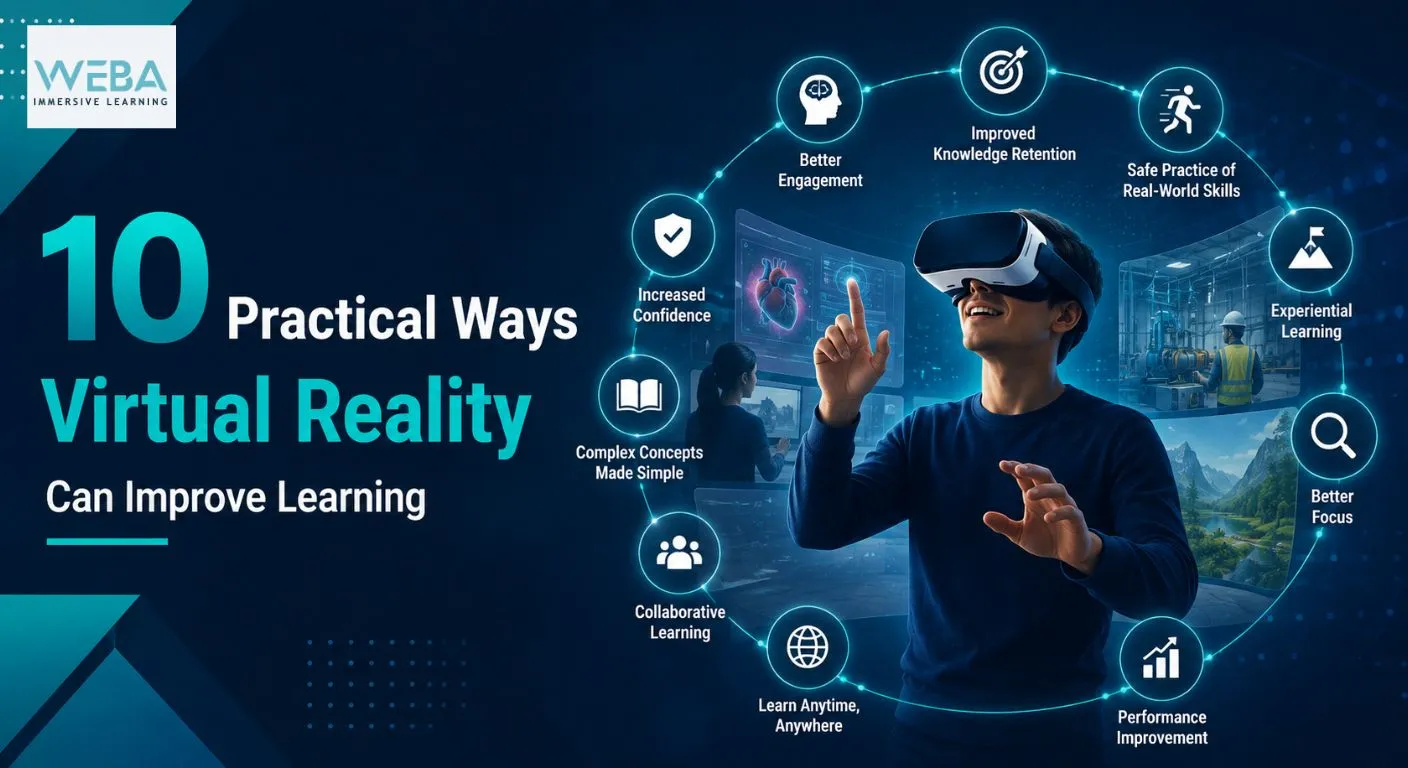

Training can become more immersive when learners practice situations, explore environments, and make decisions inside simulated experiences. Virtual reality for learning allows learners to interact with three-dimensional environments and experience realistic situations in a controlled setting instead of relying only on videos, slides, or written instructions. This makes VR particularly useful when practice, spatial understanding, or decision-making is central to the learning objective.1. Learners Can Practice Without Real World Consequences
One of the strongest advantages of immersive training is the ability to practice difficult situations without exposing learners, equipment, customers, or colleagues to unnecessary risk.
A learner can enter a simulated environment, make a decision, observe the outcome, and try again. Mistakes become opportunities for practice rather than costly real-world incidents.
This approach can be useful for:
- Emergency response training
- Workplace safety
- Equipment operation
- Customer interactions
- Technical procedures
- Leadership scenarios
For example, instead of explaining an emergency procedure through slides, learners could enter a simulated workplace and identify hazards, respond to warning signals, and select the appropriate actions.
The experience becomes more than an explanation. It becomes a rehearsal.
2. Complex Environments Can Be Recreated
Some subjects are difficult to teach because learners cannot easily access the environment where the skill will eventually be used.
VR can recreate environments digitally, allowing learners to explore them regardless of physical location.
Consider training that involves:
- Manufacturing facilities
- Construction sites
- Laboratories
- Healthcare environments
- Aircraft or vehicles
- Warehouses
- Specialized machinery
A virtual environment can give learners the opportunity to understand locations, equipment, sequences, and procedures before entering the real environment.
This can be especially valuable when physical training is expensive, difficult to arrange, or potentially hazardous.
The goal is not necessarily to reproduce every detail. The virtual environment should reproduce the details that matter to the learning objective.
3. Decision Making Can Become Part of the Experience
Traditional training often explains what employees should do. Immersive learning can ask them to actually decide what to do.
A learner might encounter a situation and choose between several possible responses. The system can then provide feedback based on that decision.
A simple scenario might work like this:
Situation → Decision → Consequence → Feedback → Retry
This structure can help learners understand that workplace decisions often have consequences.
It can be particularly effective for subjects involving judgment, such as safety, customer service, management, ethics, and operational procedures.
Rather than memorizing a list of rules, learners can explore how those rules apply when circumstances change.
4. Learning Can Become More Experiential
There is a significant difference between reading about an environment and experiencing a representation of it.
For example, a learner studying machinery maintenance could read instructions describing different components. An immersive experience could allow the learner to inspect those components virtually, identify the relevant parts, and follow a maintenance sequence.
The experience becomes spatial and interactive.
This can support learning when employees need to understand:
- Where something is located
- How components relate to each other
- What sequence should be followed
- What changes when a decision is made
- How an environment behaves
Experiential learning does not mean every course needs VR. It is most useful when interaction with an environment contributes meaningfully to the learning objective.
5. Training Can Be Repeated More Easily
Some skills require repetition before learners become comfortable performing them.
Physical training can sometimes be limited by equipment availability, instructor schedules, location, or operational costs. A digital simulation can provide another opportunity to practice.
Learners can repeat scenarios until they understand the process or become more confident.
This can be valuable for:
- New employee onboarding
- Technical training
- Safety procedures
- Emergency response
- Equipment familiarization
- Customer-facing situations
Repeated practice also gives learners a chance to explore different decisions instead of simply completing one predetermined path.
That flexibility can make training more useful for situations where there is rarely only one possible response.
6. Game Mechanics Can Make Practice More Interactive
Immersive learning does not have to be passive. Interactive challenges, scoring, progress indicators, branching choices, and rewards can introduce game-like elements into training.
An elearning game can turn a learning objective into a challenge where employees need to solve problems, make decisions, or complete tasks.
For example, learners could receive points for:
- Identifying hazards
- Selecting the correct procedure
- Completing a task accurately
- Making safe decisions
- Solving a workplace problem
However, game mechanics should support the educational objective rather than distract from it.
A leaderboard may be useful for a competitive activity but unnecessary for a sensitive compliance scenario. The right mechanic depends on the audience, subject, and desired behavior.
7. Learners Can Receive Immediate Feedback
Feedback is an important part of practice. If learners have to wait until the end of a course to discover whether they made the right decisions, opportunities for correction can be missed.
Immersive environments can provide feedback during or immediately after an interaction.
For instance, if a learner selects an unsafe action, the experience can explain why that decision creates a problem and allow the learner to attempt the scenario again.
Useful feedback can explain:
- What happened
- Why the choice was effective or ineffective
- What principle applies
- What the learner should consider next time
The quality of feedback matters more than simply telling learners whether an answer is right or wrong.
8. Training Can Be More Engaging When the Experience Has a Purpose
Immersion alone does not guarantee effective learning.
A visually impressive VR environment can still fail if learners do not understand what they are supposed to accomplish. Strong immersive training begins with a clear objective and builds the experience around it.
Before developing a VR activity, organizations should define:
- What should learners know?
- What should they be able to do?
- What decisions should they practice?
- What mistakes should they recognize?
- How will learning be assessed?
Once these questions are answered, designers can determine whether VR is appropriate.
This prevents technology from becoming the starting point. The learning requirement should come first.
9. Difficult Training Scenarios Can Be Standardized
Instructor-led training can vary depending on the trainer, location, timing, and group.
A digital simulation can provide a more consistent scenario for every learner. Each participant can encounter the same core situation while still being allowed to make individual decisions.
This can be helpful for organizations operating across multiple teams or locations.
Standardized immersive scenarios can support:
- Consistent onboarding
- Repeatable skills practice
- Common assessment criteria
- Centralized learning objectives
- Comparable learner experiences
Customization can then be added where necessary, such as adapting terminology, procedures, or workplace environments.
This combination of consistency and flexibility can make immersive training easier to integrate into larger learning strategies.
10. VR Can Complement Rather Than Replace Other Learning Methods
The most effective training strategy does not necessarily need to choose between VR and traditional eLearning.
Different learning formats serve different purposes.
| Learning method | Often useful for |
|---|---|
|
|
|
|
|
|
|
|
|
|
|
|
|
|
A blended approach can combine these formats. Learners might first complete a short digital module, enter a VR simulation to practice the skill, and then participate in an instructor-led discussion.
This approach keeps technology in its proper role: supporting the learning experience rather than becoming the objective itself.
For organizations evaluating immersive training, the most important question is not whether VR is impressive. It is whether immersion solves a learning problem that another format cannot address as effectively. Experienced providers such as Webalearn can help organizations evaluate the instructional and technical requirements before developing an immersive learning experience.
Key Takeaways
- VR can provide realistic practice without exposing learners to real-world risks.
- Immersive environments are particularly useful when spatial understanding or practical experience matters.
- Decision-based scenarios can help learners practice judgment rather than simply memorize information.
- Game mechanics can make interactive learning more engaging when they support clear objectives.
- VR does not need to replace traditional eLearning and can work effectively as part of a blended strategy.
- The learning objective should determine whether VR is appropriate, not the technology alone.
Interesting Facts
- Immersive training can allow learners to repeat the same scenario without requiring the physical environment to be reset.
- VR can simulate environments that may be expensive, hazardous, remote, or difficult to access for regular training.
- Game mechanics can be incorporated into digital learning without turning the entire experience into a conventional video game.
- Immediate feedback can make simulated decision-making more useful by connecting learner actions with consequences.
FAQs
What types of learning work best with VR?
VR is particularly suitable for training involving physical environments, procedural practice, spatial understanding, decision-making, safety, and situations that are difficult or risky to reproduce in person.
Is VR better than traditional eLearning?
Not necessarily. VR is most valuable when immersion and interaction contribute directly to the learning objective. Traditional eLearning can remain more efficient for information delivery, reference content, and straightforward assessments.
Can VR be used for employee training?
Yes. Organizations can use immersive simulations for areas such as safety, equipment operation, customer interactions, technical procedures, onboarding, and leadership decision-making.
Does VR training need game elements?
No. Game mechanics are optional. They can improve motivation or engagement in suitable activities, but immersive training can also be highly effective without points, rewards, competition, or other game features.
What should companies consider before developing VR training?
Organizations should evaluate the learning objective, target audience, required hardware, accessibility, content complexity, development resources, assessment requirements, deployment environment, and long-term maintenance needs.



















Sign in to leave a comment.