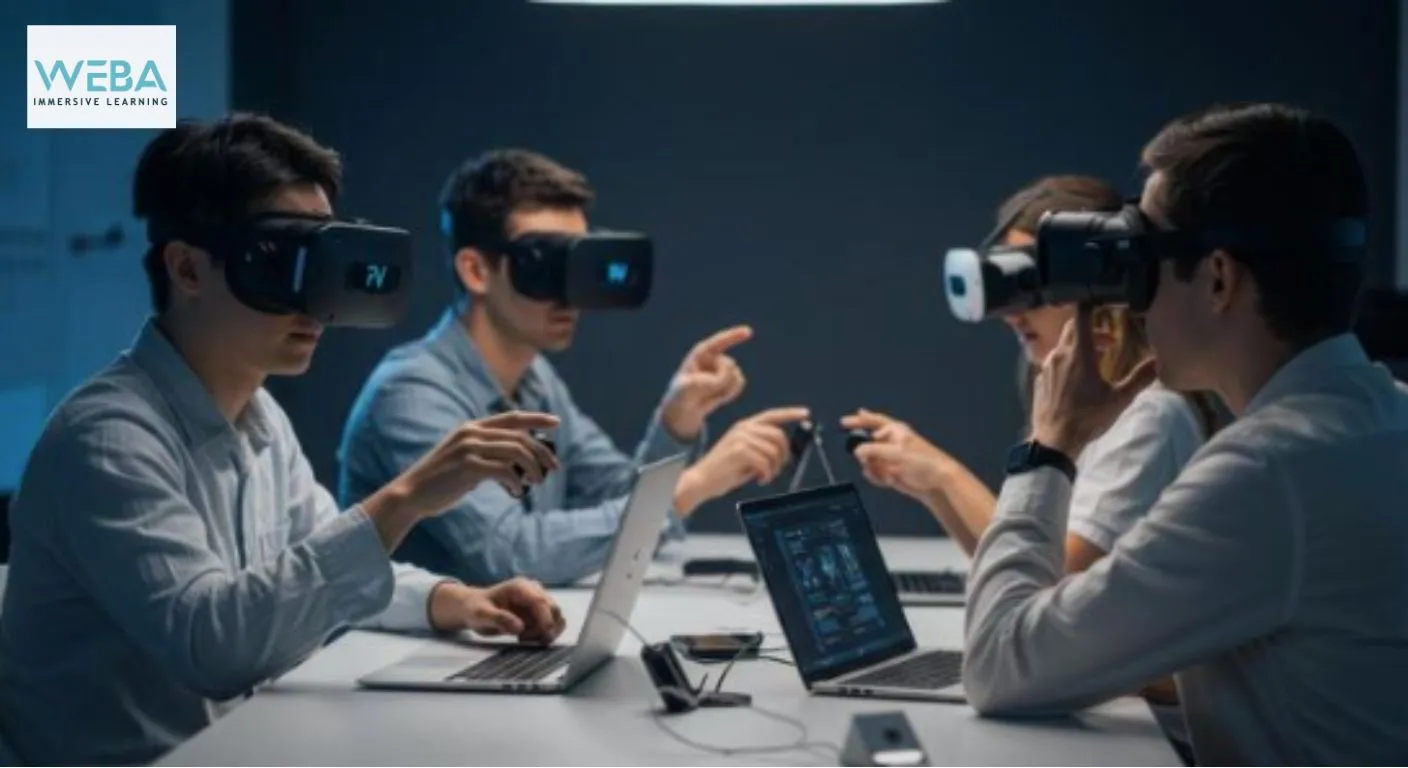

Immersive training can make learning more memorable when employees need to practice decisions, procedures, or behaviors rather than simply absorb information. Virtual reality for learning creates simulated environments where people can experience situations, make choices, and learn from consequences without the risks of real-world practice. Its value, however, depends on how well the experience matches the learning objective.
What Makes Immersive Training Different?
Traditional digital courses are often built around screens, narration, animations, quizzes, and written explanations. These formats work well when the objective is to introduce concepts, explain processes, or test knowledge.
Immersive training approaches the problem differently. Instead of asking learners to imagine a situation, it places them inside a simulated environment.
Consider an employee learning how to respond to a workplace emergency. A conventional course might show a video explaining the correct procedure before asking a few assessment questions. An immersive experience can place the learner inside a simulated workplace, present a developing situation, and require them to decide what to do next.
That distinction matters because some skills depend on judgment rather than recall.
Immersive learning can be particularly useful when employees need to:
- Practice procedures repeatedly
- Make decisions under pressure
- Navigate unfamiliar environments
- Develop communication or interpersonal skills
- Experience consequences without real-world risk
- Build confidence before performing a task in reality
The technology itself is not the learning strategy. The instructional objective should determine whether an immersive approach makes sense.
Where Can VR Training Deliver the Most Value?
The strongest use cases tend to involve situations that are difficult to reproduce through conventional training.
Safety and emergency preparation
Safety training can involve hazards that cannot be safely recreated for practice. A simulated environment can allow learners to identify hazards, respond to incidents, and repeat scenarios without putting people or equipment at risk.
For example, employees could practice responding to a simulated equipment malfunction or emergency evacuation. Repetition can help learners become more familiar with appropriate actions before they face a comparable situation at work.
Equipment and technical procedures
Some equipment is expensive, difficult to access, or unsuitable for repeated training. A virtual environment can provide a controlled space for familiarization and procedural practice.
This does not necessarily replace hands-on training. Instead, it can prepare employees before they work with the actual equipment, potentially making practical sessions more focused.
Customer and interpersonal scenarios
Not every training scenario involves physical tasks. Immersive environments can also simulate conversations and social situations.
Employees might practice handling an unhappy customer, conducting a difficult conversation, or responding to a workplace situation. These experiences can make soft-skill training more active than simply reading recommended responses.
How Does Immersive Learning Compare With Conventional eLearning?
The right question is not whether immersive training is better than conventional eLearning. It is whether the format is appropriate for the desired behavior or skill.
| Training need | Often suitable approach |
|---|---|
| Basic knowledge | Conventional eLearning |
| Policy awareness | Short digital modules |
| Quick refreshers | Microlearning |
| Decision-making practice | Scenario-based learning |
| Physical procedure practice | Simulation or immersive training |
| High-risk situations | Immersive simulation |
| Repeated knowledge checks | Interactive assessments |
| Complex skill development | Blended learning |
A company may therefore use several formats within one learning journey.
For instance, an employee could first complete a short digital lesson, move into an immersive scenario to apply the concept, and finish with an assessment and manager-led discussion.
This blended model can prevent organizations from using expensive technology where a simpler format would work just as well.
Can Gamification Make Immersive Training More Engaging?
Immersive experiences do not automatically create motivation. Learners can still disengage if the activity feels repetitive, confusing, or disconnected from their work.
That is where gamified elearning can complement immersive learning.
Game mechanics such as progress indicators, challenges, feedback, scoring, achievements, and branching decisions can give learners a clearer sense of progression. However, these elements should reinforce the learning objective rather than turn every training activity into a competition.
A safety simulation, for example, might reward learners for identifying hazards correctly and making appropriate decisions. The reward system supports the behavior being practiced instead of distracting from it.
Good design asks a simple question: does the game mechanic help the learner understand, practice, remember, or apply something?
If the answer is no, it may not belong in the experience.
What Should Businesses Consider Before Investing?
Immersive training can require more planning and production effort than a conventional course. Organizations should therefore evaluate the business case before committing to a large program.
Start with the learning problem.
Ask:
- What behavior needs to change?
- Does the learner need practice rather than information?
- Can the scenario be reproduced effectively without immersive technology?
- How frequently will the training be used?
- Can the experience be updated when procedures change?
- How will learning outcomes be measured?
Content maintenance deserves particular attention. Training environments can become outdated when equipment, procedures, regulations, workplace layouts, or organizational processes change.
Accessibility and learner comfort also matter. Not every learner will have the same level of familiarity with immersive technology, and organizations need to consider whether alternative learning routes are necessary.
A practical implementation strategy usually begins with a focused use case rather than attempting to convert an entire training library into immersive experiences.
How Can Organizations Measure Whether It Worked?
Completion rates alone do not prove that immersive training improved performance.
A stronger evaluation approach connects the learning experience to measurable outcomes.
Depending on the program, organizations might examine:
- Scenario decision accuracy
- Assessment performance
- Time required to complete a task
- Reduction in procedural errors
- Confidence before and after training
- Supervisor observations
- Workplace performance indicators
- Retention through later assessments
The measurement method should be established before development begins. This helps instructional designers build the experience around the behavior that the organization actually wants to improve.
For example, if the goal is better emergency response, simply tracking how many employees completed a VR module provides limited insight. Measuring whether employees correctly identify hazards and follow the required response sequence is more meaningful.
What Does a Practical Immersive Learning Program Look Like?
A strong program does not begin with technology. It begins with a scenario.
An organization might identify a recurring workplace problem, map the decisions employees need to make, and determine which moments would benefit from realistic practice.
The development process can then include:
1. Define the performance gap
Identify what employees currently struggle to do.
2. Design the scenario
Build a realistic situation around the required behavior.
3. Determine interaction points
Decide where learners should make decisions, perform actions, or respond to changes.
4. Add feedback
Explain why choices were effective or ineffective.
5. Connect assessment to performance
Measure whether the learner can demonstrate the intended skill.
6. Review and update
Monitor the experience as business processes evolve.
This approach keeps immersive learning focused on outcomes instead of novelty.
Organizations exploring these experiences may also benefit from working with a digital learning specialist that can connect instructional design, technology, assessment, and deployment into one learning strategy. Webalearn, for example, approaches digital learning development from the perspective of building practical training experiences around organizational needs.
Is Immersive Training Worth the Investment?
The answer depends on the problem being solved.
Immersive training can be compelling when learners need realistic practice, especially when real-world practice is dangerous, expensive, inconvenient, or difficult to repeat. It is less compelling when the objective is simply to communicate information that could be understood through a short digital lesson.
The most effective programs treat immersive technology as one part of a broader learning ecosystem.
That means combining the right format with the right objective, supporting the experience with useful feedback, and measuring whether the training changes performance.
The goal should never be to make learning more technologically impressive. The goal is to make practice more meaningful.
Key Takeaways
- Immersive training is most valuable when learners need to practice decisions, procedures, or behaviors.
- VR can simulate difficult, costly, or risky situations in a controlled environment.
- Conventional eLearning remains effective for knowledge delivery and straightforward assessments.
- Gamification can strengthen engagement when game mechanics support the intended learning behavior.
- Organizations should define learning outcomes and measurement methods before developing an immersive experience.
- A focused pilot can be more practical than converting an entire training library at once.
Interesting Facts
- Immersive training can allow learners to repeat scenarios without recreating the real-world situation each time.
- Simulations can support both technical skills and interpersonal decision-making.
- VR does not have to replace classroom or digital learning; it can form one stage of a blended learning journey.
- The instructional objective should determine the technology rather than the other way around.
FAQs
Q1. What type of training is best suited to VR?
Training that requires realistic practice is often a strong candidate. Safety procedures, technical tasks, emergency response, equipment familiarization, and complex decision-making can benefit from simulated environments.
Q2. Is VR training better than traditional eLearning?
Not universally. Traditional eLearning can be more efficient for knowledge acquisition, policies, concepts, and simple assessments. Immersive training becomes more useful when learners need realistic practice or behavioral rehearsal.
Q3. Can immersive training be combined with other learning methods?
Yes. A learning program can combine digital lessons, immersive scenarios, instructor-led sessions, assessments, and workplace practice. This can provide different types of learning support within one program.
Q4. How should companies measure immersive training?
Measurement should focus on the intended performance outcome. Depending on the objective, organizations can track decision accuracy, procedural performance, assessment results, error rates, confidence, or workplace behavior.
Q5. Does VR training replace hands-on practice?
Not necessarily. In many situations, immersive training can prepare learners before hands-on practice. It can introduce procedures and allow repetition while practical training provides experience with the real environment or equipment.
Q6. What is the biggest mistake when implementing immersive learning?
Starting with the technology instead of the learning problem is a common mistake. Organizations should first identify the behavior or skill they need to improve and then determine whether immersive training is the appropriate solution.

























Sign in to leave a comment.