

Employees do not simply need to know information; they often need to know what to do with it. Scenario based elearning addresses this gap by placing learners in realistic situations where they must evaluate information, make decisions, and respond to consequences. Instead of passively reading about workplace expectations, employees can practice applying them in situations that resemble the challenges they may encounter on the job.
1. It Turns Abstract Information Into Practical Decisions
Policies, procedures, and concepts can seem straightforward until employees have to apply them.
A scenario can turn an abstract rule into a practical question: What would you do next?
For example, instead of simply explaining a customer service policy, a course could present an upset customer and ask the learner to select an appropriate response. The learner then sees the likely consequence of that decision.
This structure helps connect information with action.
Scenarios can be particularly useful for topics such as:
- Customer service
- Leadership
- Workplace conduct
- Compliance
- Sales conversations
- Safety procedures
- Data security
The emphasis shifts from remembering information to understanding how it should influence behavior.
2. Employees Can Practice Without Real Workplace Pressure
Making a mistake during a real customer interaction, safety incident, or management conversation can have consequences. A simulated scenario provides a safer environment for practice.
Learners can make decisions, receive feedback, and try again without affecting an actual customer, colleague, project, or business process.
This creates room for experimentation.
A learner might choose an inappropriate response, discover why it was ineffective, and then revisit the situation using a different approach.
The value comes from the opportunity to practice judgment before employees face similar situations in real life.
This is particularly useful for new employees who may understand a procedure conceptually but have limited experience applying it.
3. Training Can Reflect the Organization's Actual Challenges
Generic training often uses examples designed for a broad audience. Those examples may be useful, but they do not always reflect the situations a particular workforce encounters.
Customized scenarios can incorporate relevant:
- Job responsibilities
- Customer interactions
- Internal processes
- Products and services
- Workplace terminology
- Common mistakes
- Business challenges
For example, a financial services organization might create decision-making scenarios around customer conversations and information handling, while a manufacturing organization could focus on safety decisions and operational procedures.
The closer the situation is to the learner's environment, the easier it can be to understand why the training matters.
4. Learners Can See the Consequences of Their Choices
One of the most useful elements of scenario-driven training is consequence-based feedback.
Rather than immediately revealing the correct answer, a course can show what happens after a learner makes a particular choice.
A simple structure could be:
Situation → Choice → Consequence → Feedback → Better Response
This encourages learners to think through their decisions.
For example, a manager dealing with a workplace concern might choose between ignoring the issue, confronting an employee immediately, or following the appropriate reporting process. Each option can lead to a different outcome within the learning experience.
The learner is therefore encouraged to consider not just what the correct action is, but why it matters.
5. Different Learning Paths Can Reflect Different Roles
The same workplace situation may require different actions depending on an employee's responsibilities.
A frontline employee might need to recognize an issue and report it. A manager may need to investigate, document, escalate, or support the employee. A specialist may have additional responsibilities.
Scenario-based training can account for these differences.
Organizations can create separate scenarios or branching paths for:
- New employees
- Managers
- Team leaders
- Customer-facing staff
- Technical specialists
- Senior decision-makers
This prevents every learner from receiving exactly the same experience when their responsibilities differ.
Role-specific scenarios can also make training more relevant without requiring an entirely separate learning program for every employee group.
6. Complex Situations Can Be Broken Into Manageable Steps
Some workplace problems are difficult because several factors need to be considered simultaneously.
A scenario can guide learners through these situations progressively.
For example:
- Present the initial situation.
- Ask the learner to identify the issue.
- Introduce additional information.
- Ask for a decision.
- Show the consequence.
- Provide guidance.
- Allow another attempt.
This structure can make complex decision-making easier to understand.
It is also useful when the correct response depends on context. Learners can see how new information changes the situation rather than treating every workplace problem as having an obvious answer.
7. Training Can Become More Immersive
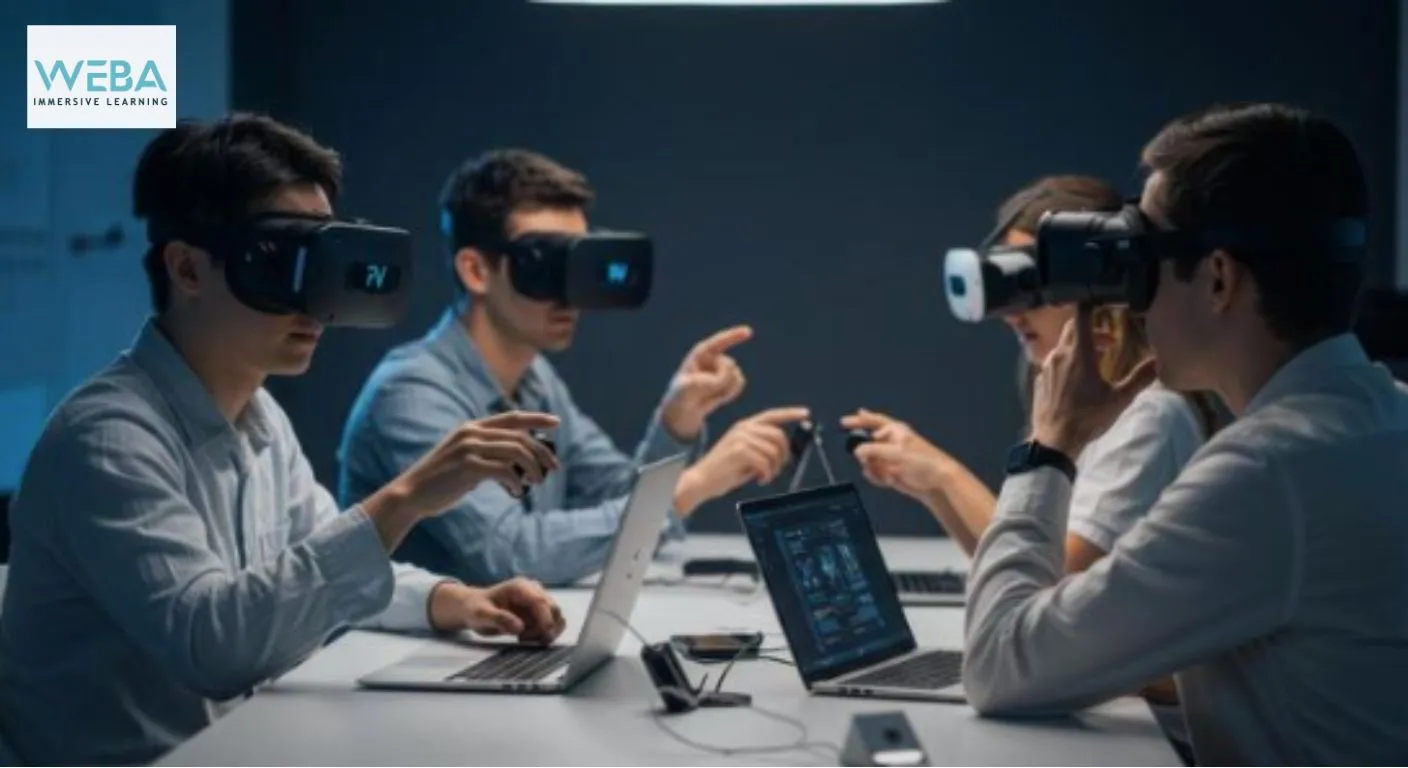
Scenarios do not have to be limited to text and multiple-choice questions. Organizations can combine branching decisions with video, audio, animation, simulations, interactive environments, or other digital experiences.
These immersive learning solutions can give learners a stronger sense of participating in the situation.
For example, a leadership module could use video-based conversations in which the learner chooses how to respond to an employee. A safety module could place learners inside a simulated workplace where they identify hazards.
The appropriate level of immersion depends on the learning objective.
A simple interactive scenario may be more effective than an expensive simulation when the subject does not require a complex environment. Immersion should enhance the learning experience rather than become a technology showcase.
8. Learners Can Practice Difficult Soft Skills
Soft skills can be challenging to teach because they involve judgment, communication, tone, and interpersonal awareness.
Scenarios can provide a structured way to practice these skills.
Possible applications include:
- Giving constructive feedback
- Handling disagreements
- Managing difficult conversations
- Responding to customer complaints
- Supporting team members
- Making ethical decisions
- Communicating organizational changes
A scenario can present realistic dialogue and ask the learner to choose an appropriate response.
This does not completely reproduce the complexity of human interaction, but it can provide useful practice before learners encounter similar conversations in their roles.
9. Assessment Can Measure Application Instead of Recall
Traditional quizzes are useful for checking knowledge, but they may not reveal whether an employee can apply that knowledge.
Scenario-based assessments can test application directly.
Instead of asking:
“What does this policy state?”
the course can ask:
“A situation has occurred. What should you do?”
This difference matters when training aims to influence behavior.
Organizations can evaluate:
- Decision quality
- Process understanding
- Risk recognition
- Judgment
- Problem-solving
- Response selection
The assessment can also provide targeted feedback based on the learner's decision.
This makes the assessment part of the learning experience rather than simply a final score.
10. Training Can Encourage Reflection and Better Judgment
The strongest scenarios do more than identify right and wrong answers. They encourage learners to think about why a decision is appropriate.
After a scenario, learners can be asked to reflect on questions such as:
- What information influenced your decision?
- What risk did you identify?
- What could happen if the issue were ignored?
- What would you do differently next time?
Reflection can help connect the simulated experience with future workplace behavior.
For organizations, this also creates an opportunity to identify areas where employees need additional support. If learners repeatedly struggle with a particular type of decision, the issue may indicate that the training needs clearer explanations, better examples, or additional practice.
A well-designed scenario is therefore not simply an engaging activity. It is a structured opportunity to rehearse judgment in a controlled environment. For organizations developing customized digital learning programs, Webalearn can help translate specific workplace challenges into practical learning experiences that align content, scenarios, interactions, and assessments.
Key Takeaways
- Scenario-based training helps employees practice applying knowledge rather than simply consuming information.
- Realistic decisions can make workplace training more relevant and memorable.
- Simulated environments allow learners to make mistakes without real-world consequences.
- Role-specific scenarios can reflect different responsibilities across an organization.
- Immersive technology can enhance scenarios when realistic environments add genuine learning value.
- Scenario-based assessments can evaluate judgment, decision-making, and application of knowledge.
Interesting Facts
- A scenario can have multiple possible paths rather than a single correct sequence.
- Consequence-based feedback can show learners why a decision matters, not just whether it is correct.
- Scenarios can be created for both technical skills and interpersonal situations.
- Immersion does not always require VR; interactive video, branching activities, audio, animation, and simulations can also create experiential learning.
FAQs
Q1. What is scenario based eLearning?
It is a digital learning approach that places learners in realistic situations and asks them to make decisions, solve problems, or respond to workplace challenges.
Q2. What types of training benefit from scenarios?
Scenarios can be useful for compliance, leadership, customer service, sales, safety, communication, cybersecurity, onboarding, and other subjects where employees need to apply knowledge.
Q3.Are scenario-based courses suitable for all employees?
They can be adapted for different roles and experience levels. The scenarios should reflect the responsibilities, challenges, and decisions relevant to each learner group.
Q4. Does scenario-based training require virtual reality?
No. Scenarios can use text, animation, interactive choices, video, audio, simulations, or VR. The format should be selected according to the learning objective.
Q5. How can organizations measure the effectiveness of scenario-based training?
Organizations can evaluate decision accuracy, assessment results, learner feedback, recurring knowledge gaps, and relevant workplace performance indicators.






















Sign in to leave a comment.